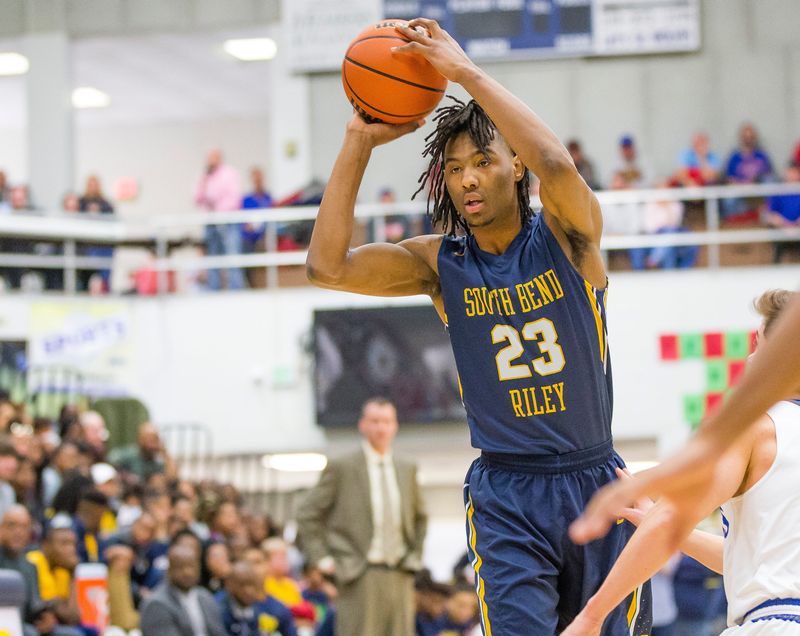
SOUTH BEND — Damezi Anderson Jr. doesn’t live in the hometown he holds near and dear to his heart. He doesn’t even live in Indiana.
Now residing in Kansas City, Missouri, Anderson Jr. is still following his passion and playing basketball overseas. He’s also intentionally keeping a comfortable distance from South Bend.

Anderson Jr. loves being a Riley Wildcat, often returning to his alma mater for basketball games each winter. But recently, there’s been something heavy on the 2018 graduate’s mind holding him back from living in South Bend full-time.
He said each time he returns home, most people only remember him for his athletic accomplishments, of which he has many. Anderson Jr. holds the record for most points scored by any boys basketball player in South Bend Community School Corporation history at 1,949. He has the third most points from a boys player in city history, only trailing Saint Joseph’s JR and Chase Konieczny.
Anderson Jr. was a two-time NIC MVP, an Indiana All-Star and Mr. Basketball finalist his senior year. The Wildcats made a run to Class 4A semi-state with a 26-1 record that same season. He garnered a scholarship to Indiana University, where he played for two seasons before transferring to Loyola Chicago and Detroit Mercy.
But, Anderson Jr. was emphatic that he’s not just an athlete. He feels that narrow mindset is part of a trend with many Black athletes, and he wants to change that narrative by having tough, but necessary, conversations with those who don’t look like him.
Anderson Jr. wants to be a shoulder to lean on, a resource to his community and someone remembered for constantly evolving.
“There’s more to us than that,” Anderson Jr. said. “We go through personal stuff, survival, things that are very tough mentally that motivate us to even be the great athletes that we are. Coming from the inner city and going through the things I went through, that’s the only reason I played basketball — to get away from it.
“If there was more support and recognition in the community, I would be in South Bend as we speak right now.”
Paying it forward
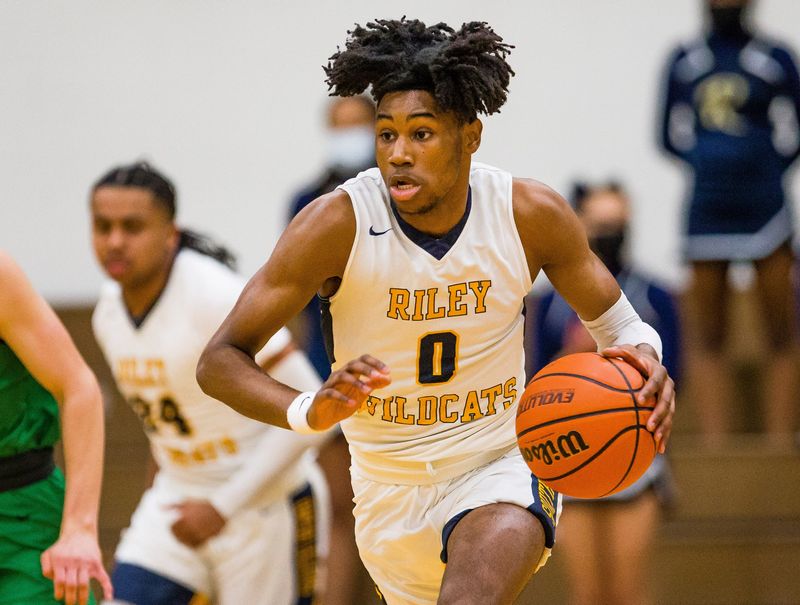
It would be hard to find a better successor for Anderson Jr. in the Riley boys basketball program than Blake Wesley. However, his relationship with his hometown is different than his predecessor’s.
Wesley, a 2021 Riley alumnus, scored 1,592 points for the Wildcats, won two IHSAA 4A sectional titles and a regional championship while being named a 2021 Indiana All-Star before securing a commitment to Notre Dame. In his lone season with the Irish, Wesley made second team All-ACC by averaging 14.4 points, 3.7 rebounds, 2.4 assists and 1.3 steals per game.
He forayed that production into becoming the 25th overall pick in the 2022 NBA Draft by the San Antonio Spurs. Wesley has played in 156 NBA games, spending his first three seasons with the Spurs before heading to the Portland Trail Blazers for the 2025-26 season.
Although Wesley is a free agent now, he hasn’t lived in his hometown since being drafted. That doesn’t mean he doesn’t cherish coming back any chance he gets, making it a priority to hold training camps for youth in South Bend and the surrounding areas.
When he was in town for the 2026 NBA All-Star break, Wesley held camps in South Bend, Merrillville and Elkhart within the span of three days, all free of charge.
The latter was a decision based on his understanding of his hometown’s demographics.
“Me being Black and being in the NBA is very special; not a lot of people can do that,” Wesley said. “It definitely matters to South Bend, and it matters to me, too. I like to give back. Not a lot of guys in the NBA run camps for free. Some people can’t afford it, and a lot of people understand that. I don’t want anybody’s money; I want the kids to have fun.”
Although Wesley wasn’t as critical of South Bend’s treatment of their star Black athletes as Anderson Jr. was, he did relate to the feeling of much of the support he does receive seeming to revolve around what he can do for others, rather than vice versa.
His advice to his campers is simple, and its advice he personally follows.
“Always listen to your parents, pray and work hard,” Wesley said. “You never know. Anything can get taken away from you as soon as possible. I always tell them to stay humble, be yourself and don’t let somebody tell you that you can’t do it. Plenty of times, people told me I’m not going to make it to the NBA, and I proved them wrong. Now, they want to be my friend.”
A 25-year legacy continued
According to the United States Census Bureau, South Bend’s estimated population as of July 2026 is 103,509. Approximately 22.4% of that population is Black. Twenty-six years ago, that population was a reported 107,789 with a 24.6% Black population.
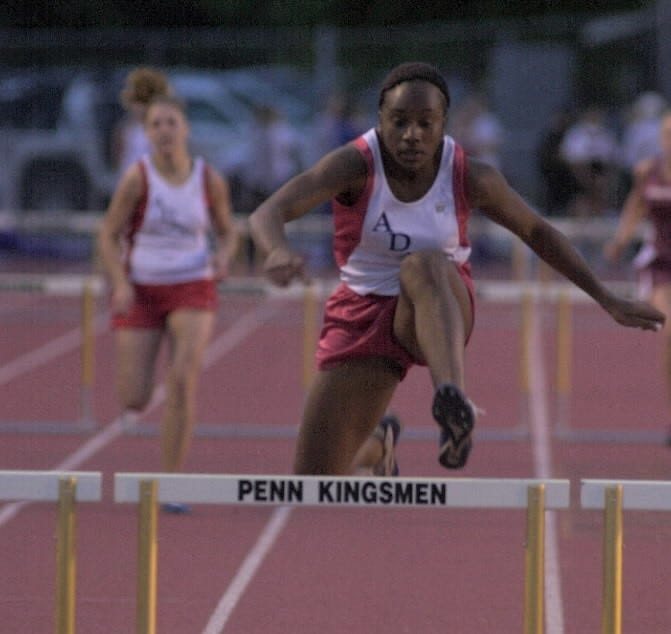
In that 26-year span, 12 Black athletes have won individual sport IHSAA state championships in track and field or wrestling. LaQuesha (Taylor) Bray, a 2002 South Bend Adams alumna, is one of them.
She won the 300-meter hurdles state championship as a junior in 2001 and finished in second place as a senior. She won four regional titles in the 300-meter hurdles and three regionals in the 100-meter hurdles across her career, winning four sectional championships in each.
Although she, too, lives out of state in Alabama, Bray has a different perspective on how she views her hometown’s recognition of her athletic accomplishments a quarter-century later.
“It got me to love the community I was in, because they loved me,” Bray said. “It’s amazing being a Black athlete from South Bend, because you don’t know the big impact you made until you grow up and get older. When I started coaching, I never realized how many young kids were watching me. When you’re running, you want to be the best and you don’t think about the impact it makes until life hits you.”
Before moving to Alabama, Bray was a track and cheerleading coach at Riley from 2017-20 and Adams in 2021. Now a mother of four, she has become more reflective of the legacy she left back home.
“It’s amazing that people still recognize me from what I did,” Bray said. “It humbles me, and it’s a good feeling. My kids will be like, ‘You know everybody, and everybody knows you.’ I’m like, ‘Well, mommy did a lot.’”
‘We were a part of something’
Skylar Diggins, a 2009 Washington alumna, is perhaps the most accomplished athlete in city history, regardless of race, gender, sport or era. Leading the Panthers’ girls basketball team to four straight IHSAA state championship games from 2006-09, they won the 2007 Class 3A title in her sophomore season.
As a senior, Diggins was named Indiana Miss Basketball before heading to Notre Dame, where she continued to make more history. Her jersey is retired with the Irish, and she’s currently in her 12th WNBA season as a seven-time All-Star.
Diggins has the most points of any South Bend basketball player, boys or girls, with her 2,790 standing as the sixth-most in state history. Now closer to home than ever with the Chicago Sky, Diggins has also felt reflective about her hometown and what it meant to represent South Bend’s Black community during her days with the Panthers.
“It really honed us in, it brought us in and it kept us focused,” Diggins said. “I put all my emotions into it, because that was my hometown and my home team.”
She said it was important for her to rely on community leaders like her father, Maurice Scott Sr., and Jimmie ‘Hal’ Lindsey, just as it was to spend much of her free time in public spaces like the Martin Luther King Jr. Dream Center and the Charles Black Center. That’s where she and other women of color felt at home away from home.
“Just like in any city, there are things you could get into that aren’t always positive,” Diggins said. “Basketball, to me and to us, was like a safe haven. We were a part of a team; we were a part of something. It steered you away from any negative opportunities you had in the city.”
Never forgotten
Jacqueline Batteast spent much of her youth at the same places Diggins mentioned. Batteast was emphatic about the importance of South Bend’s Black youth of today being able to relate to people like Diggins and Wesley — people they see on TV every basketball season — and knowing that many of the same places they stand today are the same places those larger-than-life athletes stood before them.
Batteast, unlike the four athletes highlighted before, still lives in South Bend. That’s intentional, and it’s not just because of her self-described introverted personality.
“All the professional athletes who have come from this city and for the reputation to be iffy, I don’t understand that,” Batteast said. “Another reason I wanted to stay home is that sometimes you can leave and you can do great, but you sort of get forgotten.”
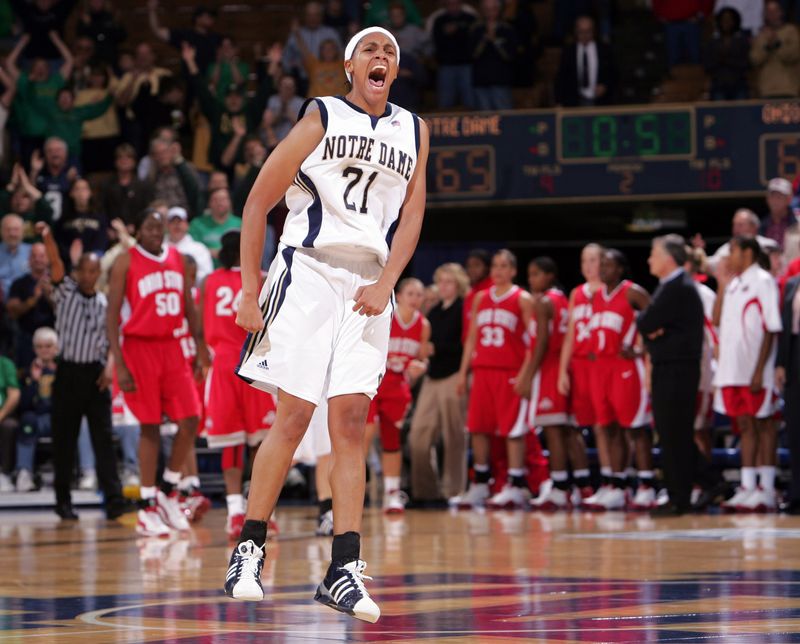
Batteast, a 2001 Indiana All-Star, finished her Panther career with 1,635 points, the 11th most in South Bend girls basketball history. She continued to cement her legacy as one of the greatest local athletes of her generation by scoring 1,874 points in four years at Notre Dame — the 10th most in program history.
Batteast was the 2005 Big East Player of the Year, a two-time First Team All-Big East selection, a 2005 Third Team AP All-American and the 2002 Big East Rookie of the Year with the Irish. She was selected with the 17th overall pick in the 2005 WNBA Draft and won a WNBA Championship with the Detroit Shock (now Dallas Wings) in 2006.
Her accomplishments make Batteast impossible to forget, but she related to Anderson Jr.’s sentiment about how Black athletes of the past can at times be treated in South Bend. It’s why she believes more Black voices should be uplifted in her community, one in which many Black people — such as Batteast’s father, Wayne — sought out in search of a better life.
“Black people in general want to see each other succeed,” Batteast said. “We want good things for our neighbors, our family. We want to have opportunities, we want to have jobs, we want to live in neighborhoods. A lot of our families moved up here from Jim Crow South. People think about slavery and civil rights, and they think it was such a long time ago, but it’s just one generation removed from me. My dad came up here in 1967; a young boy getting out of Mississippi. I remember him telling me that he went to school for the first time thinking he went to the wrong school because it wasn’t segregated. He had never been in a classroom with white students or had a white teacher.
“You form a community, and it’s something that goes way back longer than before I was even thought of. I guess it’s ingrained in your DNA, in your blood. You see that person, and it’s just automatic familiarity. You’re wishing the best, you want them to be successful, you don’t want any harm to come to them and you want to make sure they’re good. I don’t know how to explain it. My parents sacrificed a lot, and now we’re afforded different lives than they had when they grew up, and they had different lives than my grandparents.”
Black individual sport state champions from South Bend (2000-2026)
A special shoutout must also go to Washington’s 2022 IHSAA 3A state champion girls basketball team, featuring future collegiate players such as New Mexico’s Mila Reynolds, UT Arlington’s Amiyah Reynolds, Colorado’s Kira Reynolds, Arizona State’s Rashunda Jones, Akron’s Monique Mitchell and Winthrop’s Ryiah Wilson, coached by 1998 Riley alumnus Steven Reynolds Jr., who was a collegiate standout in the early 2000s at Western Michigan.
Crystal (Riley) McKinney, Altarea Hall and LaToya (Hamilton) Swanson: South Bend Clay (Girls track and field, 4×400-meter relay, 2000)
Noah Shelton: South Bend Adams (Boys track and field, high jump, 2000)
Leroy Dixon: South Bend LaSalle (Boys track and field, 100 and 200-meter dash, 2001)
Lorenzo Swanson: South Bend Clay (Boys track and field, 110-meter hurdles, 2001)
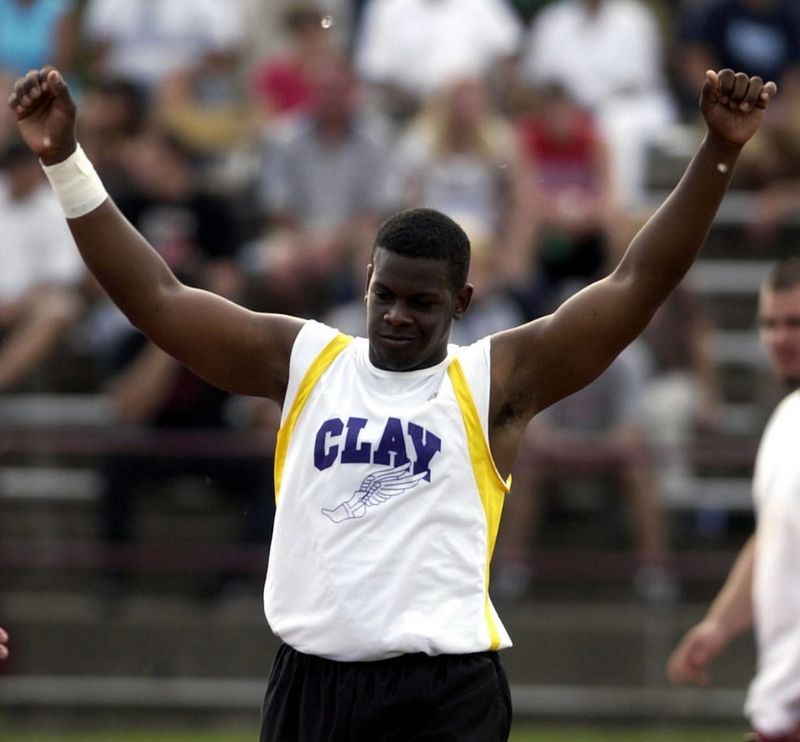
Jason Brown: South Bend Clay (Boys track and field, Shot put, 2002 and 2003)
George Malone: South Bend Riley (Boys wrestling, 215 pounds, 2007)
John Michael Hankerson: South Bend Washington (Boys track and field, 100-meter dash, 2015)
Angel Thomas: South Bend Adams (Girls track and field, 100-meter dash, 2023)
Adriana Swanson: South Bend Washington (Girls track and field, 100-meter hurdles, 2025)
NOTE: This is part three of a four-part series exploring the history of Black athletes in South Bend. The complete series runs July 20-23 online at southbendtribune.com and in the July 20th, 21st, 22nd and 26th print editions of the newspaper.
Kyle Smedley is a sports reporter at the South Bend Tribune. Contact him via email at ksmedley@usatodayco.com or follow him on X @KyleMSmedley.
This article originally appeared on South Bend Tribune: How 5 Black South Bend athletes from the 21st century want to be remembered
Reporting by Kyle Smedley, South Bend Tribune / South Bend Tribune
USA TODAY Network via Reuters Connect
By Kyle Smedley, South Bend Tribune | USA TODAY Network