This story has been updated with the latest legal developments.
A feeling of heaviness has settled over Junior Mesamours.

As a Haitian American living in Indianapolis and a full-time interpreter working in criminal, civil and immigration courts, he sees first hand the weight of the Trump administration’s immigration policy on his community.
Many Haitians living in Indianapolis are anxious, Mesamours said.
The threat of deportation has confined Haitians who are either undocumented or with vulnerable legal statuses to their homes ― away from the prospect of being racially profiled, chance police encounters that can escalate, or, worse, being detained by U.S. Immigration and Customs Enforcement and deported back to a nation in turmoil.
At the beginning of the administration’s immigration crackdown, some parents stopped sending their children to school, Mesamours said. That’s happening less now, but fear and anxiety have become more entrenched. To avoid encounters with ICE, he and other advocates in Indy’s Haitian community say many people are staying inside, attending celebrations behind closed doors, missing appointments, losing jobs and falling behind on bills.
Mesamours said he is sensitive to their situation. He feels inclined to speak up for friends and neighbors who have too much to lose.
“I’m a very sensitive person,” he said. “I love my people.”
Fear and anxiety have grown over the past year as the Trump administration seeks to end temporary protected status. The humanitarian status is granted to nationals from designated countries facing political and economical instability, armed conflict and environmental disasters that make obtaining life’s basic needs impossible. People who are TPS holders can live and work in the United State without fear of deportation.
That changes if TPS goes away. Haitians with TPS status living in Indiana and other states could become eligible for deportation overnight.
“When people go back,” Mesamours said, “many go back to despair to hopelessness.”
Why temporary protected status?
Haiti was first granted TPS designation in 2010 when a catastrophic 7.0-earthquake struck the island nation, resulting in 220,000 dead, 300,000 injured, one million displaced people and severely damaging infrastructure. Port-Au-Prince was the epicenter for the devastation.
The status was supposed to be temporary, but it’s been extended several times in the more than 15 years since the earthquake as Haiti has fallen further into poverty, gang violence and civil unrest, and negative economic growth.
Mesamours, who briefly worked for the United Nations, said conditions worsened even more about two or three years prior to the 2021 assassination of Haitian President Jovenel Moïse. Another 7.2 magnitude earthquake struck that year as well, bringing devastation to rural areas. That earthquake killed more than 2,200 people, injured over 12,000 others and destroyed thousands of homes.
“There has been so much violence, so many people are dead and kidnapped,” Mesamours said, “So many families are ruined.”
“Haiti is living currently its worst crisis of its existence,” he said. Add to that, Haiti is experiencing a prolonged economic decline and hyper inflation.
“It’s extremely complicated right now,” Mesamours said. “Haiti needs TPS right now more than it did in 2020.”
Still, it is against this backdrop that then-Secretary of Homeland Security Kristi Noem determined that Haiti no longer meets the conditions for its temporary protected status designation. It’s the same conclusion Noem and the Trump administration made for countries such as Venezuela, Ethiopia, Afghanistan, Cameroon, Myanmar, South Sudan, Syria. Other countries such as Somalia, Sudan, Yemen, Ukraine, El Salvador, and Ukraine are expected to lose their status in coming months.
The administration’s determination to end TPS for multiple nations has been met with legal challenges. In some instances, federal judges have allowed TPS to expire ― as it did with most Venezuelans holding the designation. Some Venezuelans still have valid status until Oct. 2.
Noem announced that Haiti’s would expire on Feb. 3, 2026. But a day earlier, a federal judge issued an order staying Noem’s TPS termination decision. A federal appeals court upheld protected status for Haitians in a March 6 decision, but the Trump administration is likely to appeal to the U.S. Supreme Court.
For Haiti’s TPS, the ongoing back and forth in the court is driving anxiety. The loss of status means a loss not only in the ability to work legally but to remain in the country, making them subject to deportation.
‘A time of fear’
As of March 31, 2025, an estimated 1.3 million foreign nationals in the United States were protected from removal by TPS, including 34,575 individuals who listed Indiana as their state of residence, according to a report from the Congressional Research Service which compiles reports and data for Congress.
Nationals from Venezuela, Haiti, Ukraine and El Salvador comprised the largest bulk of individuals with TPS status at the time. Most TPS holders resided in Florida and Texas.
According to the U.S. Census Bureau 2024 data, foreign-born populations hailing from those countries have increased in Central Indiana in recent years. The data is not an indication of an individual’s legal status as not all foreign-born individuals are TPS holders.
The Indianapolis metro area is home to nearly 11,000 foreign-born people from Myanmar, which is formerly known as Burma, roughly 6,700 from Honduras, 4,700 from El Salvador, 6,600 from Haiti and 6,000 from Venezuela.
Individuals with temporary protected status can also seek an adjustment of status and pursue asylum or other forms of legal status. Leaders in Indianapolis’ Burmese and Ethiopian communities say few individuals residing here have TPS.
Nationwide, some 350,000 Haitians are estimated to be living in the U.S. with the humanitarian protections. Advocates, such as Jenny Menelas, say it’s difficult to estimate how many people in Central Indiana have that status. She intentionally does not inquire.
The past two months have weighed heavily on Menelas, who is also Haitian American and an Immigrant Welcome Center board member, as well. She’s lost sleep as her fears have grown about the possibility of learning that people she knows could be deported.
“It’s a very challenging time. There’s a lot of unknowns and a lot of fast moving changes at the federal level that has consequences for people. It’s a time of confusion. A time of fear. It’s really unstable.”
America, she said, is not as safe as it used to be for people with different immigration statuses.
Facing the uncertainty of their legal status, some people have chosen to self-deport to other countries if they have the resources, Mesamours said. Others with limited savings are stuck.
“To come here, they sell everything ― their livestock, their land, their properties,” Mesamours said. “They sell everything to come here because they were expecting to restart a new life.”
Finding Community
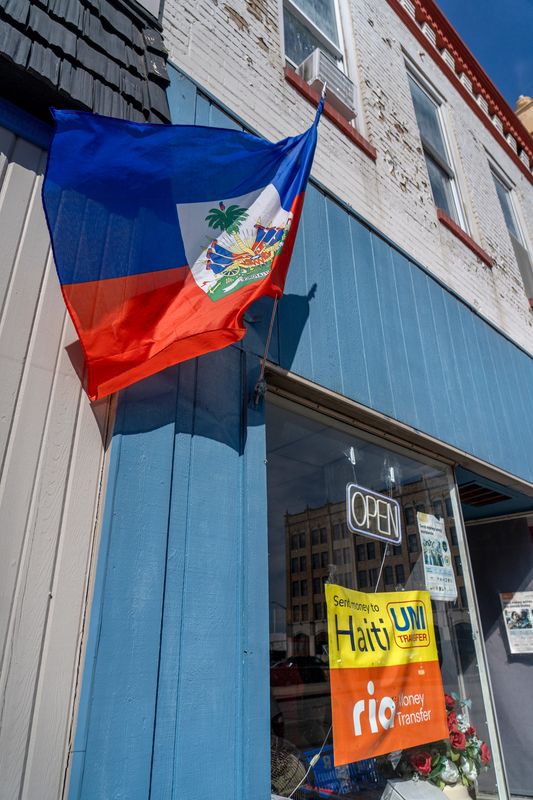
Haitians who’ve come to Indianapolis have found and built community here. Advocates say affordable housing, education and job opportunities attracted to many Haitians to the Midwest.
Solidarity within the community has made it possible to establish an ecosystem of self-sufficiency and entrepreneurship in Central Indiana. Indianapolis now has Haitian grocery stores, restaurants, hair salons and others businesses. Many of the Haitians Mesamours encounters work in industries such as hospitality, warehouse and manufacturing or gig work like food and grocery delivery or ridesharing.
Both Menelas and Mesamours said they think the ecosystem will survive this period of time but not without stress. Last year, word spread that Haitians were being apprehended by ICE on the west side of Indianapolis.
“People were just afraid. Typically people with TPS or who do not have good documentation, they would just not go out ― even people with green cards would not go out,” Mesamours said.
“It might be false information,” he said, “but it is something that could actually happen.”
Sometimes people disappear for weeks and their family members don’t hear from them, he said. Something as simple as getting a ticket can escalate into ICE detention.
“Ever since Indiana law enforcement have signed contracts with ICE,” he said, “they’ve been picking up people for everything.”
Contact IndyStar investigative reporter Alexandria Burris at aburris@gannett.com. Follow her on X, formerly Twitter, at @allyburris and on Bluesky at@allymburris.bsky.social.
This article originally appeared on Indianapolis Star: Haitians in Indiana fear deportation as TPS status hangs in balance
Reporting by Alexandria Burris, Indianapolis Star / Indianapolis Star
USA TODAY Network via Reuters Connect