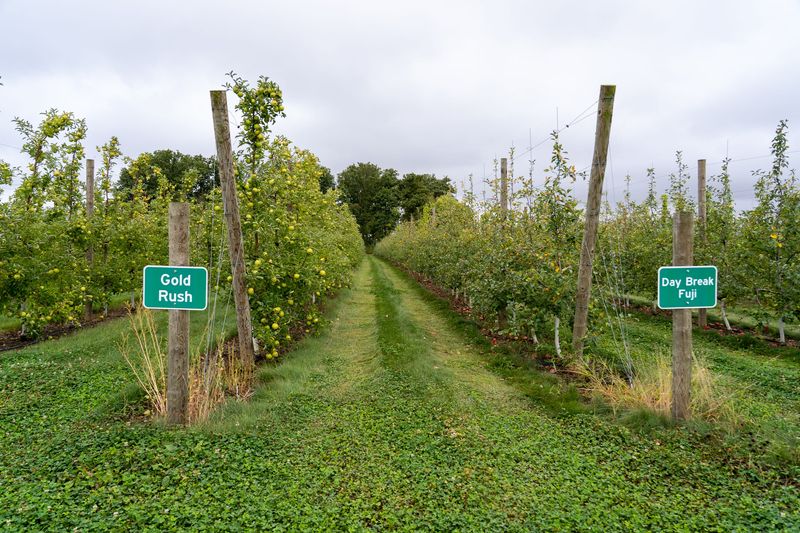
Apple orchards have changed. The large stout trees with thick gnarling branches of a few decades ago are now flimsy bushes skinnier than hydrangeas that stand under 10 feet tall and need to be propped up with wood and steel trellises.
The trees may be less imposing but the sheer volume of crisp red fruit they produce is still impressive.

Growing apples has always been more complicated than raising a crop harvested once a year such as pumpkins, said Ruth Ann Roney, general manager of Tuttle Orchards in Greenfield, about an hour outside of Indianapolis. So apple farmers share their wisdom with one another.
“It’s not like there’s a book you go through to learn, but more like networking and experience to pass along knowledge,” Roney said.
Tuttle grows more than 30 varieties of apples in orchards split up across the 200-acre farm, about a quarter of the acreage is devoted to long rows of apple trees. One orchard is set up for customers to come in, browse the rows and pick their own apples. The other orchard is dedicated to commercial purposes like growing apples to brew cider and make different apple-flavored treats.
But choosing what apple varieties to grow on those orchards can be tricky. A few decades ago, Red Delicious apples were a popular variety; today customers prefer Honeycrisp and other tangier varieties.
Staying ahead of people’s changing tastebuds, then, is key for those who run apple orchards.
“You’re trying to guess for the next 30 years what’s going to be the cool and trendy apples,” Roney said. “Sometimes that’s hard to do, but you do have some sense from talking to people buying them and noticing what’s selling.”
So, having a large variety is good. Tuttle’s large selection of genetically different trees means they can start selling starting July 4th and continue through the winter.
But an apple tree can be deceiving. The bottom portion of the tree called rootstock typically has different genetics than the branches it supports above, which are called scion wood. The rootstock determines how big the tree will grow and the scion wood determines the genetics of the apple, or what variety it will produce.
Workers in a nursery can graft scion wood from a different tree onto that rootstock and a third apple may arise. A Gala, for instance, is a cross between a Red Delicious and Kidd’s Orange Red. The nursery will then grow the newly grafted tree for three or four years before selling it to a commercial orchard like Tuttle Orchards.
Once the tree reaches its final home, farmers plant the trees with the graft above ground. In a few more years the new tree will start providing fruit.
During the spring, Roney said, the orchard rents honeybees to pollinate the fruit trees. Timing the bees takes some forethought, Roney said, because the bees will be most effective when it is sunny.
Come fall, the bulk of the trees start bearing fruit, waiting to be picked. And the scent when staff at Tuttle Orchards in Greenfield pack nearly a million apples into a cooler is not only nostalgic, but immediately mouthwatering.
Visitors to Tuttle’s can collect their own or shop in the orchard store. Turns out no matter what the trees look like, they will still produce apples that can provide the base for tasty cider, donuts, take-and-bake pies and slushies.
IndyStar’s environmental reporting project is made possible through the generous support of the nonprofit Nina Mason Pulliam Charitable Trust.
Karl Schneider is an IndyStar environment reporter. You can reach him at karl.schneider@indystar.com. Follow him on BlueSky @karlstartswithk.bsky.social or X @karlstartswithk.
This article originally appeared on Indianapolis Star: Growing apples has changed over the years. Here’s how it’s done in Indiana
Reporting by Karl Schneider, Indianapolis Star / Indianapolis Star
USA TODAY Network via Reuters Connect