Recently, I had the opportunity to visit a place that had been on my bucket list for a long time: the Trail of Tears state park.
Located outside of Jackson, Missouri, the park commemorates the forced displacement of the Native Americans from the Five Civilized tribes: the Cherokee, the Seminole, the Muscogee, the Chickasaw, and the Choctaw.

All together, 60,000 Native Americans were forcibly removed from their ancestral lands in the southeastern United States, to the newly designated Indian territory west of the Mississippi river.
The Indian Removal act of 1830 was signed into law on May 28, 1830 by President Andrew Jackson. The law called for an exchange of lands with the Indian tribes with either states or territories and for their removal west of the Mississippi River.
The Trail of Tears National Historic Trail is a network of routes stretching 5,043 miles across nine states.
The specific land and water paths taken by the Cherokee and other forcibly relocated tribes ranged from 800 to 1,200 miles long, and took up to eight months to complete.
Today, the official trail encompasses land and water routes across Alabama, Arkansas, Georgia, Illinois, Kentucky, Missouri, North Carolina, Oklahoma, and Tennessee.
The park itself was established in 1957 and contains 3,515 acres.
It was a quiet and peaceful day when I visited this historic park. I decided to visit the Missouri Park because I was within close proximity to it on my travels.
When I first arrived, I went straight to the visitor center to get some information.
The center had a lot of displays that told the history of the trail and the events. It was very sobering to read some of the history that I found there. I picked up a map of trails, though I was more interested in following part of the Trail of tears itself.
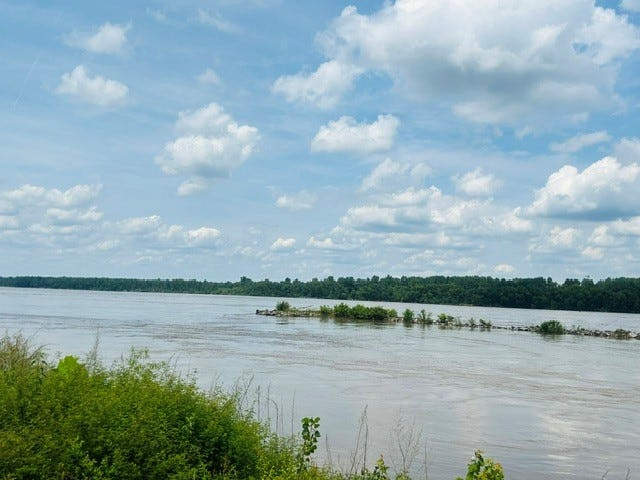
I found that the main road followed the Trail of Tears so I followed it all the way down to the Mississippi river where the Native Americans crossed to get to the other side.
Some of the groups travel by foot while others traveled by Keel boats and steamboats. Eventually the people made it to their new home in Oklahoma.
I had to sit and just meditate on the whole thing for a while. There was so much history involved in this story and I’ve only shared a little bit of it.
The mighty Mississippi on this day was a little bit flooded, very wide, and appeared to be very deep. That was the closest I’ve ever been to the banks of that river. It was breathtakingly beautiful.
The whole experience was a bit overwhelming for me. Many of the Native Americans lost their lives while walking this trail, thus how the trail got its name.
There are several recreational trails at this park that you can take to see different vantage points of the Mississippi river and other special interest places. I hiked to an overlook where I could get a good view of the river and I could see the state of Illinois on the other side. There’s a couple of campgrounds at the park as well. I decided ti just to spend the afternoon there hanging out. I had a nice visit there and learned a lot more about history.
There are several hiking trails in the park and the one that I picked out to hike during my stay was the Shepherd Point trail. It’s a 3 mile out and back trail. The trail features sharp ridges, steep ravines, and distinctive woodland trail. The trail ascended to the top of a ridge, ending near Shepherd Point. This spot is on top of a bluff overlooking the Mississippi river and is a great place to view eagles.
This park is worth the effort to visit if you get the chance.
Today, the official Trail of Tears trail, encompasses land and water routes across Alabama, Arkansas, Georgia, Illinois, Kentucky, Missouri, North Carolina, Oklahoma, and Tennessee.
To retrace the historical journey, explore, or plan a trip, you can use the National Park Service Trail of Tears Itineraries to find specific, accessible sites and visitor centers along the route.
I’ve always enjoyed hiking places where I could be out in nature and learn about history at the same time. This was one of those places.
To get to this place: The address of the park is 429 Moccasin Springs Road, Jackson, Missouri.
A quote for your week: “ The Trail of Tears is a story of resilience and resistance in the face of overwhelming odds.” – John Ehle – Author and Historian -1925-2018
Until the next trail,
Susan Anderson is a resident of Owen County who enjoys hiking and backpacking and writes a weekly column about her experiences. Readers can reach her via email at saanders@hotmail.com or on Instagram @farsideoftheedge.
This article originally appeared on Evening World: Following history at the Trail of Tears State Park
Reporting by Susan Anderson, For the Evening World / Evening World
USA TODAY Network via Reuters Connect

By Susan Anderson, For the Evening World | USA TODAY Network