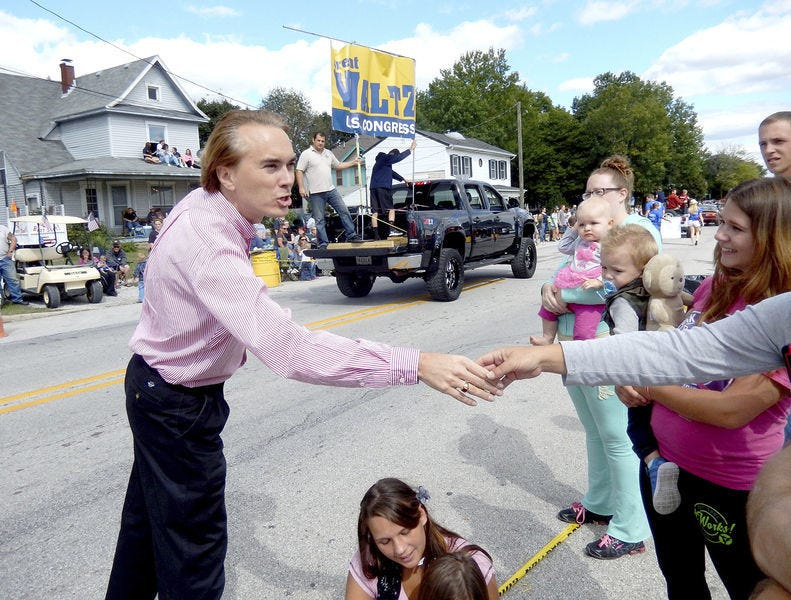
A federal judge has denied a motion to overturn former state Sen. Brent Waltz’s federal prison sentence for illegally funneling tens of thousands of dollars in casino cash to his congressional campaign.
The decision brings to close a yearslong effort by Waltz to get his 10-month prison sentence and subsequent probation tossed.

Waltz, a Republican from Greenwood, pleaded guilty in 2022 to receiving $40,500 in conduit campaign contributions and making false statements to the FBI.
But in 2023, Waltz claimed in court filings that his decision to plead guilty was based on bad advice from his former lawyer, Russell Johnson. Waltz said Johnson failed to explain to him that accepting the plea agreement would likely lead to prison time.
In his Feb. 9 decision, however, Chief District Court Judge James R. Sweeney II said Waltz’s arguments did not warrant overturning his plea deal and sentence.
In a phone interview after the decision, Waltz said he is disappointed that Sweeney, who presided over the criminal case, chose to uphold the sentence, but Waltz said he’s not surprised by the outcome.
“Judge Sweeney, I don’t have a very high opinion of him,” Waltz said.
He vowed to continue fighting to clear his name.
“I am living, breathing proof that anyone can have their constitutional rights taken away from them unjustly,” said Waltz. “And I will fight for the rest of my life if need be to have those restored.”
What did Waltz plead guilty to doing?
Waltz served in the Indiana Senate from 2004 to 2016. Instead of seeking another term, he unsuccessfully pursued the U.S. House seat for the 9th Indiana Congressional District.
Several years later, in September 2020, a federal grand jury indicted Waltz, along with New Centaur Inc.’s attorney John Keeler, for violating campaign finance laws. Waltz was accused working with political consultant Kelley Rogers to funnel the straw contributions from the Indiana casino company, helmed by mogul Rod Ratcliff, to his campaign.
To skirt campaign finance limits, the money was routed through fake contracts from the casino company to Rogers. Rogers and Waltz then used the money to reimburse friends and family members for contributions to Waltz’s campaign.
Waltz admits he pressured Rogers to quickly raise money for his campaign, thinking that he stood a better chance of winning if he could pack his campaign war chest early. Despite his admission of guilt under oath in court, Waltz denies taking part in or having knowledge of the scheme and he says Rogers never implicated him.
Why was Waltz seeking to overturn his guilty plea?
Waltz claims his former attorney, a trial lawyer with death penalty experience, did not communicate to him the specifics of U.S. sentencing guidelines and how the monetary scale of the campaign finance violations could be used as a threshold for sentencing.
“In the discussions, we would go back and forth and brainstorm and strategize, but the decision was ultimately mine to make,” he said, “but it was absolutely based on incorrect, faulty information.”
In a short affidavit submitted to the court in 2023, Waltz’s attorney acknowledged some of his claims, saying that he told Waltz what he believed to be true at the time, even though he had not researched the issue.
What the court says
According to court records, Waltz served nearly six months of the 10-month sentence in a federal prison in Kentucky before being released to a halfway house for four weeks and home confinement for two more. He also received two years of probation.
With a new attorney in 2023, Waltz sought a hearing in hopes of getting the guilty pleas and sentence tossed. He argued that the court should vacate the sentence on grounds that the legal advice he received fell below the standard of effective assistance guaranteed by the Sixth Amendment.
He did not get the hearing. The court took nearly three years to make a decision.
In his 19-page decision, Sweeney noted the ex-state senator pleaded guilty in exchange for the dismissal of the three other charges that would have elongated his prison sentence if convicted.
The judge disagreed that poor legal representation significantly impacted the outcome of his sentencing.
“Mr. Waltz’s testimony that Mr. Johnson ‘repeatedly told’ him that his guilty plea would not carry ‘a presumptive sentence of imprisonment’ is testimony that Mr. Johnson advised him correctly,” the judge said. “He was not subject to a presumptive sentence. To advise him otherwise would have been incorrect.”
Waltz also affirmed under oath that he had read and discussed the agreement and the sentencing guidelines with his attorney before the hearing. The judge also went over the agreement and sentencing again with him in court, where he affirmed all facts were true.
The court noted that the agreement Waltz signed explicitly states: “the sentencing guidelines are not mandatory or binding on the Court, but are advisory in nature.” During the plea hearing, Waltz acknowledged that the judge could deviate from federal sentencing guidelines and any recommendations from prosecutors.
Waltz had waived his right to appeal as part of his plea deal. In his dismissal, Sweeney refused to let him get out of that. The judge denied him a certificate of appealability, writing that Waltz failed to show that reasonable jurors would find his claims valid or that the court erred.
Waltz said he plans to explore his legal options.
“It just seems so wrong that one person can have the final word on something like this without even being able to appeal it to a higher court,” he said.
Former IndyStar reporter Johnny Magdaleno contributed to this story.
Contact IndyStar investigative reporter Alexandria Burris at aburris@gannett.com. Follow her on X, formerly Twitter, at @allyburris and on Bluesky at@allymburris.bsky.social.
This article originally appeared on Indianapolis Star: Ex-state Sen. Brent Waltz loses challenge to overturn federal sentence
Reporting by Alexandria Burris, Indianapolis Star / Indianapolis Star
USA TODAY Network via Reuters Connect