Indiana’s billion dollar plan to supply water to Boone County’s LEAP district, a region with limited water resources, has been mired in controversy since its conception. Citizens Energy now plans to ship up to 25 million gallons a day from the watersheds of Central Indiana, including Eagle Creek, to Lebanon to support industry in the tech park.
The local Lebanon water utility intends to send the used and treated wastewater back south and — much to the consternation of many area residents — discharge 15 to 20 million gallons a day directly into Eagle Creek.

Over the past several months, hundreds of Hoosiers who oppose the project have implored public officials to halt the project, shown up at public meetings, and protested construction. Dumping the treated wastewater into Eagle Creek’s ecosystem has proved a key sticking point for many, who note that research shows that wastewater, even when treated, can alter ecosystems.
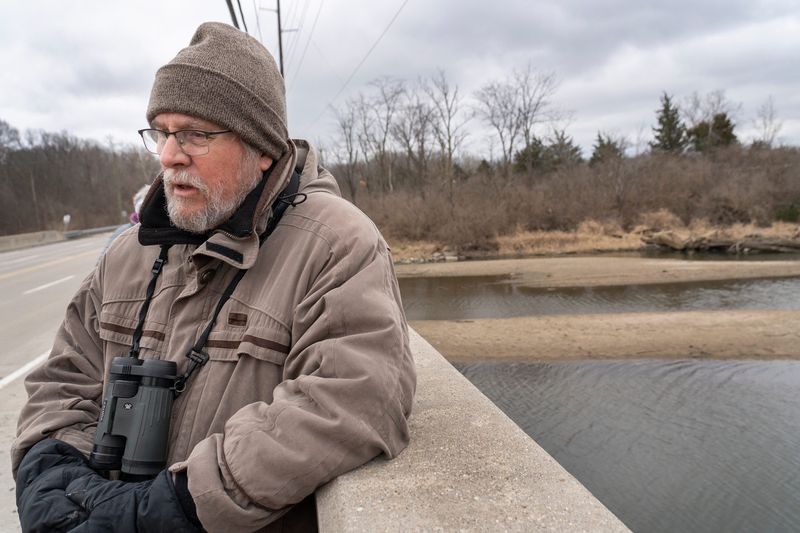
“Treated wastewater has things in it that aren’t traditionally measured, and we know these things can accumulate in an ecosystem,” said Martin Risch, a retired hydrologist who worked at the Indiana Department of Environmental Management and the United States Geological Survey. “If we ignore those complexities and think it’s as simple a solution of water up and treated wastewater back, we’re overlooking the things that can happen in the ecosystem… and that change could be profound.”
In an effort to assauge such concerns, Lebanon Utilities announced plans to upgrade its wastewater treatment plant. But that plan has provided little reassurance for Eagle Creek advocates skeptical of the proposal.
Friends of Eagle Creek want to know how the utility can adequately upgrade the plant without pollution permits, which could dictate how to treat the water. And because the LEAP district is still largely unpopulated, it remains unclear what kinds of contaminants might enter the water as it’s used.
A jumbled permit timeline isn’t that uncommon when it comes to building water treatment systems, according to Larry Kane, a retired environmental attorney who once worked at IDEM and opposes the plan.
“But it’s not wise,” he said.
Waiting on permits
The project is moving forward in fits and starts. IDEM issued a construction permit for the wastewater treatment plant upgrade, said Ed Basquill, Lebanon Utilities general manager. But the project’s second piece, which includes roughly 16 miles of 48-inch pipes running to Indianapolis and a discharge site on Eagle Creek’s north shore, is still wading through a complex permitting process.
The permit is acquired through four stages: Lebanon Utilities engineers must first work with IDEM to determine waste load allocation, or the upper threshold of pollutants that can be released into Eagle Creek. Then, the engineers have to demonstrate the project will not diminish the watershed’s health.
“The idea is that the engineers needed to demonstrate to IDEM that they will not make the water quality worse,” Basquill said.
Both of these processes are ongoing. Once they are completed, the utility hopes to move to the third phase: construction permitting for the pipes to Eagle Creek. Originally, Lebanon Utilities had hoped to receive the construction permit in October 2026, but Basquill expects it will now take longer due to the public interest in the prokect.
Then, Lebanon Utilities must seek a final permit through IDEM, which could dictate limits for contaminants like organic waste, heavy metals, phosphorus and ammonia. Lebanon Utilities will then be required to test the discharge site and report the results.
“We’re not going to make the water quality any worse and we’re probably going to make it better,” Basquill said. “IDEM exists to make sure we are following a process.”
While environmentalists have expressed concern about how the new plant would adequately treat wastewater when pollution limits are not yet known, Basquill said this is not an issue. He said he has worked closely with Eli Lilly and Meta, two companies that have committed to building in the LEAP district, to take into account their water needs, which are mostly cooling-related, for the treatment plant’s construction design.
However, LEAP’s list of future tenants could balloon. The district is in its infancy, and at full capacity, the tech park could house hundreds of companies, working in the life-sciences, microelectronics, agriculture technology and electrification, according to the IEDC’s website.
“No one really knows, at least from the public’s perspective, what the wastewater contaminants will be,” Kane said. “There could be any of hundreds of different contaminants, and we simply have no idea what they are.”
As a final precaution, Basquill said, the utility will require companies to test their wastewater and if necessary, pre-treat the water on-site before sending it to the Lebanon wastewater treatment plant.
Lingering concerns
Members of the Eagle Creek Park Advisory Committee want more information about how the project will affect the park because the full scope of environmental impact remains unclear.
In August 2025, the IFA determined that Lebanon Utilities’ leg of the project didn’t necessitate an environmental impact statement, which baffled many on the committee who see a host of potential threats.
“The problem is that the project is bifurcated into many different pieces that you’re looking at smaller environmental impacts of several projects,” Kane said.
Discharging treated wastewater into a place like Eagle Creek isn’t uncommon — wastewater has to go somewhere. Several miles upstream from Eagle Creek, the TriCo Regional Sewer Utility and the Zionsville Wastewater Treatment Plant discharge into streams that feed the reservoir.
But what is odd in this instance, said Risch, is that the discharge site is located in a contained reservoir instead of flowing water.
“In Indiana, that’s not done typically,” he said. Discharging water into a stream or river provides a natural buffer, he added, and you “want enough water to dilute some of that treated sewage.”
Vegetation along streams can also accumulate and retain pollutants, mitigating wastewater impacts on wildlife.
The lack of accessible and reliable information available to the public has made dialogue with the utilities more difficult, said Lou Ann Baker, another member of the park foundation’s advisory committee. And before the project keeps moving forward, the committee would like to see a water budget to make sure there’s enough water to handle the project.
Risch is in talks with his former employer, the USGS, to commence a bathymetric study of Eagle Creek, which could provide a more accurate estimate to the reservoir’s capacity.
“Worst case scenario is what is driving a lot of public concern right now,” he said. “If we’re in a drought and there’s a lot of demand for water, and then there’s this new extra demand to supply Lebanon under contract, are we going to run into a situation where water levels get lowered more than were really intended?”
In addition, Risch is thinking about the impact from pollutants that IDEM doesn’t monitor. He said it is probable that some chemicals or contaminants will escape detection and could impact the natural ecosystem around the reservoir.
“We are quite aware that not everything that comes out of that pipe at the end of wastewater treatment is measured. If a scientist goes in with sophisticated chemical analysis techniques, you can find a lot of things that people put down their sink, flush away at the end of the day, and small amounts of those chemicals survive the treatment process,” said Risch. “I fear the health consequences that could be associated with this for the creatures that can’t escape.”
IndyStar’s environmental reporting is made possible through the generous support of the nonprofit Nina Mason Pulliam Charitable Trust.
Sophie Hartley is an IndyStar environment reporter. You can reach her at sophie.hartley@indystar.com or on X at @sophienhartley.
This article originally appeared on Indianapolis Star: Eagle Creek advocates: ‘Not wise’ to dump LEAP wastewater in reservoir
Reporting by Sophie Hartley, Indianapolis Star / Indianapolis Star
USA TODAY Network via Reuters Connect