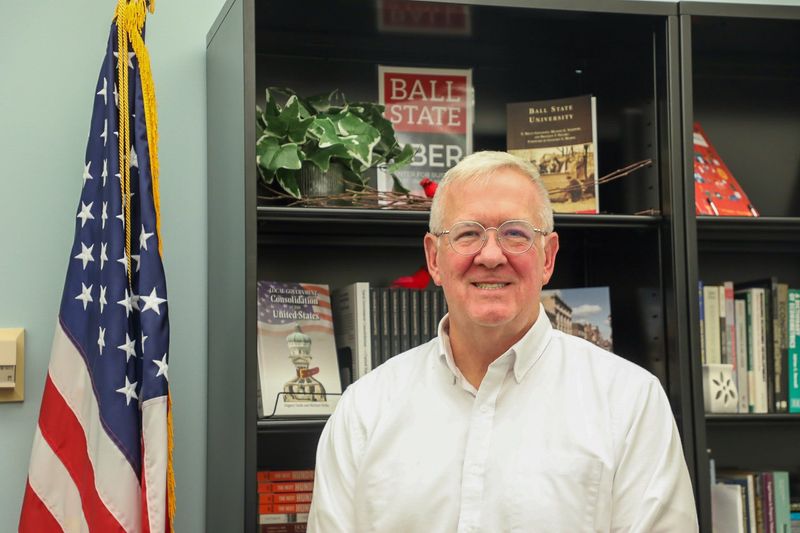
MUNCIE, IN — In a small, windowless office, tucked in the corner of the Center for Business and Economic Research on Ball State’s campus, Michael Hicks types on an old laptop.

He’s currently researching the impact of AI data centers, work that has already drawn attention from outlets like the New York Times.
He doesn’t view any of it as particularly his own doing. The real accomplishment, he said, is “the existence of a really strong research center at a state university that everybody listens to, whether they like us or not.”
It’s the team, not him.
Regardless, Hicks acknowledges the spotlight lands on him anyway.
“Judge me by what I write,” he said plainly, arms resting at his sides in his office chair.
After 19 years as director of Ball State’s Center for Business and Economic Research, Hicks is leaving to take on the role of director of the newly combined College of Business and Technology at Shenandoah University. A reception in his honor will be at 3 p.m. Aug. 13 at the center in the Whitinger Business Building on Ball State’s campus.
Hicks has spent more than three decades studying economics, or as he described it, “where people and businesses go or don’t go, and what causes that.”
Before economics, though, there was the U.S. Army. Hicks graduated from the Virginia Military Institute and served as an active-duty infantry officer, seeing many deployments, before leaving active duty and eventually retiring from the reserves as a lieutenant colonel.
He earned his doctorate from the University of Tennessee in 1998 and went on to hold faculty and research positions there, at Marshall University, and at the Air Force Institute of Technology. He was already tenured by the time Ball State hired him in 2007.
Hicks inherited more than the role, also taking over his predecessor’s weekly newspaper column, a job that would eventually grow into more than 1,000 columns published across the state and USA Today network.
Not everyone has been a fan.
Hicks’ research on hospital monopolies, work that argues consolidated health systems are overcharging the average Indiana family roughly $3,000 a year, has drawn some of the sharpest pushback of his career.
He said hospital groups have written columns attacking him, sent letters to Ball State President Geoffrey Mearns asking that he be fired, and in at least one case, threatened him in person at the Indiana Statehouse.
He’s also become a target on the political side. Hicks doesn’t take the criticism as a sign he’s doing something wrong, and if anything, he sees it as proof the work is doing its job.
“I’m a 60-something college professor,” he said. “The ideas and the research are really important. … It’s not that I’m a lightning rod, it is the ideas that scare people, and that’s a good thing. Ideas should be powerful.”
His theory is that politicians on both sides become angry not because they disagree, but because they know their own voters have read his work and believe it.
“When the lieutenant governor calls me ‘woke,’ it’s because he knows that people in his party believe the things that I’ve written,” he said. “If a Democrat gets mad at me, it’s because they know powerful people in their party have read what I do.”
For all the tension, Hicks says the hospital research may end up being one of CBER’s most durable contributions. He pointed to growing bipartisan interest in the General Assembly as a sign the issue is being taken seriously.
Although he acknowledges that his work can help create change, he is equally willing to reflect on his own record and what he’s gotten wrong.
He missed calling the 2007 recession, the 2014 economic slowdown, and overestimated the Affordable Care Act’s damage while missing the hospital-consolidation wave that followed.
His read on tariffs comes with an asterisk as his original estimate assumed rates near 27%, but after Supreme Court rulings cut that to about 6%, he said the damage has been real, if “more muted” than expected.
That indifference to his own legacy is echoed, and also complicated, by the people who worked alongside him.
Dagney Faulk, CBER’s director of research and Hicks’s collaborator of nearly two decades, hasn’t pretended his departure won’t change the center.
“It will be a bit quieter,” she said. “He has a big personality and a lot to say.”
What she says she’ll miss more is the way he worked.
Hicks “spends hours pulling together datasets, doing the analysis and then figuring out how to present it and talk about it in a way that people can understand,” Faulk said. “He was not content to just do the work and get a publication. He wanted people to know the results and what that meant to policy, quality of life, etc. I hope some of that rubbed off on me. I know it did.”
That intensity, she said, borders on obsession once a subject grabs him, adding that when a topic interests him, and he starts working on it, “he can’t put it down.” Lately, the topic has been data centers. Before that, it was tax increment financing.
For Katherine Wilcox, a third-year business economics major and CBER’s newest research assistant, the relationship started differently, as his student, not his colleague.
She signed up for his “Banking on Belize” project in spring of 2025, where students turned Belizean central bank data into reports presented to the country’s government agencies. By the end of the trip, she said, she’d started looking up to him as a mentor.
That mentorship steered her further into economics than she could’ve ever planned. Wilcox was a sports administration major when she told Hicks she didn’t feel challenged. He told her an economics degree would open more doors in the sports world than she realized and pushed her to switch.
“I was hesitant that I wasn’t smart enough to commit to switching,” she said. “He reminded me that I was asked to join this high(ly) immersive learning project, and I would not have been asked if I wasn’t capable.”
She changed her major, and by the end of the school year, he’d offered her the position at CBER.
Wilcox remembers the trip more for what happened outside the research, like karaoke with her class in Belize, Hicks included, and a sprint through the Houston airport to make a connecting flight.
What surprised her most once she started working alongside him rather than sitting in his classroom was simpler:“His humor really came out,” she said.
As for what comes next, Hicks is ignoring the word “retirement.” His new position will entail what he describes as an extension of what he’s always done, just somewhere new. He plans to keep writing, too, just less often.
“It will take 20 years for anything you write or say to have any effect,” Hicks recalled learning from his first boss. “That’s probably about right.”
He’s leaving Ball State one year short of that mark.
This article originally appeared on Muncie Star Press: ‘Controversial’ economist and writer Michael Hicks leaves Ball State
Reporting by Trinity Rea, Muncie Star Press / Muncie Star Press
USA TODAY Network via Reuters Connect
By Trinity Rea, Muncie Star Press | USA TODAY Network