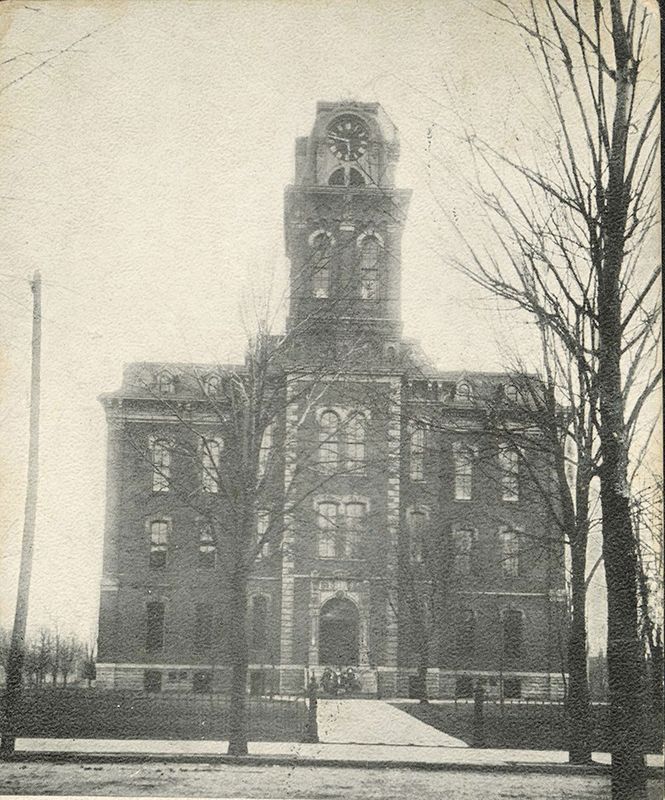
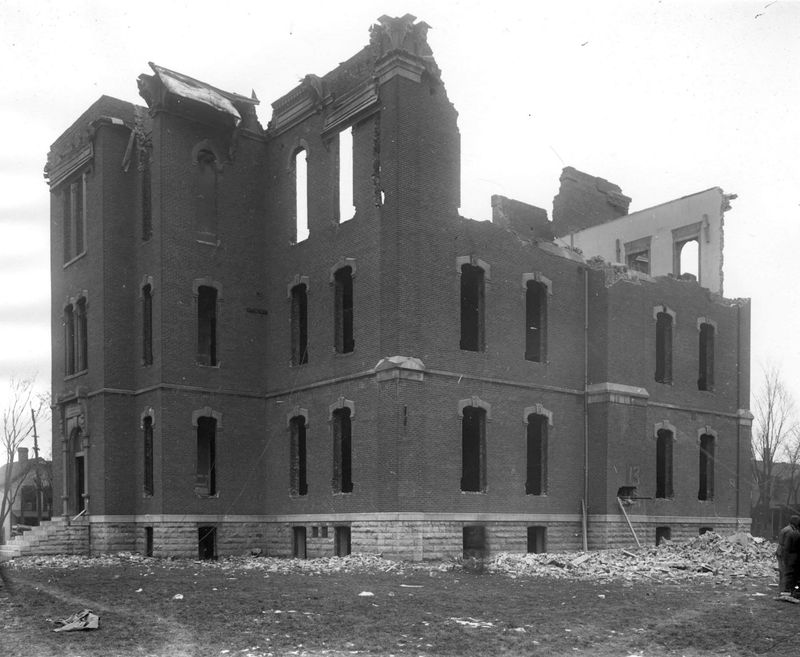
By 1910, Muncie’s gas boom-era teenage population had outgrown the capacity of its 1880 high school building, located on the block bounded by Adams, High, Charles and Franklin streets. In 1914, school officials demolished it and built a bigger school on the same site.

The 1880 building was not especially old in the early 1910s, but it was cramped. It was already the fourth schoolhouse used for secondary education in Muncie.
The first was the Delaware County Seminary. Despite the name, county seminaries were secular, county-run schools that prepared common-school graduates for college. Built in 1841, Delaware County’s seminary stood where Gillespie Towers is today. It was replaced by the first Jefferson School in 1864.
A few years later, Muncie’s first high school opened in the Washington School Building on Vine Street, between Adams and Charles. High school students then met for a few terms in the basement of St. John’s Universalist Church at the northeast corner of Jackson and Madison streets.
The first students graduated in 1868, all women: Louise Nelson, Rose Ross, Frone Case, Mary Craig Paine, Florence Anthony, Lizzie Montgomery and Ida Husted.
Muncie’s first dedicated high school building was a single-story, wood-frame structure built in the early 1870s at the southeast corner of Franklin and Adams streets.
By 1879, the city’s 81 high schoolers couldn’t fit in their undersized building. School officials opted to construct a much larger high school on the same square.
The result was a large, three-story schoolhouse completed in 1880. Stone was quarried in Franklin County and on John Gilbert’s farm near Yorktown. The school was topped by a tower that included a 3,000-pound, Boston-made bell and clockworks, donated by local businessman Charles A. Willard. The bell still survives, located today in the Muncie Field House. The total cost for the school, including desks and seating, came to $41,497.83, or about $1.4 million today.
The high school’s bottom two floors housed classrooms, while the third contained an auditorium. Students were greeted each morning by a stone lion’s head carved into the arch over the entrance, facing Adams Street.
When the building was demolished in 1914, some of the work was done by a chain gang of prisoners from the Delaware County Workhouse. In early April, the crew uncovered a tin can beneath the old cornerstone, an informal time capsule placed there when the foundation was laid in 1879.
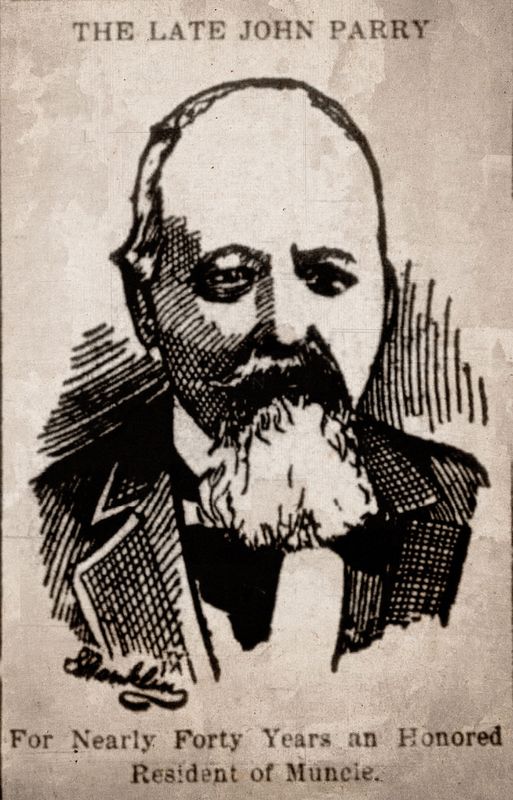
The contents included a copy of the Indianapolis Journal from Nov. 14, 1879, a packet of pea seeds and a handwritten letter by John Parry, a well-known local mason who cut and laid stone for the high school.
Published in the April 11, 1914, Muncie Evening Press, Parry’s letter is a delightful account of how the school was built and by whom, sprinkled with opinions of fellow Munsonians.
Parry wrote that the school was modeled on one in St. Louis and designed by board members John McClintock, John Husted and Thomas Neely, along with architect and carpenter Peter Bandy. Parry had wanted to hire John Ludlow, whom he considered Muncie’s best carpenter, but Ludlow was “a very great drunkard” and lost the bid.
Muncie’s school superintendent at the time was Hamilton McRae. His wife, Emma, was a beloved high school teacher known affectionately by students as “Mother McRae.” Parry wrote that she was “much better educated and a better teacher than her husband.”
John Parry was born in Pembrokeshire, South Wales, in 1823. On July 4, 1853, Parry left Liverpool for New York, crossing the Atlantic in 42 days. He worked as a stonemason and eventually made his way to Henry County, Indiana, around 1860.
Parry came to Muncie in 1862 after winning the contract to build Walling Hall, a two-story business building and auditorium west across High Street from the courthouse.
In the years that followed, Parry secured numerous stone contracts, including for the 1863 Masonic Hall at Main and High streets, the Kirby House Hotel at Jefferson and Main, the first Wysor Opera House south of the courthouse in 1872, the Meeks Furniture Building at 115 E. Main St. and several stone arch bridges over the White and Mississinewa rivers.
Aside from the high school, Parry’s best-known work in Muncie was the foundation for the 1880 Boyce Block on Main Street. When he finished in late May, the Muncie Daily Times wrote that Parry had buried another informal time capsule beneath the building’s cornerstone.
Parry’s capsule is likely still there. The Times reported it contained “Muncie papers, names of present city officers, statistics of the city” and other documents. The official time capsule was placed inside the cornerstone when it was laid a month later.
In the early 1880s, Parry served on Muncie’s City Council, representing the First Ward alongside Charles Kilgore. Parry lived with his wife, two daughters and son on West Jackson Street near the river, in what is now the Old West End. The Welsh-American immigrant died in 1899 and was buried in Beech Grove Cemetery.
Almost everything Parry built has since been demolished. Among the survivors are the Boyce Block and the old Meeks Furniture Building on Main Street.
Parry’s high school was demolished in 1914 and replaced by a new school on the same square. Muncie High became Muncie Central 1923. That building stood until 1974, when it, too, was demolished, a year after the present Muncie Central opened in Wysor’s Bottoms on North Walnut Street.
Ball Corp. bought the old high school square and built a new headquarters there in 1974. The building later housed The Star Press before becoming Ivy Tech’s John and Janice Fisher Building, returning education to the heart of downtown Muncie.
Much of John Parry’s work may be gone, but his story remains to remind us that immigrants quite literally built the foundations of our great city.
Chris Flook is a Delaware County Historical Society historian and senior lecturer of media at Ball State University.
This article originally appeared on Muncie Star Press: ByGone Muncie: The Welsh immigrant who built Muncie High School
Reporting by Chris Flook, Muncie Star Press / Muncie Star Press
USA TODAY Network via Reuters Connect
By Chris Flook, Muncie Star Press | USA TODAY Network