On Saturday, Sept. 15, 1894, a battle took place in Muncie for control of Walnut Street. The clash pitted Warren-Scharf Paving against Citizens’ Street Railway.

Trouble had been brewing for months.
In April, Muncie’s city council awarded Warren-Scharf $81,000 ($3.2 million today) to pave downtown streets with asphalt. This was the city’s first large-scale street paving project.
Founded in 1884 by engineer Samuel Scharf and four Massachusetts brothers, Warren-Scharf pioneered laying Trinidad asphalt over concrete. The company won paving contracts nationwide and maintained an Indianapolis office.
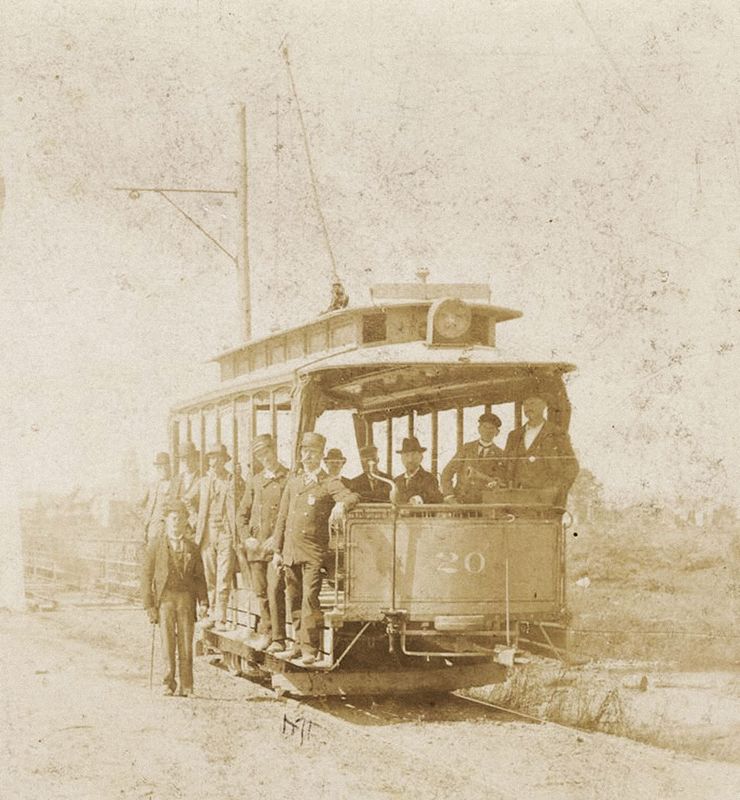
Chartered in 1892, Citizens’ Street Railway replaced Muncie’s failed steam-powered streetcars with electric trolleys. Running on overhead wires, Citizens’ tracks ran down Walnut Street into Congerville, with other lines to Whitely, Riverside, Westside, Avondale, Industry and Heekin Park.
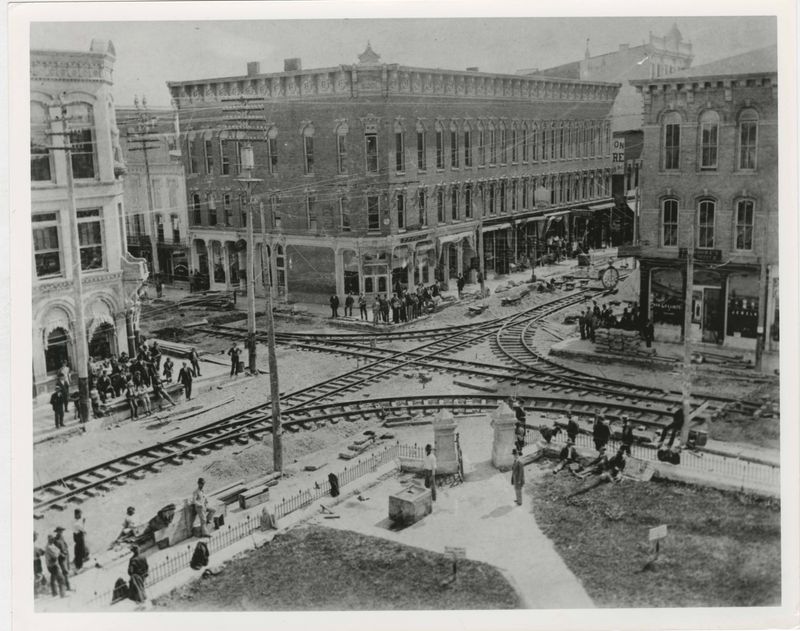
By September 1894, Warren-Scharf’s paving work had reached the streetcar tracks on Walnut. Citizens’ planned to build a rail spur from High Street to the rear of its powerhouse and car barn, where North Street meets Walnut (today between Star Financial Bank and city hall). The spur allowed trolleys in and out of the facility while the Walnut Street tracks were removed for paving.
However, the railway, paving company and city engineer couldn’t agree on when that should happen.
Paving work slowed as workers waited. Warren-Scharf then accused Citizens’ of threatening the company’s October frost deadline. The railway countered that too many streets were being torn out, disrupting trolley service and ignoring franchise and property rights.
To do the paving work, Warren-Scharf Superintendent R.R. Brown managed 50 laborers, including teamster George Davis. Citizens’ was led in the field by Superintendent William Hilligoss and track foreman William S. Pettey. The railway employed dozens of motormen, engineers and conductors and was owned by George McCulloch, a local industrialist. City engineer William Wood oversaw all street work on behalf of Muncie, while metropolitan police superintendent James Miller commanded a force of 12 officers to keep peace.
These people converged on Walnut Street the morning of Sept. 15, 1894.
About 7 a.m., Brown deployed his paving crew between Main and Washington streets. Laborers began excavating Walnut, loading dirt and rock into Davis’s wagons.
Soon after, Whitely Car No. 6 lumbered south down Walnut Street. The trolley’s motorman Will Russey pushed the car through the crowd of workmen all the way to Main. A furious Brown ordered his pavers to pull up the rail behind the trolley, cutting off Russey’s northern retreat.
Brown then told George Davis, who the Daily Times described as “a sturdy old fellow who obeyed orders,” to park his team on the tracks and not move until his wagon was loaded.
In response, Hilligoss boarded the trolley and took control from Russey. He then drove the streetcar into Davis’s team, forcing the horses and wagon backward into the workmen. The old teamster, according to the Daily Herald, “grasped a club and started after Hilligoss,” only to be stopped by Brown.
Heavy rain began to fall as the paving crew armed themselves “with shovels, picks and rocks and showed inclination to use them.” Brown climbed into the trolley and confronted Hilligoss: “These fellows would eat you up if you tried that again.”
Hilligoss shot back, “They might, but there’d be a few corpses.”
By then, a delighted crowd of Munsonians had gathered on both sides of Walnut and on the courthouse square to watch the chaos. Favoring neither party, the throng cheered “the paving workmen and the street railway employees alike whenever either side scored a point,” according to the Morning News.
When the rain stopped, Warren-Scharf’s workers began aggressively pulling out rails north on Walnut toward Washington Street. An Irish laborer named Hopkins built a barricade across the tracks and warned that the next trolleyman who crossed it would “git his face pushed down his t’roat.”
The Whitely car remained trapped in front of the courthouse, but Hilligoss sent 17 other streetcars from the trolley barn and parked them on Walnut, blocking Warren-Scharf’s workers from moving north. One trolley ran back and forth, attempting to disrupt the digging.
Then, get this: Railway workers grounded the trolleys, charging the cars, handrails and tracks with 500 volts. Hilligoss loudly warned anyone touching the rails would do so “at his peril.”
Undeterred, Brown moved his crew down to Main Street and began tearing up trolley track where it crossed Walnut. In response, Hilligoss sent the Industry and Avondale cars around to blockade the crossing. To counter, “paving employees chucked dirt on the rails.”
George McCulloch watched the entire skirmish unfold from the courthouse with his attorneys, John Ryan and William Thompson. Asked for comment by a Morning Star reporter, McCulloch pointed toward Walnut Street and replied, “What is there to say? Can’t you see everything out there?”
Chief Miller arrived mid-morning with several patrolmen and began arresting the railway men blocking Main Street. He pulled motorman Perry Freeman from the Industry car, receiving a severe electrical shock in the process.
Patrolman George Ball arrested motorman Ed Patton. As he grabbed him, both men were shocked as they completed a circuit. Chief Miller then removed Hilligoss from the controls, while patrolman Lucus Coffey arrested track foreman William S. Pettey.
Relishing it all, the surrounding crowd of Munsonians “hallooed and cheered, and for a time, it seemed that pandemonium had broken loose.”
Track demolition and the “electric blockade” continued through the morning until McCulloch’s lawyers filed an injunction against Warren-Scharf, the city of Muncie and engineer William Wood. Judge George Koons issued a temporary restraining order, protecting the railway’s tracks.
The battle was won in court but wasn’t officially over until the Whitely streetcar smashed through a makeshift barricade across Walnut.
Freeman, Patton, Hilligoss and Pettey all posted bonds, and no prosecution followed. Come Monday, all parties met and agreed on a path forward. Work resumed to everyone’s satisfaction. A paved Walnut Street with functioning trolley tracks opened in mid-October.
The Muncie Morning News proclaimed that a “gentle, white-winged peace hovers over the once warring street railway and paving companies, spreading her downy pinions above the scene of Saturday morning’s warfare.”
Chris Flook is a Delaware County Historical Society historian and senior lecturer of media at Ball State University.
This article originally appeared on Muncie Star Press: ByGone Muncie: The 1894 battle of Walnut Street
Reporting by Chris Flook, Muncie Star Press / Muncie Star Press
USA TODAY Network via Reuters Connect
By Chris Flook, Muncie Star Press | USA TODAY Network