Monroe County Community School Corp. is among the best school districts in the state in preparing students for college — at least when test results are adjusted for poverty and other factors outside schools’ control, according to a new analysis from Ball State University.

“If you’re in the top quintile for college preparation — and you’re a fairly large school corporation — that’s an astonishingly good job at preparing students for post‑secondary education,” said Michael Hicks, director of the Center for Business and Economic Research at Ball State University and a co‑author of the study.
The analysis, released this month, tried to answer a common but difficult question: How much credit — or blame — do schools deserve for their test results? Rather than ranking districts by raw scores, the study adjusts outcomes for factors schools cannot control, such as student poverty, demographics, funding, enrollment size and the share of English language learners.
Looking past raw test scores
The remaining difference — what Hicks and co-author Dagney Faulk, the center’s Director of Research, classify as “value added” — is meant to reflect how effectively schools translate their resources and instructional choices into student performance.
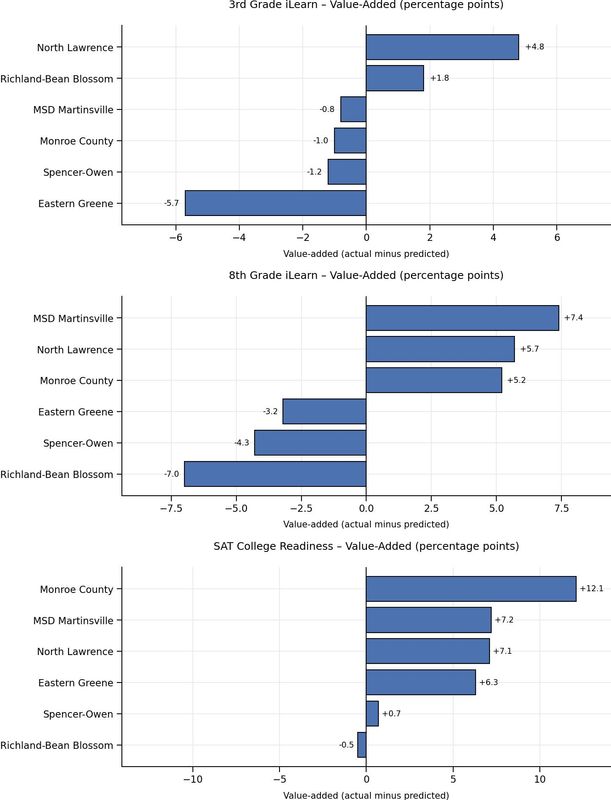
Viewed through that lens, Monroe County’s results look about average for tests in third and eighth grade but unusually strong by the time students approach the end of their high school careers.
Hicks and Faulk say about half of Indiana schools’ test variation can be explained by factors such as demographics, resources and poverty, with the latter accounting for up to 40% by itself.
Students in affluent families have access to more resources — they get breakfast every morning, they have computers, they have parents who have time to read to them, they may get tutoring assistance — and therefore tend to perform better on tests, Hicks said.
“A school corporation that has a very high proportion of affluent students is going to have a higher average test score than a poor school, even if what happens in the classroom is identical,” he said.
The study controlled for those factors schools cannot influence, leaving the remaining difference to reflect elements schools can control — such as teacher and administrator quality, grading rigor, remediation strategies and instructional choices.
How Monroe County compares to nearby districts
On third‑ and eighth‑grade exams, MCCSC landed solidly in the middle of the pack statewide. The district performed slightly below expectations in third grade, once poverty and demographics were taken into account, and slightly above expectations in eighth grade. Nearby districts North Lawrence, Richland‑Bean Blossom and MSD Martinsville showed stronger than expected results at the third‑grade level, while North Lawrence and Martinsville also outperformed expectations in eighth grade.
Spencer-Owen and Eastern Greene performed more poorly, though not near the bottom.
All of the nearby school districts performed better than expected in SAT college readiness, except Richland-Bean Blossom, which performed slightly worse.
However, MCCSC clearly outperformed the other regional schools, ranking among the top 20% of school districts in the state in SAT college readiness.
An MCCSC spokeswoman said district officials had not yet had an opportunity to review the study and did not provide comment by deadline.
A deliberate tradeoff?
While Hicks acknowledged that the study does not show which of the “unobserved factors,” such as teacher and administrator quality, is responsible at any given school, he said he suspects MCCSC has made a deliberate choice to trade average outcomes in elementary and middle schools for excellence in high schools.
“I can tell you that takes a lot of courage from a school board and a superintendent and from teachers,” he said.
Hicks said schools can “juice” their early grades by focusing on tests, and they won’t feel that pain until children reach high school. At that point students may lack a fundamental understanding of how best to learn and they may not know the facts that children should accumulate through elementary and middle schools to become good students.
Some schools, for example, emphasize pre‑algebra, which can boost eighth‑grade test scores, he said. Others move students into algebra earlier, a choice that may depress middle‑school results but pay off later in higher SAT performance.
Hicks said he suspects MCCSC leaders would say, “‘What I’m trying to do is to prepare a graduate at the end of their 12 or 13 years with me, who is ready for post secondary education, and that if that means that I don’t do quite as well in third grade or eighth grade, I’m willing to do that.”
And that’s exactly what communities should want, he said.
“That’s a tradeoff that, as a parent or as an economist, you would take ninety‑nine out of a hundred times,” he said. “I wouldn’t care at all about my kids’ third‑grade iRead test scores or eighth‑grade iRead test scores. … I care a great deal about how prepared they are for college or postsecondary education, regardless of what they do.”
Boris Ladwig can be reached at bladwig@heraldt.com.
This article originally appeared on The Herald-Times: Adjusted test scores show Monroe County schools lead region in SAT readiness
Reporting by Boris Ladwig, The Herald-Times / The Herald-Times
USA TODAY Network via Reuters Connect