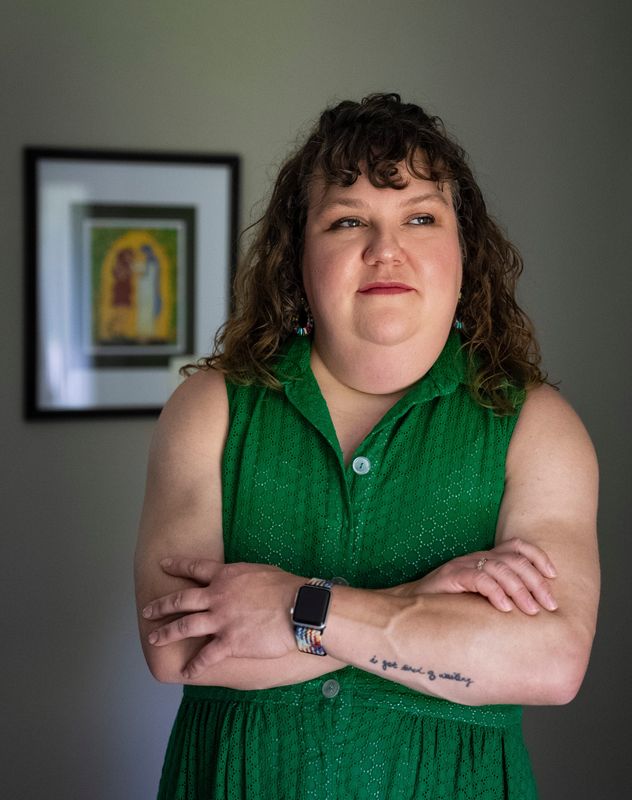
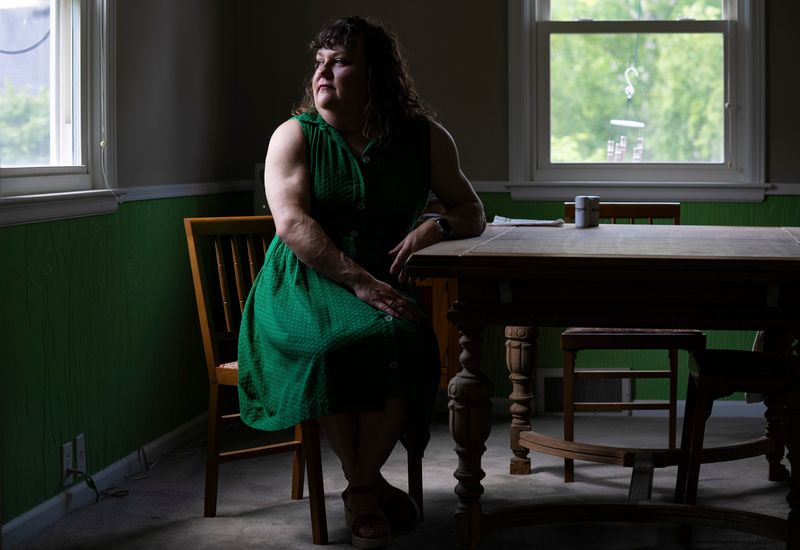
MUNCIE, IN — A Facebook post changed Suzanne Swierc’s life.
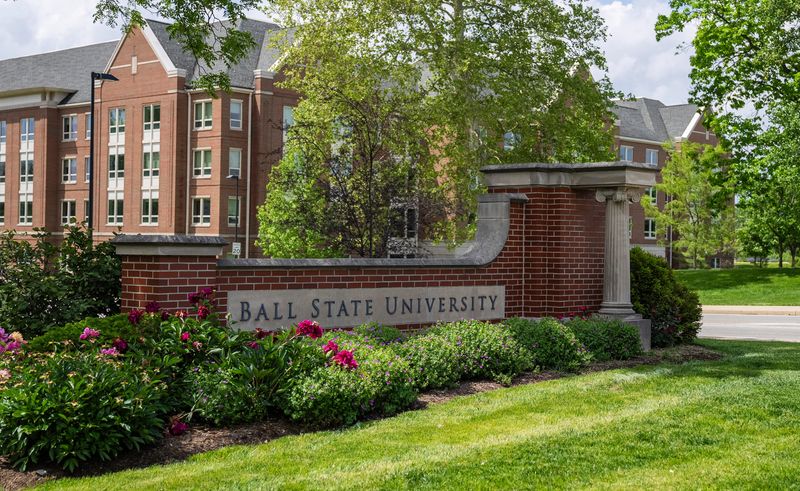
Last fall, Ball State University fired her after she made a post that both offered prayers for slain conservative activist Charlie Kirk’s soul and criticized the “violence, fear and hatred he sowed.”

Her termination was prompted by thousands of social media comments, hundreds of phone calls and pressure from Indiana’s attorney general.
Eight months later, sitting in her home half a mile from campus, she grabbed a tissue and dabbed the tears she tried to keep in.
“It’s so surreal to have been fired from my job, a job that I loved, that I was good at… most of the people I interacted with seemed to like me. I liked them,” she said. “It’s just, it’s crazy, and every so often, I just stop and think, ‘Wow, this is a thing that happened to me.'”
It’s an example of how disputes over free speech can often launch unassuming private citizens to the frontline of an aggressive culture war.
Swierc, the university’s former director of health promotion and advocacy, is one of dozens of public employees who were targeted by conservatives and fired from their jobs for comments about Kirk. She was the subject of threatening phone calls, detailed personal attacks and a post on a state-hosted education accountability portal.
Now, she is ready to move on and will do so with $225,000 of Ball State’s money.
The Indiana chapter of the American Civil Liberties Union represented Swierc in a federal lawsuit filed last September against university President Geoffrey Mearns. Her lawyers argued that Ball State violated her First Amendment rights when it fired her. They reached a settlement in April, and the ACLU released the terms of the settlement this week after filing to dismiss the case.
“I don’t think my life’s been ruined. It’s been made very difficult, and there are days when I’m like, I don’t know when this is going to be over or when it’s going to be better,” Swierc said. “But it’s not all bad.”
In an email to university leadership on Tuesday, Mearns stood by his decision to fire Swierc. The reaction to her post was predictable, he said, and was “extraordinarily damaging” to the university’s reputation and “exceptionally disruptive to our mission and our people.”
Becoming an advocate
Swierc shakes her head and laughs when asked if she grew up in a political household. Politics just weren’t a kitchen table conversation.
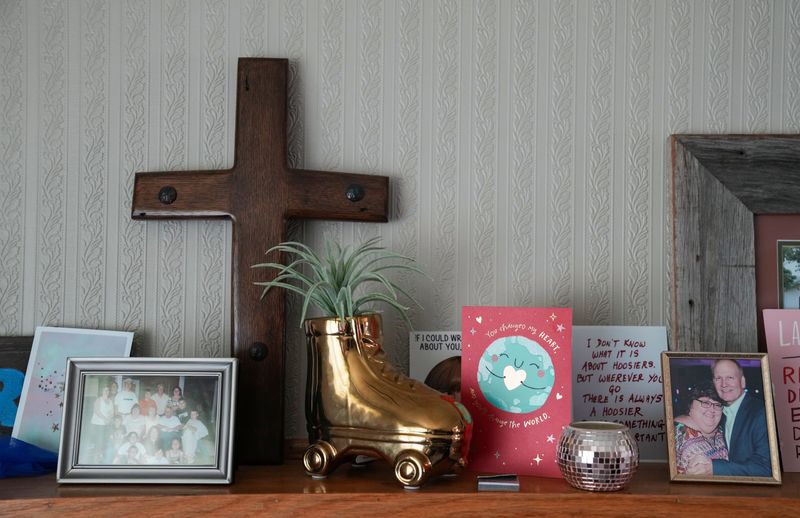
Born and raised in Texas, Swierc grew up in a large Catholic family, the type where “my grandmother was one of 10, and my grandpa was one of nine.” Those faith values shaped her and her siblings, evidenced by the number of religious wall hangings in her home and the fact that her brother is an ordained priest.
“It’s very much still a thing that will always be part of my life to some degree,” she said.
She began to discover her voice, and her First Amendment rights, by writing for her high school newspaper. She spent her free time journaling and reading, so it made sense that she eventually served as its editor-in-chief for two years. She also found herself getting into debates with her classmates during free periods and at the lunch table, talking about abortion, the death penalty and gay marriage.
She arrived at Texas State University planning to become a sports writer and declared her major as journalism, but wasn’t sold.
It was in the bread aisle at the grocery store where Swierc decided on a new major. The family doctor had encouraged her family to eat more whole grains, and they were perusing the aisle, looking at nutrition labels. Her mom wondered how they didn’t have a dietitian in a family so large.
The more she entrenched herself in the world of public health, the more Swierc’s views changed and her worldview widened.
After grad school at Texas A&M University, she moved to San Antonio, where she worked for Big Brothers Big Sisters of South Texas. There, she learned a lot about racial disparities and white privilege just by spending time with people who didn’t grow up the same way she did. Living in a bigger city also opened her up to meeting and making friends with a more diverse group of people.
“A lot of it was recognizing systemic issues that affect all kinds of different things, but largely how racism has impacted the country and different states and how that just continues to impact life for those folks,” she said. “Also, finally making friends and being around queer people very much helped me come around to LGBTQ+ issues.”
She later moved back to College Station and worked at Texas A&M for several years doing health advocacy. In the spring of 2023, Swierc decided to leave Texas. She applied to a position at Ball State and got the job as the university’s director of health promotion and advocacy.
Her role focused on how to reach students with critical health information. That meant she crafted programming with her staff, presented in classrooms and networked with people around the campus to infuse more healthy behaviors into students’ lives. Much of her work was focused on sexual health — answering questions like how to use a condom or what an intrauterine device is. This was ironic as a cradle Catholic, she said. She never imagined she would be tasked with teaching college kids about safer sex.
Working on a college campus was energizing, she said, and the bright-eyed young adults inspired her. She saw it as her responsibility to see the wholeness of their person, beyond just being students. She said she wanted students to know they had an advocate in her and to know that they were supported, even if they weren’t receiving that from home.
“There’s somebody on this campus who is in your corner,” she said about her approach to the job. “It can be me, it might be somebody else, but there are people here who want you to succeed, both as a student and as a whole person.”
Swierc posts on Facebook after Charlie Kirk’s assassination
On Sept. 10, 2025, Swierc and her staff spent the day in the sun working one of their biggest programs of the year: the college’s wellness fair held at the campus amphitheater.
Standing in her office’s lobby reflecting on the day, one of her staffers saw that Kirk had been shot while speaking at Utah Valley University. Swierc was vaguely aware of who Kirk was from social media and working on a college campus, but she felt he was someone whose opinions weren’t worth her attention.
It wasn’t until Swierc got home and was scrolling on Instagram that she saw the video of the assassination herself.
“I immediately was like, ‘Okay, I don’t need to look at that, and let me just keep scrolling,'” she said. “I watched the Twin Towers fall on live TV in 2001. I don’t need to have similar experiences again because this is terrible.”
Later in the night, after Kirk was confirmed dead, she was scrolling on Facebook. She saw some people minimizing his death while others were putting him on a pedestal.
“Nothing that I was reading was capturing how I was feeling about the situation, considering a lot of the things that he would talk about and some of the attitudes that he inspired with his speech,” she said. “Nobody else’s words are capturing how I’m feeling right now, so I will just do it myself.”
When writing that post, Swierc said she intertwined her need to protect her friends and the marginalized communities she worked with and her Catholic belief that all people are made in God’s image.
“That’s not my job to decide who gets to go to heaven, who doesn’t, but he’s still a human person with a soul who hopefully will get there,” she said. “And so you don’t have to like everybody, but they’re still made in God’s image and still have that soul.”
She then hit post.
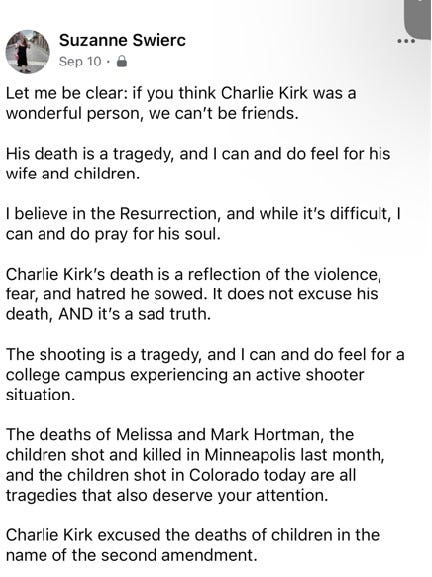
“Let me be clear: if you think Charlie Kirk was a wonderful person, we can’t be friends. His death is a tragedy, and I can and do feel for his wife and children,” she wrote in the post. “Charlie Kirk’s death is a reflection of the violence, fear, and hatred he sowed. It does not excuse his death, AND it’s a sad truth.”
‘Something traumatic is happening’
Two days after her post, just before 1 a.m., Libs of TikTok, a far-right X account with 4.7 million followers, posted a headshot of Swierc and her Facebook post, calling on Ball State to address her comments.
When she woke up at 6 a.m. and checked her phone, she immediately panicked. She had dozens of voicemails and messages from people calling to tell her she should be fired. Her phone continued to ring nonstop. She deleted an app that routed her office phone’s calls, but they had her personal number, too.
Indiana Attorney General Todd Rokita repeatedly singled out Swierc in X posts and included her comments on a state-hosted education dashboard tracking negative or celebratory comments that school and college employees made about Kirk. He later celebrated her firing.
She struggled for hours to pack an overnight bag for a long-planned weekend road trip to Chicago to see rock group HAIM. It was then that she realized she was going through a traumatic event and experiencing symptoms that she taught about in her sexual assault programming.
“Part of me did recognize that, ‘Oh, something traumatic is happening to me. This is why this is going on,'” she said. “But I have no idea what to do with myself.”
When she got back from Chicago, her mom had flown up from Texas to support her and help her listen to the dozens of voicemails for any threats. One said she deserved “what Charlie Kirk got.”
On Monday, she was already scheduled to meet with human resources since she texted her boss about the situation. The meeting was focused on making sure her team was safe and going over security measures.
Two days later, she was called into another meeting at 4 p.m. She knew there was a good chance she would be fired. She thought about an English professor who was publicly dismissed at her alma mater, Texas A&M, for a viral video taken during a lecture mentioning gender identity.
So, she wasn’t surprised when the termination letter was slid across the table.
Life after getting fired
In the days after, her phone was still buzzing nonstop. Some of them were still people calling to berate her, but now there was a mix of people checking in and supporting her after seeing her name in the news.
She had her first panic attack a few weeks later, after her family left and she was alone for the first time. She began to shriek and cry. Her mom texted a group chat of Swierc’s friends created to relay updates about the situation. A friend immediately made her way and hung out until Swierc was able to calm down.
Swierc stands by her post and does not regret it, saying she has just as much of a right to say her opinion as anyone else. Still, the situation overwhelmed her.
“When I would have a panic attack or be particularly upset or sad or insert other emotion here, one of the underlying emotions was shame,” she said. “[My friends were] like, ‘But you didn’t do anything wrong.’ Rationally, I know that, but that is still back here.”
She had another panic attack after cleaning out her office, and then, another while walking home from a neighborhood association meeting that was held on campus.
It wasn’t just that she was fired, she said. It was the virality of the post, the personal attacks, the news stories, the fact that the state’s attorney general was posting about her. It plunged her into a life transition she did not want or ask for.
Something that sticks with her is the vengeful motivation of people who sought to damage her reputation without knowing her. As she comes to digest what happened, the shame that plagued her is fading.
“Grief is an interesting thing because no matter what causes the grief, it’s never a thing that’s going to completely go away,” she said. “You just grow around it.”
In addition to therapy, her way to grow around it was to throw herself into her community. That choice was her silver lining.
The weekend after she was fired, she was in Indianapolis refereeing roller derby. She helped pick up and drop off her friends’ kids and moved a friend’s grandmother into a new home. Her CrossFit gym comped a month after she lost her job, and they supported her to hit a personal record of squatting 315 pounds. Recently, she got a part-time job that she said is fulfilling and has a great mission.
She found things to look forward to each month — short trips and get-togethers. She read several books, which are now added to her packed bookshelves and has her “cozy, winter hobbies” of puzzles and sewing.
“You can’t self-care your way into healing from trauma,” she said. “You can take as many bubble baths as you want. That’s good and fine, and it does good things for you. But at the end of the day, there’s still very tangible needs, both physical and emotional.”
‘Picking up the pieces’
Reaching this settlement closes this painful chapter for Swierc, but she has complicated feelings. While she is glad she can move on, she wishes more justice was served. The settlement doesn’t address censorship on college campuses, which she believes has gotten worse, or the hundreds of people who harassed her. A settlement also doesn’t establish a legal precedent like a court ruling could have, she said.
“Ball State will continue on to be Ball State, and I’m still here picking up the pieces of my life,” she said. “There’s still no precedent set for myself or anybody else who has or ever will experience a thing like this.”
Joshua Bleisch, one of the ACLU attorneys who worked on her case, said it’s difficult in these cases where the legal remedies can only do so much for those impacted by the latest flare-up of an ongoing culture war.
“The awful things that were said about her, the awful amount of publicity that she never asked for,” Bleisch said. “It was just thrust upon her, and so I mean, we’re never going to undo that.”
Swierc is working to resume her career — though it’s still a semi-traumatic experience to apply for jobs. For now, she wants to stay in Muncie and intends to stay in the community she built, even if she has to drive through the campus of the college that didn’t stand by her.
Now, she does so with $225,000 in hand, a strong support system and much thicker skin.
“People are saying all kinds of things,” Swierc said. “And like Taylor Swift said, ‘It might have my name in the headline. It doesn’t mean it’s any of my business.'”
The USA TODAY Network – Indiana’s coverage of First Amendment issues is funded through a collaboration between the Freedom Forum and Journalism Funding Partners.
Have a story to tell? Reach Cate Charron by email at ccharron@indystar.com, on X at @CateCharron or Signal at @cate.charron.28.
This article originally appeared on Indianapolis Star: A Facebook post changed her life. She has trauma, $225K to show for it
Reporting by Cate Charron, Indianapolis Star / Indianapolis Star
USA TODAY Network via Reuters Connect