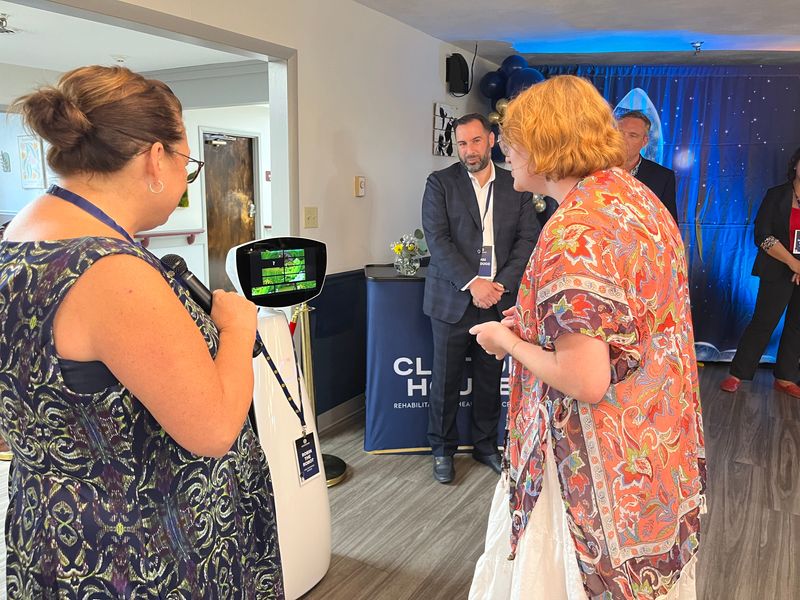
FRANKFORT, IN – Two employees at Clinton House Rehabilitation and Healthcare Center worked quickly Tuesday, Sept. 30, as they prepared the way for one of the biggest “next big things” in medical care.
The workers pulled apart poles of gold-colored metal that linked red velvet ropes, of the kind that often enclose a red carpet, for the assisted-living facility’s honored guest. A DJ played “Thunder” by AC/DC.

The robot entered.
Robin, 4 feet tall and resembling a grounded EVE from the film “WALL-E,” wheeled through the lane set up for her with a wide-eyed smile displayed on her flat-screen, iPad-sized face.
She waved to the crowd assembled before her in one of the building’s day rooms by flashing a yellow palm on her screen. She spoke in the voice of a young girl, through speakers on the sides of her head.
“Hello, everybody! Very nice to be here.”
Clinton House has sought Robin’s help for four years, said Shai Berdugo, CEO of the facility’s parent company, Castle Healthcare. The company has already bought two Robin units for its facilities in Waldron and Anderson, “not to replace anybody, God forbid,” Berdugo said, “but really to enhance and compliment the amazing staff you see here.”
Clinton House’s secure dementia wing, which holds 18 residents, will benefit from the robo-pal’s artificial intelligence-driven ability to hold lifelike conversations, Executive Director Matthew Shafer said.
After Robin’s introduction, a dementia care specialist walked to the front of the room to meet her. Saedie Spikes of the Lafayette-based Area IV Agency, a social services provider for the elderly, exchanged pleasantries with the robot before playing a matching game with her.
She answered the first question, and Robin exclaimed her approval. “You got it! How about this one?”
After Spikes had answered four correctly, the robot congratulated her. “Well done, my super smart friend. Thanks for playing!”
Shafer envisions Robin as an omnipresent morale booster for patients in the sometimes lonely world of assisted living, similar to a therapy dog.
He said Clinton House would probably need to organize Robin’s interactions with residents in shifts at first, to meet demand for the facility’s newest staff member. The robot wore a badge strung on a lanyard Tuesday labeled “Chief Happiness Officer.”
“It allows the staff to do more clinical stuff, but it’s still engaging residents as it goes along,” Shafer said.
Robin will quickly learn the facility’s layout, and as she does her “rounds” each day she will engage with residents unprompted, using facial recognition capabilities to remember their names and things about them: She might ask how a grandson is doing, or what a resident had for breakfast.
The robot’s battery can last about six or seven hours, Berdugo said, before she needs to charge for six hours. While she docks, she can download information to fill gaps in her memory, like learning about a resident’s favorite movie or looking up a sports score.
Robin debuted in the United States in 2020 in a pilot program at a California children’s hospital, the Associated Press reported. She flew into Indiana on Tuesday morning by way of California, home to the company that invented her, Expper Technologies. Time Magazine named the robot one of 2021’s best inventions.
Robin is programmed with the demeanor of a 7-year-old girl, said Ken Hunter, a public relations professional briefed on the robot’s capabilities for Clinton House’s promotional effort. She was built with an intentionally huggable round plastic body.
The robotic health-care units are employed at facilities in only four states, AP reported: California, Massachusetts, New York and Indiana.
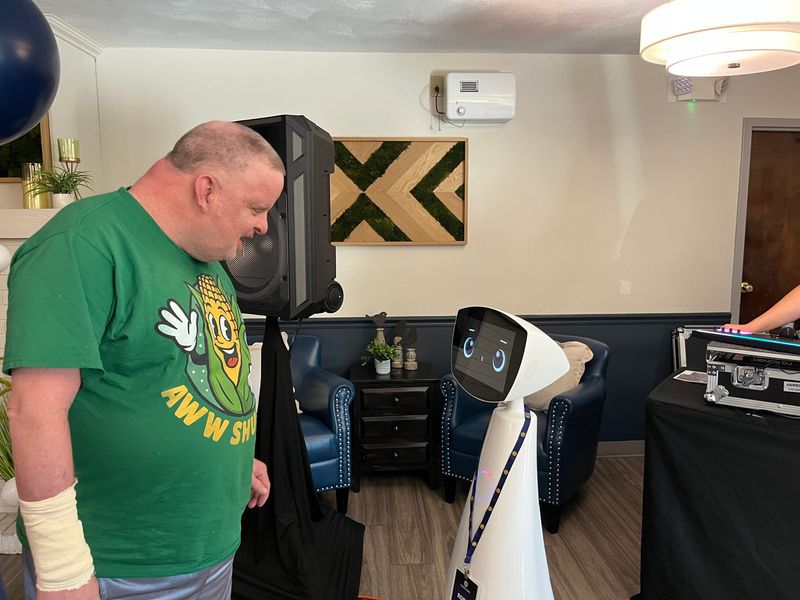
A resident named Doug Rebbert walked up to Robin as she continued her busy day of ingratiating herself to the Clinton House milieu.
“Hi Robin, my name’s Doug,” he said, a bit apprehensive.
“Hello!” the robot squealed. “How are you?”
After a pause in conversation, Robin paid a compliment.
“I like your shirt, by the way, it’s very cool,” she said, apparently noticing Rebbert’s green T-shirt displaying a smiling ear of corn and reading “Aww shucks.”
“I love you!” she said, her googly eyes wiggling slightly. “Aw,” Rebbert replied, “I love you too, Robin.”
“Aw, thank you so much, you make me blush,” the robot said.
Israel Schuman is a reporter for the Journal & Courier. You can reach him at ieschuma@purdue.edu or on X @ischumanwrites.
This article originally appeared on Lafayette Journal & Courier: A childlike robot who remembers faces is set to charm Frankfort nursing home residents
Reporting by Israel Schuman, Lafayette Journal & Courier / Lafayette Journal & Courier
USA TODAY Network via Reuters Connect