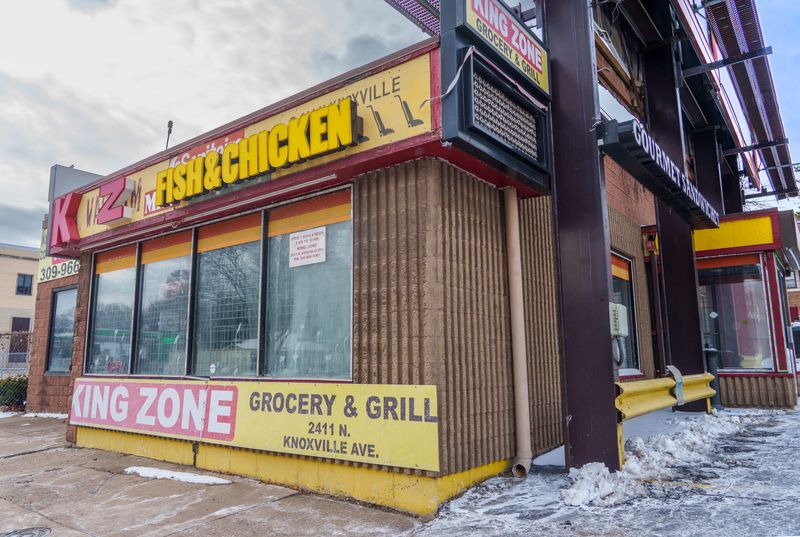
PEORIA — Is a corridor of Knoxville Avenue in central Peoria too dangerous for liquor sales at a convenience store?
That question has the Peoria City Council split and debating the merits of a site approval request for alcohol sales by a Knoxville Avenue business.

The store, King Zone, which operates at 2411 N. Knoxville Ave., is asking the council to give it site approval to sell packaged liquor from the store, which rests between the East Bluff and West Bluff neighborhoods.
On Tuesday night the council, once again, deferred making a decision about whether or not King Zone should be allowed to sell liquor, but it was clear that there will be division among the council.
Those opposed to the sale of liquor at the site, a group of council members that includes Mayor Rita Ali, Bernice Gordon-Young, Mike Vespa and Denise Jackson, said that area of the city is already too rife with crime to introduce packaged liquor to it. They said no business plan should supersede public safety.
The councilmembers who back the business’s request however, which includes Alex Carmona and Tim Riggenbach, whose districts border the store, contend a proposed plan of operation for the site make it a strong candidate for packaged liquor sales.
Ultimately, it was decided Tuesday night to defer the vote once again to allow Carmona, whose 2nd District houses the store, more time to talk to nearby neighborhood groups.
How would liquor sales impact Knoxville Avenue corridor?
Each side of Tuesday’s debate about King Zone spun their own vocabulary about both the nature of the business, some calling it a grocery store, others calling it a liquor store and some a convenience store, and as to whether or not adding liquor to the site would help it grow into an “asset” or be a “detriment” to the community.
Ali, in her argument, cited police statistics, specifically call volumes, which showed that the number of police calls for that area of the city had nearly doubled from 2025 to 2026 year to date. Calls for service in an area within a half mile of the location increased from 876 to 1,654. Ali, and other councilmembers, said that area of Peoria is too dangerous for a packaged liquor store to be approved.
“Why would we want to put a liquor store in this area when the service for crimes has almost doubled?” Ali asked Tuesday night. “I just think if we saw crime going down, maybe consider, but service calls are going up and that’s a serious concern for me.”
The Peoria Police Department and Peoria Liquor Commission both advised the council to deny the request.
Carmona and Riggenbach both said they understood and did not disagree with the concerns about crime in that area but felt that a plan of operation proposed for the business, which would restrict its liquor sales and implement other requirements, would be enough to at least give the business a chance to sell alcohol.
Riggenbach said his first reaction when Carmona brought the idea to him was to vote no, but after hearing that the owner of King Zone had broader plans and a vision to grow the store into more of a grocer rather than a convenience spot, he got on board with giving them a shot.
“We talk about food deserts all the time, and admittedly this is much more of a convenience store right now, but the guy does have milk, eggs, bread, cheese, some of the essentials, cold cuts and he’s got the commitment — Councilman Carmona judiciously did not ask for a written commitment — but his plan is to add produce as well and make this a neighborhood grocery store, if you will,” Riggenbach said. “We all know talk is cheap, but let’s see what he can do.”
At the behest of Carmona, city staff drew up a proposed plan of operations for the business that would restrict how it could sell alcohol. Mainly, the restrictions would include limiting alcohol to just five of the business’s 31 cooler doors, not allowing the sale of individual beer cans or shooters, and also requiring that liquor be kept behind the counter. The business would also have to install cameras that could be accessed by Peoria police and create new lighting for the exterior and parking lot.
Gordon-Young, who currently works as a mental health professional at the Peoria County Jail but used to be a 911 dispatcher for the city, said she remembers receiving lots of calls to that area when she was a dispatcher and also referenced the increase in call volume cited by Ali as a reason she was opposed to the plan.
She, too, pushed back on calling the store a “grocery store” and said “convenience store” is the best description of the business.
“I think the main thing is public safety. I am so concerned about the rise in crime, particularly among our youth and that is an area highly populated with families, with young people, with students,” Gordon-Young said. “And being very honest, I stood there and I looked out the door and I faced Beverly Street and the first thing that came to mind for me was the young man who lost his life right there, and all the years of working as a 911 dispatcher and all the calls I took in particular, and we took, and apparently they are still taking, of violence in this area, I think we have to be very careful.
“I am all for supporting things when they make sense, but this just doesn’t make sense to me to add liquor to this environment,” Gordon-Young continued.
Carmona, who has worked closely with the owner, championed the business for making an array of cosmetic upgrades to the store and also said the business would hopefully grow into an asset for the community.
“I will be the first one to call it out here if it’s not working,” Carmona said. “Everybody has my commitment on that, everybody knows I am a very straight shooter.”
This article originally appeared on Journal Star: Peoria council split on King Zone liquor sales amid crime concerns
Reporting by JJ Bullock, Peoria Journal Star / Journal Star
USA TODAY Network via Reuters Connect