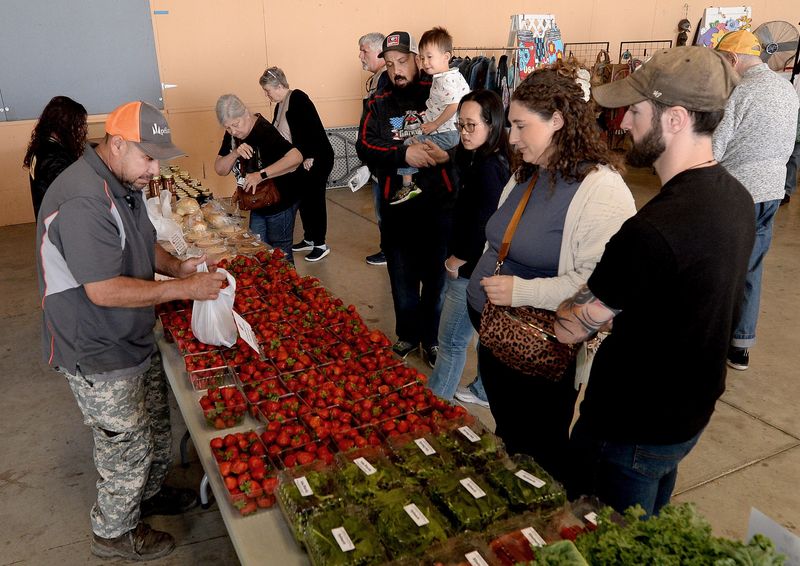
There’s something almost romantic about arriving at a farmers market with a plan, reusable bags in hand, recipes saved on your phone and a carefully organized shopping list. In theory, it sounds responsible and efficient — the kind of thing people who have their lives together probably do every Saturday morning.
And yet, some of the best meals I’ve ever made started the exact opposite way. They started with an unexpected basket of strawberries that smelled too good to pass up, a jar of caramel-colored local honey, tomatoes that looked and tasted nothing like the ones at the grocery store, a vendor offering samples of goat cheese while casually mentioning it would pair well with grilled peaches.

Suddenly, whatever meal plan existed before I arrived no longer mattered. That’s the real magic of a farmers market. The best thing there often isn’t what you came for.
As farmers markets begin filling up again for the season, it’s tempting to approach them like another grocery run. We search for ingredients to complete meals we already decided on days earlier. But markets work differently than supermarkets.
They’re built around seasonality, surprise and inspiration. You don’t always know what will be there because nature doesn’t work from a printed inventory sheet. Some weeks the asparagus is perfect. Other weeks, the strawberries arrive early. There’s a rhythm to it that asks us to pay attention instead of simply checking boxes off a list.
I think that’s why shopping at a farmers market feels so different. It slows us down. You start asking different questions. What looks good today? What’s actually in season right now? What can I make around this instead of searching for one missing ingredient to complete a recipe exactly as written?
Some of the most memorable cooking happens that way. A handful of fresh herbs turns into pasta tossed together at the last minute. Sweet corn becomes dinner because it was too fresh to wait another day. A pie wasn’t planned until you saw peaches stacked in wooden crates.
Even simple recipes like “Grandma Salad,” made with ripe tomatoes, cucumber and onion, become something special when the ingredients are fresh and in season. There’s creativity in that kind of cooking, but also a sense of freedom. It removes some of the pressure to make everything perfect.
Working in culinary education, I see this happen in classes all the time. The students who become the most confident in the kitchen usually aren’t the ones rigidly following every instruction. They’re the ones who begin noticing — tasting, adjusting, trusting their instincts. Farmers markets encourage that same mindset. They remind us that cooking isn’t only about precision or planning.
Of course, a little structure helps avoid buying enough produce for an entire small village, but the best market outings still leave room for spontaneity. Maybe that means buying the bouquet of herbs you weren’t expecting. Maybe it means changing dinner plans entirely because the mushrooms looked too good to leave behind. Maybe it simply means wandering a little longer before deciding what to cook.
The best thing at the farmers market usually isn’t the item on your list. It’s the thing that makes you excited to cook the moment you see it.
“Grandma Salad”
Ingredients
Directions
As the salad chills, the juices from the tomatoes mix with the onion, cucumber and seasoning, creating a light, flavorful dressing all on its own.
Channing Fullaway-Johnson is a culinary coordinator at Lincoln Land Community College.
Lincoln Land Community College offers credit programs in Hospitality and Culinary, and non-credit cooking and food classes through LLCC Community Education.
Cooking or food questions? Email epicuriosity101@llcc.edu.
This article originally appeared on State Journal-Register: How to turn ingredients from the farmers market into magic
Reporting by Channing Fullaway-Johnson, Special to the State Journal-Register / State Journal-Register
USA TODAY Network via Reuters Connect