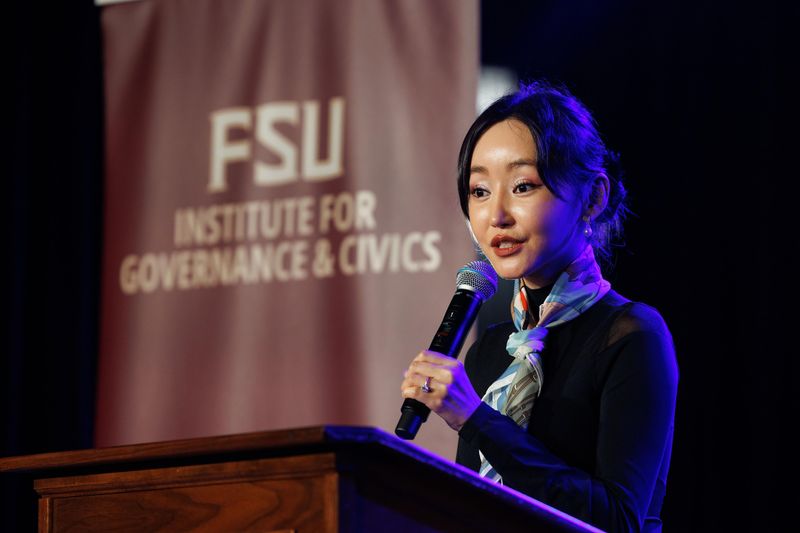
Florida State University’s Institute for Governance and Civics (IGC) hosted activist and public speaker Yeonmi Park at Club Downunder in the Student Union on Feb. 19. Known for her defection from North Korea, Park spoke at the event, which was held in collaboration with the conservative Young America’s Foundation (YAF), an organization with which she is affiliated.

Speaking to a packed room, Park discussed her experiences growing up under North Korea’s authoritarian regime and the challenges she faced after escaping. She talked about the importance of free speech, the dangers of political oppression and her concerns about growing censorship in Western societies to a diverse audience of students, faculty and community members.
“When I was growing up in North Korea, we had 50 castes,” Park said. “They said my genetics are oppressive, so I was in a lower caste. If your great-grandfather fought alongside Kim Il-sung, they said you have revolutionary blood, so you are in the top caste.”
Park and her mother escaped North Korea to China, being smuggled across the border, where the two were separated and sold by human traffickers. Park said this was due to China’s one-child policy.
Park eventually made it to South Korea, where a New York City publisher offered her the opportunity to write about her experiences and facilitated her move to the United States on an O-1 visa, a temporary work visa for individuals who have achieved national or international recognition for extraordinary ability. She then wrote her memoir “In Order to Live: A North Korean Girl’s Journey to Freedom.” Shortly after, she enrolled at Columbia University.
“[Columbia professors] said ‘Look outside, there are billionaires and there are homeless people. That is the reason why capitalism is so evil.’ As a North Korean I heard that like, so you have a right to just chill on the street?” Park said. “Imagine if you decided to do that in North Korea, you decided not to work, not be home and just be on the street. If you decide to do that in North Korea, the government will come. If you’re a girl they’re going to capture you and rape you, and if you’re a guy, they will beat you and send you to work. You have no option not to work.”
In her speech, Park criticized the current state of politics in the United States. She labeled American university culture as privileged, citing ‘wokeism’ and Marxism, in particular, as problematic. She went on to claim that Americans were indoctrinated into believing that capitalism and white men were the source of the only problems in society, and that math was racist, saying this paralleled her education in North Korea.
“Even North Korea didn’t go this crazy, because at least in North Korea they know what a woman is,” Park said.
Institute for Governance and Civics controversy
The event was among the first hosted by the Institute for Governance and Civics (IGC), a newly established university program created by the Florida Legislature that claims to promote and assess civic literacy while fostering public discourse that values diverse perspectives, intellectual rigor and an evidence-based understanding of history.
“University Relations, the Provost’s Office and communications, all of these departments came together and supported us in making this happen,” Lila Seagle, the Associate Director of the IGC, said. “Yeonmi’s story is just so moving and I think it’s just really wonderful for the folks that were born here in the United States, that were just born with so much privilege, to hear what’s happening in other parts of the world. Her story is just really, really moving.”
The IGC has faced some criticism from students on campus, with many taking to social media when it was announced that economist Glenn Loury would hold an event for the IGC titled “The Case for Black American Patriotism.”. A recently deleted post from an anonymous, FSU-based Instagram page garnered attention from students for claiming that the IGC only hires conservatives and invites conservative activists to speak.
“When the majority of your speakers are one ideology and espouse prejudicial views about many of the students FSU is meant to serve, you’re not cultivating civic education, you’re platforming discrimination,” an FSU student said on Instagram. “Stop trying to hide propaganda tactics and bigotry beneath the guise of civic engagement.”
The IGC is run by Director Ryan Owens, a professor of political science and an affiliate faculty in the FSU College of Law. Before coming to Florida State, Owens was a professor at the University of Wisconsin-Madison. In an interview with The College Fix on his move from UW-Madison to FSU for the IGC, Owens said UW-Madison had a “toxic environment for conservatives.”
“[The IGC] will examine the best means of educating and persuading Floridians to understand and apply America’s Founding principles,” Owens said. “As I see it, we have two choices. We can sleepwalk toward national suicide, or we can do our part to rebuild our institutions and watch the sun rise on America once again.”
James V. Shuls is the Head of K-12 Education Reform for the IGC. Shuls contributed to the Phoenix Declaration, which advocates for conservative educational policies. The declaration was produced by the Heritage Foundation, which organized the notorious conservative initiative Project 2025.
Beyond Yeonmi Park, the IGC has a lineup of upcoming guest speakers including Glenn Loury; President and CEO of the National Constitution Center Jeffrey Rosen discussing how the Founding Fathers were influenced by concepts like virtue; Charles C.W. Cooke, a senior writer at the National Review, and D’Alemberte chair in constitutional law at FSU Alexander Tsesis discussing free speech and misinformation; Beth Akers from the American Enterprise Institute addressing “The Economics of Higher Education”; and Jess Bravin, a Supreme Court reporter for The Wall Street Journal, alongside Editor-in-Chief of The Federalist Mollie Hemingway, as part of a panel on religious liberty.
This article originally appeared on FSU News: Yeonmi Park speaks at FSU: North Korean defector warns of censorship and oppression
Reporting by Jacob Rampino, Staff Writer / FSU News
USA TODAY Network via Reuters Connect