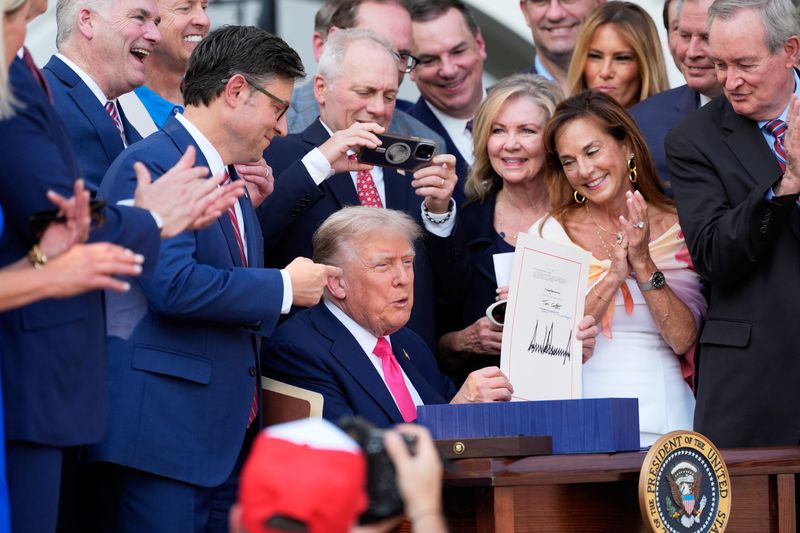
On July 4, 2025, a 51-50 vote by the United States Senate passed the One Big Beautiful Bill Act (OBBB) into law. The massive tax and spending package, which was formally introduced to the United States House of Representatives by Jodey Arrington (R-TX) on May 20, 2025, contains hundreds of provisions that delineate federal spending and tax policies that coincide with President Trump’s second term.

Many measures of the bill took immediate effect and have already garnered attention from members of Congress and people across the country. A few of the most notable actions include significant funding cuts to programs such as Medicaid, SNAP Benefits and public media outlets, including the Public Broadcasting Service (PBS) and National Public Radio (NPR).
The OBBB Act also introduced changes to higher education. Here’s how students can expect the new policies to impact their education and finances.
Federal student loans
For students who rely on federal loans to pay for their tuition, there is now a lifetime cap of $257,500 per person for all undergraduate and graduate level education.
For parents who rely on Parent PLUS, a program where the legal guardians of dependent undergraduate students can borrow money to pay for education, there will now be an annual cap of $20,000 per person. Before, the loans met the full cost of student attendance. This limit will go into effect on July 1, 2026.
The Grad PLUS loan program, which many graduate students rely on, will be eliminated completely on July 1, 2026. Graduate students will still be able to take loans of $20,500 annually, with a lifetime cap of $100,000.
Professional students will be able to borrow $50,000 annually, with a lifetime cap of $200,000. However, given that the average four years of medical school can cost up to $260,000, many students are contemplating whether they will be able to afford completing their education.
Borrowers may increases up to “hundreds of dollars per month” for repayments, according to the Student Borrower Protection Center. Private student loan organizations are expected to see a rise in popularity, but many analysts warn against using them, as they tend to come with fewer options for repayment and higher interest rates in the long run.
Loan repayment
There will also be changes to student loan repayment options. Previously, there were seven plans to choose from: Standard Repayment, Extended Repayment, Graduated Repayment, Income-Based Repayment, Income-Contingent Payment, Pay As You Earn and Saving on a Valuable Education.
The options have now been reduced to two: the Standard Repayment Plan and the Repayment Assistance Plan (RAP).
The old Standard Plan relied on fixed payments, giving borrowers 10 years to repay loans. The revised Standard Plan may give some the option to pay off their loans over the course of 15 to 25 years, with the monthly repayment amounts being lower. However, this also means that borrowers will have to pay more in interest over time.
The revised Repayment Assistance Plan serves as an alternative to the revised Standard Plan, and now gives borrowers up to 30 years to repay their loans. It looks at the Adjusted Gross Income (AGI) of the borrowers, whereas before, income plans used discretionary income to calculate monthly payments. Additionally, any debt that is forgiven after Dec. 31, 2025, is now taxable.
Pell grants
The Pell Grant is a type of federal aid awarded by the U.S. Department of Education to eligible low-income students to assist them in funding all aspects of their education, including tuition, room and board.
While the spending package expanded the program to cover various job training programs for low-income students to help prepare them for their careers, it also changes the eligibility for the grant: beginning July 2026, full-ride scholarship students will not be able to receive Pell Grants.
“President Trump’s One Big Beautiful Bill is a historic win for students, families and taxpayers,” Acting Under Secretary James Bergeron said in a statement.
“The OBBB delivers for student borrowers in a big way – simplifying the student loan repayment system, funding the $10.5 billion shortfall in Pell Grant funding left by the previous administration, supporting short-term career focused programs that train workers for in-demand jobs and holding colleges accountable by eliminating student loan eligibility for programs that leave students worse off than if they had never enrolled,” Bergeron said.
Members of organizations like the National Education Association (NEA) view the change differently.
“This budget is a direct attack on the very people our public institutions are meant to lift up,” NEA President Becky Pringle said in a statement. “Instead of investing in our children’s education, as well as their health and their future, this law hands billions in tax breaks to the ultrawealthy—while pulling the rug out from under America’s students and families.”
Taxes on college endowments
A college endowment is an aggregation of money that a university acquires, mainly through donations from alumni and foundations. This money is used for maintenance of the campus, funding salaries, research and more. It is a type of permanent investment fund, meaning that the money cannot be easily accessed in the same way as it would be from a checking or savings account.
Under the Tax Cuts and Jobs Act (2017), a 1.4% excise tax was put on qualifying private colleges, regardless of the endowment per student. With the OBBB Act, colleges will now be taxed by tier, in accordance with their endowment per student.
Colleges with $500,000-$750,000 endowments will have a 1.4% tax, colleges with $750,000-$2 million endowments will have a 4% tax and colleges with more than $2 million endowments will be charged 8%.
Although Florida State University’s endowment sits at $869 million, it is tax-exempt as FSU a public university.
Organizations like the Joint Committee on Taxation say that this new tiered taxing is projected to raise $761 million over the next 10 years. Some argue that this is a positive thing, as the funds could be directed towards things like scholarships, public education and other academic endeavors.
However, others contend that these taxes could hurt private institutions by leading them to raise tuition, reducing the amount of financial aid students receive, damaging the global competitiveness of these universities and making it harder for low-income students to access them.
Opponents of the OBBB Act claim that it is intentionally designed to prevent civic engagement.
“Most students don’t have the time and energy to read a bill that’s hundreds of pages long, and our legislators know that,” President of College Democrats at FSU Madalyn Propst said. “[Legislators] are going to continue to hide the worst of the effects in small print so that those who are the most affected won’t know.”
As the bill’s provisions take effect over the coming year, its true impact, both financial and educational, will be revealed.
This article originally appeared on FSU News: What One Big Beautiful Bill Act means for student finances
Reporting by Aila Seaman / FSU News
USA TODAY Network via Reuters Connect