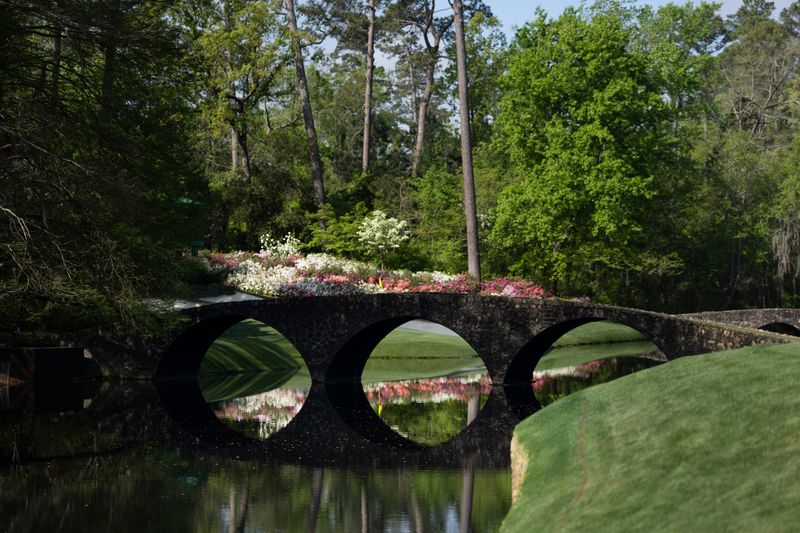
Consider this your every-so-often tutorial about Rae’s Creek, which has starred in more Masters Tournaments than anyone this side of Mr. Butler’s Cabin or Ike’s Tree (R.I.P.).
And as the focal point of Amen Corner, it will star again this coming weekend, one way or another. Guaranteed.

Also, it’s always fun to ponder, and maybe even rue, what could’ve been if the long-ago land surveyor had played a little too fast and loose with the ol’ Gunter’s Chain (“80 chains to a mile? I thought you said 90!”).
And here’s another ponder we’ll cover: What if Bobby Jones and Clifford Roberts had stuck with the original layout? Augusta National’s 10th through 18th holes were originally the opening nine, in which case the famed/infamous creek would be little more than an early-round irritant. After the first Masters in 1934, the nines were reversed.
As for branding, what if Irish lad Johnny Rae had stayed in County Down back in the 1700s, instead of coming west, settling in Augusta and becoming a community pillar. The 10-mile stream might still be known as Kenyons Creek.
With Rae’s Creek as in all real estate: Location, location, location
Let’s start with some basics that are often misplayed.
The only place — yes, only — Rae’s Creek meanders on Augusta National grounds is from behind the 11th green, past the front of the 12th green, before departing in front of the 13th tee and continuing on to an undramatic dead-end near Interstate 20.
Way back before Bobby Jones and Clifford Jones bought the 365-acre Fruitlands Nursery in the early 1930s, Rae’s Creek served as a loose boundary between the nursery and the adjoining golf course, Augusta Country Club, which sits on land once known as Arthur Brainard’s farm.
Yes, a loose boundary. The surveyor’s layout divided the properties a tad south of the creek instead of using the creek itself, which might’ve been the natural move. Years later, that smidge of separation would allow the famous Augusta National draftsman, Alister MacKenzie, to plant a par-3 green behind John Rae’s stream.
That par-3 would eventually be regarded as the greatest one-shotter in all of championship golf. Of all the what-ifs out there, imagine if Rae’s Creek crossed behind its green instead.
Turns out, John Rae still has a lot of pull
Some 70 tributaries splinter from the creek during its 10-mile trek through Augusta. Among them is the stream running down the left side of the par-5 13th before turning right, passing across the front of the green and occasionally breaking hearts.
You’ll often hear it called Rae’s Creek. Impress your friends by explaining it’s only a tributary, though one demanding tribute at inopportune times.
While the tributary has drowned many pounds of flesh over the decades, it’s the actual Rae’s Creek that not only affects outcomes directly, but indirectly, employing a gravitational pull that’s damn near lunar.
And this is where we guarantee the creek’s effect on the next few days’ play.
That area on Augusta National’s southern boundary, specifically where Rae’s Creek passes behind the 11th green, is the lowest point on the course’s property — as happens everywhere with bodies of water.
Golf balls, like water, are drawn to downhill treks. Rae’s Creek isn’t unique in this, but a big part of its lore is its pull. “Everything breaks toward Rae’s Creek” is one of those other statements that can make you sound smart in front of friends.
Flat putts are inclined to drift southward toward the course’s low point, and putts breaking away from it don’t break quite as much. And not just on that part of the course, but through all 18 holes. It’s a brand new world out there in so many ways, but the laws of gravity are hanging in there.
Come Sunday, Rae’s Creek will take on a more direct impact on proceedings. Of all the annual gifts this week brings, among the best is the scene of contenders and their caddies on the 12th tee, staring at the tree tops, the nearby flags, anything, searching for clues as to whether the fickle winds will help or hurt a short shot with major implications.
That’s when we can thank the heavens that Arthur Brainard’s surveyor didn’t take the easy way out, instead leaving that creek, and its spanning Hogan bridge, as one of golf’s most enduring hurdles.
— Email Ken Willis at ken.willis@news-jrnl.com
This article originally appeared on The Daytona Beach News-Journal: What is Rae’s Creek? Here’s a Masters history lesson on Augusta course
Reporting by Ken Willis, Daytona Beach News-Journal / The Daytona Beach News-Journal
USA TODAY Network via Reuters Connect