Astronauts on the Artemis II mission will head around the moon today, Monday, April 6, coming about 5,000 miles from the lunar surface.
As they do their lunar flyby, they’ll see the dark side of the moon, seeing sights never before seen.

On Easter Sunday, the crew entered the lunar sphere of influence, where the pull of the moon’s gravity is stronger than the pull of the Earth’s gravity.
At 5 a.m., the four astronauts aboard the Orion capsule were just over 31,000 miles away from the moon and more than 238,000 miles away from Earth. The mission puts them farther in space than anyone in human history.
This mission paves the way for a moon landing as early as 2028.
NASA will live stream events on this historic day. Here’s how to watch.
NASA live stream: When will Artemis II moon mission fly around the moon?
NASA has a livestream providing continuous coverage of the Artemis II mission.
The stream includes commentary in real-time.
A separate stream will start at 1 p.m. April 6 of the lunar flyby on NASA’s YouTube channel.
USA Today live stream of Artemis II lunar flyby today, April 6
Artemis II tracker: Follow moon mission with live updates
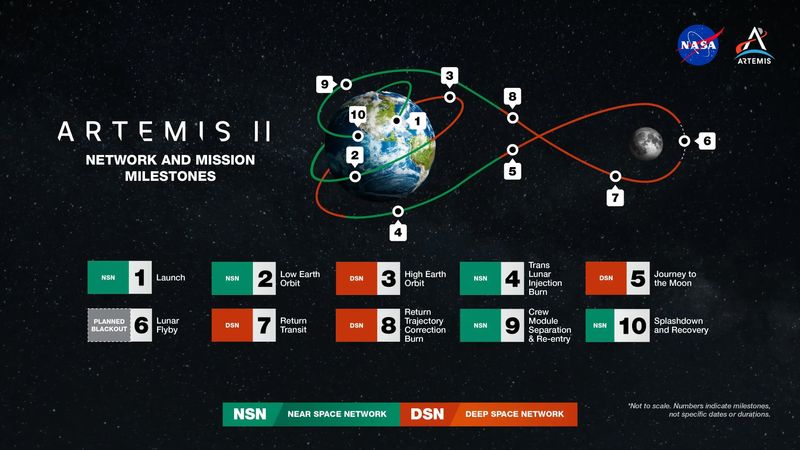
NASA has an online tracker for Artemis II available on desktop and as a mobile app, which allows users to see where the Orion spacecraft is, how fast it’s traveling, and how many miles it is in real time from both the Earth and the moon during its 10-day mission toward and around the moon, according to NASA.
The desktop version of the “Artemis Real-Time Orbit Website” (or AROW) includes key mission milestones and characteristics about the moon, including information about landing sites during the Apollo era. The mobile version included in NASA’s app adds an augmented reality feature that allows users to move their phones to see where Orion currently is, relative to Earth.
➤ Download the app here: Apple App Store | Google Play
The data is collected in real time by sensors on Orion and then sent to the Mission Control Center at NASA’s Johnson Space Center in Houston. That information has been updated since one minute after liftoff and will continue until Orion begins its reentry into Earth’s atmosphere.
What will Artemis II crew do today, April 6? Moon flyby!
Plans for Monday include the highlight of the mission, the lunar flyby:
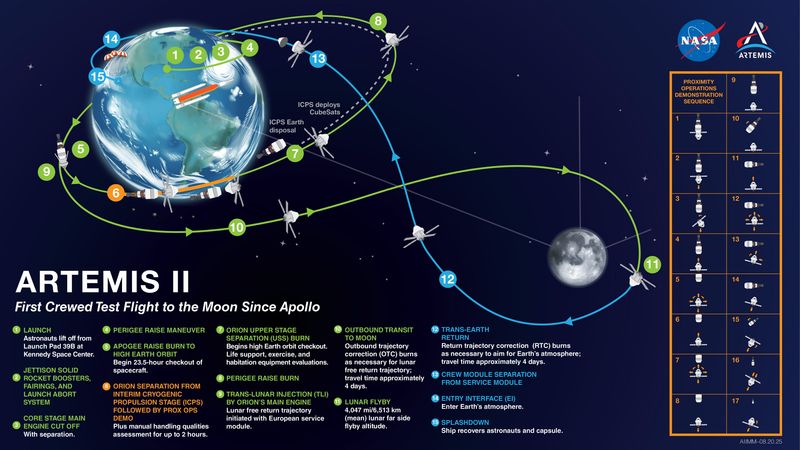
If all goes according to schedule, Artemis II is due to reach the moon and make a historic lunar flyby.
Flying between 4,000 and 6,000 miles above the moon’s surface, the crew is expected to lose communication with the Earth for anywhere from 30-50 minutes.
For about six hours, they will take photos and video of the moon’s far side and make observations to be shared with scientists on the ground after they regain communication.
When will Artemis 2 mission reach back side of the moon?
“After the TLI (translunar injection) burn that sent Orion on its path to the moon, the lunar science team began building a Lunar Targeting Plan, a guide to what the crew will look at on the moon’s surface during its approximately six-hour observation on Monday, April 6,” according to NASA.
The plan includes:
Solar eclipse offers fresh perspective of moon during Artemis II mission
“During the eclipse, the sun will be hidden from view as it moves behind the moon from the perspective of Orion,” NASA said.
“The crew will see a mostly dark moon at this time — an opportunity for them to look for flashes of light from meteoroids striking the moon’s surface, dust lofting above the edge of the moon, and deep space targets, including planets.
“While the sun slides behind the moon, the crew will observe the solar corona, the sun’s outermost atmosphere, while it’s visible.”
When will astronauts return to Earth?
The Orion capsule is expected to reenter Earth’s atmosphere Friday, April 10 − its service module responsible for propelling and maneuvering the vehicle through space will separate and burn up.
That maneuver exposes the crew module’s heat shield, protecting the astronauts from the 3,000-degree Fahrenheit conditions the vehicle will endure.
Orion will then make a parachute-assisted water landing estimated for Friday, April 10, in the Pacific Ocean near California off the coast of San Diego.
After the landing, the Artemis II crew would exit the vehicle on to a U.S. Navy recovery vessel.
Want more? Follow NASA on social media
Get the latest imagery and live updates from the Artemis II mission at:
See photos from Artemis II moon mission
What is the mission of Artemis II?
Under its Artemis campaign, NASA intends to return astronauts to the surface of the moon for the first time since the Apollo missions came to an end in 1972.
NASA is planning to establish a permanent foothold on the lunar south pole, using a series of crewed and uncrewed missions in the years ahead to build a moon base.
From there, the first humans could head toward Mars.
The 10-day mission primarily serves as a test flight, with the four-person crew testing systems and hardware ahead of a future moon landing.
When will we land on the moon?
In 2027, another crew of astronauts is due to ride Orion to Earth orbit to test docking capabilities with one or both of the commercial lunar landers being developed by Elon Musk’s SpaceX and Jeff Bezos’ Blue Origin.
A lunar landing would then come in 2028 under Artemis IV.
Will Artemis II return to Florida?
No. When they return to Earth, the astronauts in the Orion capsule will make a parachute-assisted water landing in the Pacific Ocean near California.
Meet the Artemis II crew
Watch Artemis II lift off from Kennedy Space Center, Florida
The four crew members of Artemis II are:
Watch some rocket launches with NASA+ on Prime Video
Watch NASA+ content with Amazon Prime Video
NASA content, including some rocket launches, is available to watch through NASA+ on desktop, both from its official site and YouTube. The platform is also available to download as a mobile app on smartphones.
All NASA+ content is also available to those who have Prime Video downloaded on any of their devices – whether it be a smartphone or smart TV.
The content, which does not require a Prime subscription to view, is one of Prime Video’s FAST channels (free ad-supported television). Viewers can find it under Prime’s Live TV section at the top of the screen when they open the app.
Contributing: Brooke Edwards, FLORIDA TODAY
Cheryl McCloud and Eric Lagatta are journalists for the USA TODAY Network-Florida’s service journalism Connect team. You can get all of Florida’s best content directly in your inbox each weekday day by signing up for the free newsletter, Florida TODAY, at https://floridatoday.com/newsletters.
This article originally appeared on Florida Today: Watch live stream of Artemis II moon mission during lunar flyby today
Reporting by Cheryl McCloud and Eric Lagatta, USA TODAY NETWORK – Florida / Florida Today
USA TODAY Network via Reuters Connect