Seven Palm Beach County sheriff’s officers are assigned to patrol the small, tony town of South Palm Beach. In all of 2024, they investigated one violent incident — a robbery.
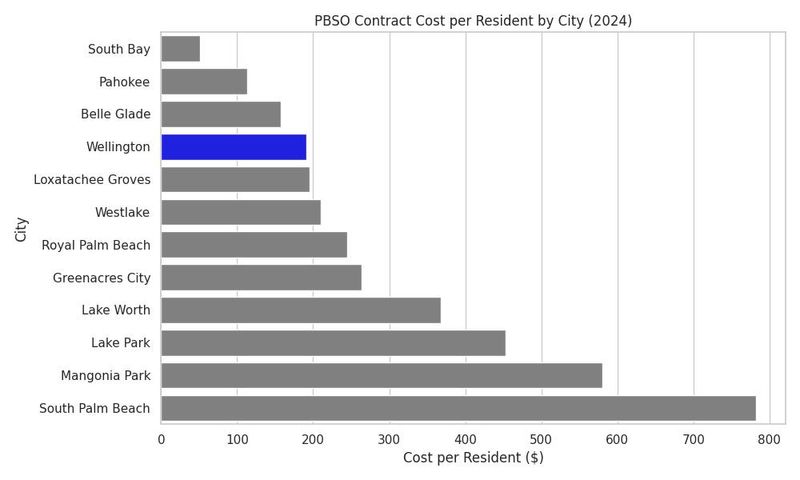
Yet the small coastal town of a tenth of a square mile with 1,500 residents paid about $1.1 million to the sheriff’s office for designated patrols that year, or $162,000 per PBSO employee. It also paid $762 per resident, again the most of any of the 12 towns that contract with PBSO for police protection.

Instead of paying for their own police departments, municipalities like South Palm Beach negotiate with PBSO for designated patrols. The agency will collect over $61 million from them this fiscal year.
The list of other communities that contract their police services from PBSO includes Greenacres, Lake Worth Beach, Mangonia Park, South Bay, Wellington, Westlake, Lake Park, Pahokee, Royal Palm Beach, Loxahatchee Groves and Belle Glade.
Years of experience in budgeting and PBSO protection show the arrangement has been successful from both a fiscal and public safety standpoint, officials at the towns say. But administrators in some of the municipalities also point to another realization — it’s unclear just how PBSO decides just how much each town should pay for its services.
What factors guide Sheriff Ric Bradshaw’s decisions on what to charge? Is it the number of deputies assigned, the crime rate, the population? He does not say.
“It is like a code that is impossible to break, no matter how hard you try,” said Jamie Titcomb, town manager of South Palm Beach. “Having said that, we are pleased with the service PBSO provides and there’s no question that we could not do it on our own for anywhere close to what we are paying.”
In a statement, PBSO said each town is charged based on a variety of factors and features singularly related to those jurisdictions.
“Each contract is tailored to meet the specific operational needs of the jurisdiction. Because those needs vary, no two contracts are the same, and deployment details are not discussed,” according to PBSO spokesperson Therese Barbera, who was asked about the methodology used.
Nonetheless, some frustration with PBSO’s nebulousness exists.
Loxahatchee Groves, upset with what it called the lack of transparency, took the unprecedented step this year of breaking its contract with PBSO. The town of 3,400 people said the annual $680,000 fee was too much and that the money could be better spent on infrastructure.
The town concluded that its crime rate was so low that it was not necessary to have designated patrols. PBSO is still obligated to respond to calls for service in the town even without a patrol contract, but Bradshaw has said that response times will depend on available resources.
How The Post researched this story
The Post filed a public-records request with the Palm Beach County Sheriff’s Office to obtain the 12 contracts related to designated patrols.
It then developed a spreadsheet comparing costs both per deputy and per resident. The data was shared with the municipalities; many of whom said they had been unable to obtain the information from PBSO.
Village of Wellington Town Manager Jim Barnes, for example, said he had never seen what all of the other towns are paying for law-enforcement protection.
Many of the contracts reviewed by The Post were 50 or more pages. The contracts detailed how many supervisors, deputies and crossing guards are provided, but there is no breakdown for what the cost is for those positions. Only a lump-sum figure is included.
Among the findings:
Some officials in towns that contracted PBSO said they were pleased with the services the agency provides.
“The evidence strongly suggests that Wellington residents receive a premium level of law enforcement service at a significantly discounted rate compared to the regional average,” Barnes said after reviewing The Post spreadsheet. “As the most populous city (62,000) among those that contract for police protection, it manages to maintain a low per-capita cost while sustaining high service levels.”
For example, Barnes noted that Lake Worth Beach serves 20,000 fewer residents than Wellington but pays $3.4 million more annually for its contract. Similarly, the city of Greenacres serves 17,500 fewer residents but pays nearly the same total contract amount as Wellington.
Barnes, like other city managers, though, was critical of PBSO for submitting budgets that lacked the type of detail that their own city departments provide.
Bradshaw does not provide line-item budgets, which would make it easier for taxpayers and municipal officials to analyze. His billion-dollar plus budget submitted to county commissioners last year also was not presented in a line-item format.
Despite topping out the list, the newly elected mayor of South Palm Beach, Rafael Pineiro, said he sees the budget item as a necessity, noting there is “zero appetite for a reduction in police services.”
Pineiro said that the cost is about what the town spent when it had its own police force. The PBSO contract, he said, allows the town to avoid unnecessary capital expenditures for a police station building and for police cars.
Palm Beach County towns would like more data on how PBSO charges for public safety services
The Palm Beach Post shared its research with many of the municipalities that contract with PBSO for special patrols.
Barnes, the village manager in Wellington, used the spreadsheet to develop its own graphics to show that his municipality is one of the winners in what it is charged for the designated patrols. But both Barnes and Titcomb said they intend to press Bradshaw for more details concerning how he determines what should be charged for police protection.
The annual fees range widely. Mangonia Park pays $114,000 per PBSO employee; Bell Glade $39,000 and Pahokee $37,000. Mangonia Park Town Manager Ken Metcalf said the review by The Post raises some questions as to how these figures are arrived at.
“I’d like to know why we are paying so much more for services than other towns,” he said.
How do other Florida sheriff’s handle such contracts?
Municipalities contracting law-enforcement services from county sheriffs is common across Florida. But there are also discrepancies in how those sheriffs bill cities and towns to which they provide public safety services.
For example, the Pinellas County Sheriff’s Office contracts with municipalities within the Tampa Bay area county.
The contract with Madeira Beach, for example, breaks out costs per deputy, per school crossing guard and per vehicle.
The contract even breaks out a charge for indirect costs that includes fees to help pay for insurance, administration and IT.
Such specificty is lacking in the PBSO contracts.
PBSO-Loxahatchee Groves contract dispute watched by others
Loxahatchee Groves’ exasperation with what the town says is PBSO’s lack of clarity in contracts boiled over in December when PBSO pulled deputies from Loxahatchee Groves following the town’s withholding of payment over a contract dispute for police services.
The town called on PBSO to renegotiate the $680,000-a-year contract; PBSO refused and has now reverted to baseline countywide service — which means PBSO will immediately respond to 911 emergency calls but ended dedicated patrol coverage.
Former Loxahatchee Groves Councilman Todd McLendon said one of the reasons he led the fight to withhold payment was that he could not get an answer from Bradshaw on how he determined what his town should pay for the five deputies assigned to Loxahatchee Groves. McLendon noted his town paid $136,000 for each of its five deputies.
“I tried repeatedly, for example, to get details on response times,” McLendon said. “They would not provide it. And I don’t understand why the cost per deputy varies so much from town to town.”
Other towns have been closely monitoring the dispute.
Lake Worth Beach spends $15.2 million on law-enforcement protection — the highest in the county. In all, 140 employees are assigned to the city of 41,000 residents. Wellington, which has about 20,000 more residents, has just 74 PBSO employees. Lake Worth Beach is billed for 12 dispatchers: Wellington and Greenacres are not.
McLendon argues that residents of Loxahatchee Groves were paying twice for police protection, once through the county budget and again for the special patrols he believes were unnecessary.
McLendon was recently defeated in March when he sought another term on Town Council. He blames Bradshaw, in part, for the defeat.
A PBSO detective, Cassana Kovacs-Suchy, resides in Loxahatchee Groves. She supported McLendon’s opponent, using social media to campaign against him, according to McLendon.
McLendon claims many of the social posts were made during working hours, McLendon said, adding: “This was a case of her working to protect her employer.”
Kovacs-Suchy hung up on a reporter when asked to respond to McLendon’s claim.
In a text, Bradshaw said PBSO employees, like any other worker, is afforded the right to weigh in on choosing the leaders in the town within which they reside.
“I have no knowledge of any political activity involving PBSO employees,” Bradshaw wrote. “Like all citizens of this country, employees of the Palm Beach County Sheriff’s Office have the right to participate in the political process during their off-duty time.”
Mike Diamond is a journalist at The Palm Beach Post, part of the USA TODAY Florida Network. He covers Palm Beach County government. You can reach him at mdiamond@pbpost.com. Help support local journalism. Subscribe today.
This article originally appeared on Palm Beach Post: Towns happy with PBSO protection, but contract details a mystery
Reporting by Mike Diamond, Palm Beach Post / Palm Beach Post
USA TODAY Network via Reuters Connect