Editor’s note: This story originally ran in Eliot Kleinberg’s Palm Beach Post Florida Times column as the first of a four-part series in 2019. It has been edited and broken into five parts for this go-round.
Did you know Palm Beach County was carved out of Dade County in 1909? Yes, and part of Palm Beach and Dade counties became Broward County in 1915. And a northwestern portion of Palm Beach County became Okeechobee County in 1917.

That’s just a snippet of how county lines were drawn, but what about their names? We’re diving into the origins of Florida’s county names, but the list of counties is too long for one column. We’ll be taking them in batches in alphabetical order for the next month. Let’s get started.
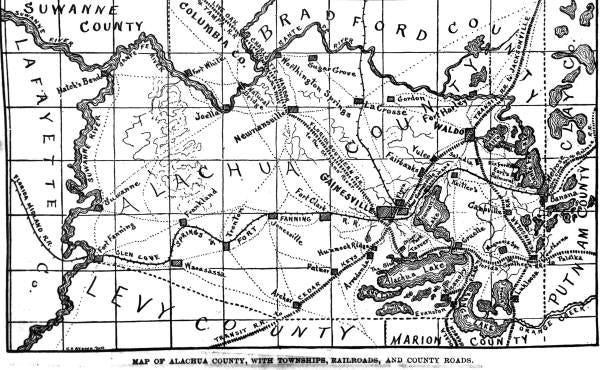
Alachua (1824): Pronounced uh-LATCH-oo-ah. (Some say uh-Latch-oo-ay for the city within the county.) A Muskogee or Timucua word for sinkhole. Historians say it might have referred to a large one near Gainesville.
Baker (1861): James McNair Baker was a Confederate senator.
Bay (1913): Named for St. Andrews Bay. It’s one of three counties named for bodies of water (Gulf, Lake).
Bradford (1861): It was New River from 1858 to 1861 but then was named for Capt. Richard Bradford, who died Oct. 9, 1861, at the Battle of Santa Rosa Island. He was the first Florida Confederate officer killed in the Civil War.
Brevard (1855): It was St. Lucie from 1844 to 1855 but then was named for Dr. Ephraim Brevard, writer of the Mecklenberg (N.C.) Declaration of Independence, or Theodore Washington Brevard, Florida’s comptroller in the 1850s. St. Lucie County later formed a little farther south.
Broward (1915): Napoleon Bonaparte Broward, governor from 1905 to 1909, earned fame, or infamy, depending on your perspective, by going full-throttle on drainage of the Everglades.
Calhoun (1838): John C. Calhoun was a U.S. Senator from South Carolina and a strong advocate of states’ rights.
Charlotte (1921): It might be a corruption of Calusa, the primary native group in the area. It’s believed English mapmakers later claimed it for Charlotte Sophia, wife of King George III.
Citrus (1887): The most ironic name; it now has no citrus! Well, mostly none. The industry flourished there in the 1880s, but a series of hard freezes over the next decade wiped out groves and drove growers south.
Clay (1858): For Kentucky U.S. Sen. Henry Clay. If not for his Compromise of 1850, historians say, the Civil War might have started a decade earlier.
Collier (1923): By early 1923, New York ad executive Barron Collier owned almost 70% of southern Lee County. Lee was responsible for part of the Tamiami Trail to Miami. Collier, frustrated at the pace of the trail’s construction, used his clout to help push through legislation splitting off Collier, to get more control over improvements in southwest Florida, which in turn helped his financial interests.
Columbia (1832): For Christopher Columbus and/or for the ensuing lyrical name for America. One of three county names with themes from the American Revolution (Liberty, Union).
Next week: Dade to Hendry.
Eliot Kleinberg is a former staff writer for The Palm Beach Post and the author of numerous books about Florida and its history.
This article originally appeared on Palm Beach Post: The origins of Florida’s county names, from Alachua to Columbia
Reporting by Eliot Kleinberg, Special to the Palm Beach Post / Palm Beach Post
USA TODAY Network via Reuters Connect