Think about the most annoying flying insect in Florida and most residents would probably say mosquitoes. But lately it’s a much smaller pestering nuisance that’s got people swatting, sweating and seething.
With summer officially beginning on Sunday, June 21, gnat populations have already been surging in the state’s sweltering, humid conditions and across the South.

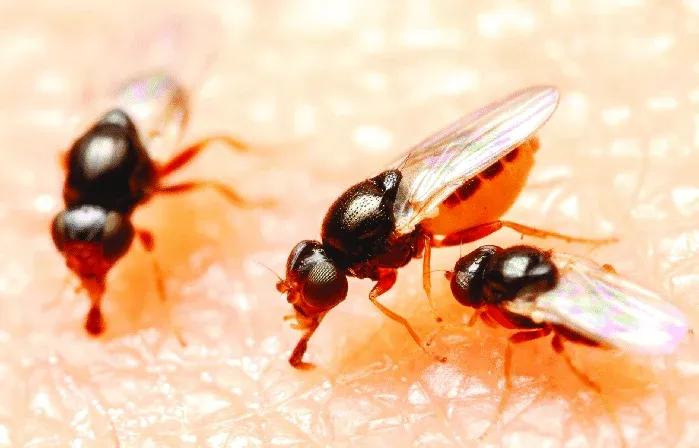
“These non-biting pests are attracted to fluids secreted by the eyes, nose and ears on both humans and animals. …. Because of their propensity for hovering around the eyes, this genus has been referred to commonly as eye gnats,” according to “Eye Gnats, Grass Flies, Eye Flies, Fruit Flies Liohippelates spp.,” published by Erika Machtinger and Phillip E. Kaufman for the University of Florida Institute of Food and Agricultural Sciences.
Their life cycle can range from 11 days to three months depending on conditions such as temperature and moisture. Development from egg to adult is completed in about three weeks during the summer in Florida and multiple generations can occur each year, according to the article.
“Breeding sites are primarily those with freshly disturbed soil mixed with organic matter, such as cut grass and hay, and moisture,” the authors wrote. “Disturbances can be caused by digging, plowing, harrowing or even by livestock activities.”
A Q&A on those pesty little gnats
Someone else who knows all about the tiny antagonists is Nathan Burkett-Cadena, associate professor, mosquito ecology and biology of disease hosts, for the Department of Entomology and Nematology, UF/IFAS. He spent some time answering questions for the Times-Union and its readers.
Most people tend to talk about how bad mosquitoes are in Florida, but what about the gnats? Am I and others imagining that gnats seem to be more prevalent this year?
We are getting into gnat season. I haven’t noticed the gnats being worse this year than they are in previous years. What tends to happen is all of a sudden there are a bunch of gnats, and the week before there were no gnats, so it seems like you’re being swarmed by gnats because you’re comparing it to no gnats from just recently.
How can they zone in so fast on a person once they step outside? What are they after and why does it always seem to be by my face and ears?
The ones that are just flying around your face and annoying you [not actually biting you]… are what we call eye gnats, one common name for that group of flies. They feed on the secretions from our tear glands that come out around eye sockets. They smell that as their food source, and so for you that might be like smelling a hamburger or smelling your neighbor grilling four or five houses away. … Basically the secretions from our tear glands are that attractive to those flies and they can fly straight to your face and try and lap them up.”
So eye gnats are not actually biting though, right? How can they cause pink eye and whatever else?
In the world of medical entomology, which is the field that I am deeply immersed, we call those mechanical vectors, versus biological vectors which are things like mosquitoes and no-see-ums that actually pierce the skin and drink your blood. They’re mechanical vectors in the way that they’re sort of passably carrying infectious fluids on their body, particularly their mouth parts and their legs.
Our eyeball is much bigger than them, so they land on our flesh surrounding the eye and they walk around and they get their little feet, which we call tarsi, and their mouth parts basically covered in the fluids being secreted from our eyes and skin. Those secretions have the bacterium that causes pink eye for example in it.
Well, they can fly to another human being and if they land on that person and then walk around their eye or the tissue around it, they can just sort of passably transfer those bacteria from an infected person to an uninfected person. Just like if you had pink eye and you wiped your finger in your eye and then you touched someone else, you would transfer that bacterium just like that.
It usually seems to be just one pestering gnat at a time, unlike a swarm, is that natural or accurate?
How would you know? They’re small enough that they may have one that flies in and pesters you for a second and then it flies away, and then you may have a different one. … You may be surprised and find that there are actually a bunch of them flying around, and what you’re mistaking for one fly is actually a bunch of them which are hanging in your area.
Where do they come from, I would typically think ponds or standing water, but I read something about sandy or disturbed soil?
Every species of mosquito and no-see-um has very particular larval habitats. … I’m no expert in where eye gnats are developing. I would be willing to bet that mostly it’s going to be muggy areas because flies in particular like wet areas. Their larvae are not very resistant to drying out. Most flies, I’m not going say all flies, are very susceptible to dry environments. So I would guess it’s some kind of muggy area with wet and rotting grass or fruits and that sort of situation.
How can you keep them away from your property or yourself when you’re outside?
I don’t think we can. DEET, which we use as a mosquito repellent, does not work because DEET it is a contact anesthetic which doesn’t really repel mosquitoes. It just prevents mosquitoes from detecting a good site to bite you on. It doesn’t actually repel mosquitoes, but when a mosquito lands on you, it prevents that mosquito from being able to determine where’s a good spot to bite, so the mosquito leaves and ends up going to somebody else that’s not wearing DEET.
So DEET doesn’t work for things like eye gnats because they’re not looking for a spot to bite. The sorts of things that are used for no-see-ums like essential oils or Skin So Soft that are sometimes considered to be effective for deterring no-see-ums also, as far as I know, don’t work for eye gnats. I don’t know of any research in particular that’s ever been done to look at repellency of eye gnats. If it has been done, it’s most likely been done in Africa where eye gnats can transmit some debilitating diseases.
Are they more interested in people or animals?
I think it doesn’t matter. As long as it’s an animal that’s producing these lacrimal secretions, that the eye gnat is going to fly around those animals and look for its meal. … So I don’t think they prefer human beings to any extent at all. There’s just a lot of them out there, so there’s plenty to go around.
Can you compare the size of a gnat to a mosquito?
That’s a tough one because there are over 3,700 known species of mosquitoes in the world, and some of them are enormous and others are tiny, tiny, tiny. … For common mosquitoes an eye gnat is about the size of the head of one of those mosquitoes. I would say a mosquito is about five times bigger.
What’s the difference between gnats and biting midges, sometimes called no-see-ums?
The names no-see-um and biting midge are two common names from the same group of insects that are called Culicoides, that’s the scientific name, the genus of little flies. … Eye gnats are a completely different scientific group. They’re in the family Chloropidae. … The short of it is they’re not similar to one another at all other than the fact that they’re both considered flies.
This article originally appeared on Florida Times-Union: Summer brings another surge of those pesky little gnats
Reporting by Scott Butler, Jacksonville Florida Times-Union / Florida Times-Union
USA TODAY Network via Reuters Connect

By Scott Butler, Jacksonville Florida Times-Union | USA TODAY Network