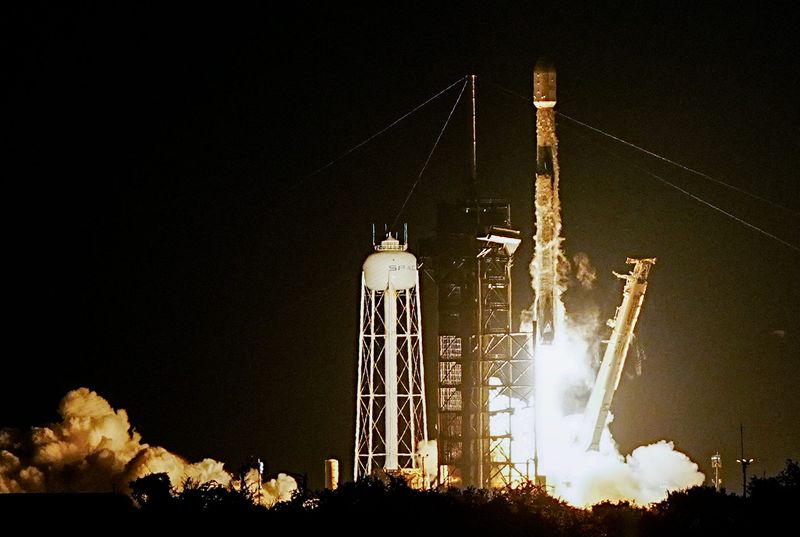
A SpaceX Falcon 9 rocket carried the X-37B Space Force space plane back into orbit late on Thursday, August 21 — marking the mysterious uncrewed vehicle’s eighth mission.
The mission, known as USSF-36, launched at 11:50 p.m. from NASA’s Kennedy Space Center Pad 39A, atop a SpaceX Falcon 9 rocket.

Storms had moved through the area in the hours prior but conditions improved to 90% favorable just before launch.
Upon liftoff, the rocket flew on a northeast trajectory – providing views of the launch north of the Space Coast.
As the rocket’s first stage booster returned to Cape Canaveral Landing Zone 2, a sonic boom was heard throughout Brevard County and the surrounding areas.
The launch marked the fourth National Security space launch (NSSL) Phase 2 mission of the year.
“In fact, we have more missions queued for launch over the next 12 months than in any prior 12-month period in the history of the NSSL program…and we welcome this challenge,” Col. Ryan Hiserote, senior materiel leader, Launch Execution for Space Systems Command Assured Access to Space organization, was quoted as saying in a post-launch press release. “Putting innovative capabilities such as these in orbit builds United States strength in the space domain and increases our nation’s overall warfighting capability.”
In an August press release, William Blauser, Acting Director of the Air Force Rapid Capabilities Office described the eighth mission of the X-37B as “U.S. Space Force’s premier test platform for the critical space technologies of tomorrow”.
The X-37B will spend an undisclosed amount of time in orbit, testing not only the capabilities of the space plane, but technology demonstrations, including testing a new sensor, which will enable GPS contact where communication would have previously been difficult.
The X-37B is also carrying experiments for the Air Force Research Laboratory and the Defense Innovation Unit – including laser communications demonstrations in Low Earth Orbit which will investigate more effective satellite communication.
In total, the X-37B has spent more than 4,200 days in orbit across its past seven missions. It’s unknown how long the vehicle will spend in orbit on this mission.
Next SpaceX rocket launch in Florida
The next launch from Cape Canaveral is set for no earlier than 2:45 a.m. Sunday, Aug. 24, from Launch Complex 40 in Cape Canaveral Space Force Station.
The launch will consist of a SpaceX Cargo Dragon spacecraft launched atop a Falcon 9 rocket. The mission is SpaceX’s 33rd ISS resupply mission for NASA – which will deliver supplies and science experiments to astronauts onboard the International Space Station.
Being a mission to the space station, the rocket must take off on time or SpaceX will have to wait for another launch opportunity. If needed, the next launch opportunity would be 2:22 a.m. Monday, Aug. 25.
Brooke Edwards is a Space Reporter for Florida Today. Contact her at bedwards@floridatoday.com or on X: @brookeofstars.
This article originally appeared on Florida Today: SpaceX rocket launches mysterious X-37B space plane from Kennedy Space Center in Florida
Reporting by Brooke Edwards, Florida Today / Florida Today
USA TODAY Network via Reuters Connect