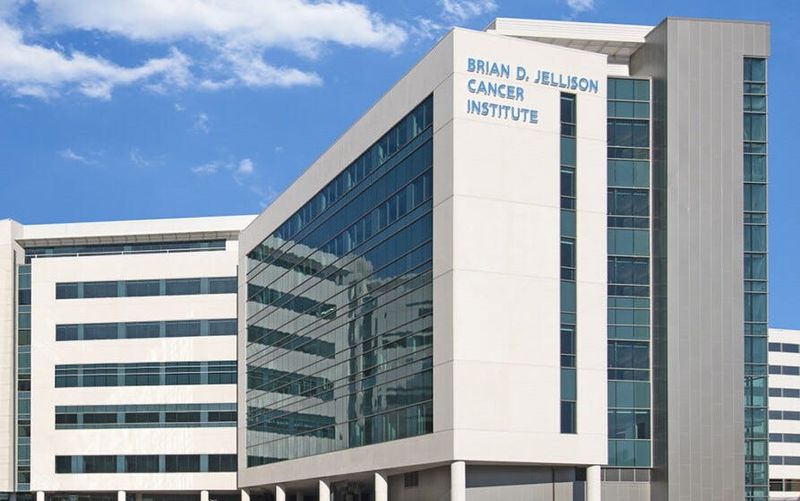
Sarasota Memorial Health Care System recently reported that 75% of lung cancers diagnosed through an innovative early detection program at SMH’s Brian D. Jellison Cancer Institute in 2025 were found at the earliest, most treatable stages (Stage I or II).

The benchmark results – more than double the national average for early detection and nearly triple Florida’s average – demonstrate the success of a scalable model that can be used to improve early detection and outcomes for the world’s deadliest cancer.
“Diagnosing lung cancer early is the single, most important thing we can do to save lives,” said Joseph Seaman, associate chief medical officer at Sarasota Memorial and a pulmonologist who helped develop SMH’s early detection program. “When detected early, in Stage I or II, 70% of lung cancer patients will survive five years or more. When it’s found very late (Stage IV), the 5-year survival rate drops to just 10%.”
Sarasota Memorial’s program harnesses the power of artificial intelligence (AI) to help identify at-risk patients, regardless of where or why they enter the health system. Because elective lung cancer screenings capture only a small percentage of the population at risk, the team implemented Eon’s technology-enabled platform to identify and flag “incidental” pulmonary nodules in scans completed at the health system for other reasons.
Eon’s platform uses the power of AI to help SMH identify incidental findings documented in more than 430,000 radiology reports each year across its southwest Florida inpatient and outpatient facilities.
SMH launched its lung cancer screening program for current and former smokers in 2016.
“We knew there was more we could do for our community. Our imaging volumes are enormous. We just needed a reliable way to flag incidental findings in real time so we could proactively reach all of the people who could benefit from earlier evaluation,” said Amie Miller, program lead for the early detection program at SMH’s Jellison Cancer Institute.
After integrating Eon’s platform, the volume of incidental findings sent to the screening team increased from an average 1-2 per week to more than 170 per week.
The proactive approach translates directly into earlier diagnosis. Between 2022 and 2025, SMH’s early detection team evaluated more than 9,000 patients across screening and incidental pathways and diagnosed 144 lung cancers, with 67% diagnosed at Stage I or II. In 2025 alone, the team diagnosed 53 cancers, with 75% in Stage I or II. That is more than double the national average (28%) for early detection and nearly triple Florida’s average (25.8%).
Dr. Aki Alzubaidi, CEO and founder of Eon, said SMH’s approach demonstrates the opportunity to improve outcomes and address incidental findings earlier by pairing multidisciplinary clinical expertise with technology that supports early detection and longitudinal care management.
“By ensuring every at-risk patient is identified and receives follow-up, Sarasota Memorial’s program is improving outcomes at both the individual and community level,” he said. “It offers a scalable model for improving early detection through real-time identification of incidental pulmonary nodules, standardized guideline-based follow-up pathways, and longitudinal monitoring to ensure patients complete recommended care.”
While state and national rates for early detection of lung cancer cover a broader patient population, SMH’s program underscores the tangible benefits of early detection. For more information, visit smh.com/expanding-early-lung-cancer-detection
The United States Preventive Services Task Force recommends annual screening for lung cancer with annual low-dose CT scans in adults aged 50 to 80 years who have a 20 pack-year smoking history, and currently smoke or have quit within the past 15 years. A pack-year is an expression of the amount of cigarettes smoked per day and the number of years the person smoked: Packs Per Day x Years Smoked = Pack Years. For example, smoking a whole pack a day for a single year would be one (1) pack-year. And smoking two packs a day for one year would be two pack-years. For information about SMH’s lung cancer screening program, call (941) 917-5864 (LUNG) or email lungcancerscreening@smh.com.
Submitted by Kim Savage
This article originally appeared on Sarasota Herald-Tribune: Sarasota Memorial’s AI program finds lung cancer early
Reporting by Special to the Herald-Tribune, Sarasota Herald-Tribune / Sarasota Herald-Tribune
USA TODAY Network via Reuters Connect