The red tide that enveloped our coast from the fall of 2017 until January 2019 did $2.7 billion in damages to the south Florida tourism industry, according to a federal study released May 20.
Previous estimates placed that total at a much more modest $318 million.

“The calculated $2.7 billion in losses were due to decreased revenues in hotels, restaurants, bars, and other businesses on the coastline,” the National Oceanic and Atmospheric Administration, or NOAA, says in the study. “This new estimate suggests that the magnitude of losses due to red tide events can pose a devastating economic threat to the tourism industry.”
NOAA says the event known as the 2018 red tide outbreak caused immense damage to hotel and restaurant industries in both Southwest and Southeast Florida.
During that red tide outbreak, which started in the fall of 2017, untold numbers of marine animals died. Beachfront hotels and restaurants were almost empty, and some residents put their homes up for sale and left Southwest Florida altogether.
And although the event happened in the Gulf and most directly impacted the Lee County area, Southeast Florida suffered a tremendous loss in tourism revenue as well, the study says.
“Researchers then compared this information with local tourism sales data from the Florida Department of Revenue,” a NOAA web page reads. “The results showed major losses in Southwest Florida ($1.3 billion) and Southeast Florida ($1.4 billion).”
Although natural, red tide blooms can be fed along the coast by human inputs like excess nutrients from farms, septic tanks and lawns.
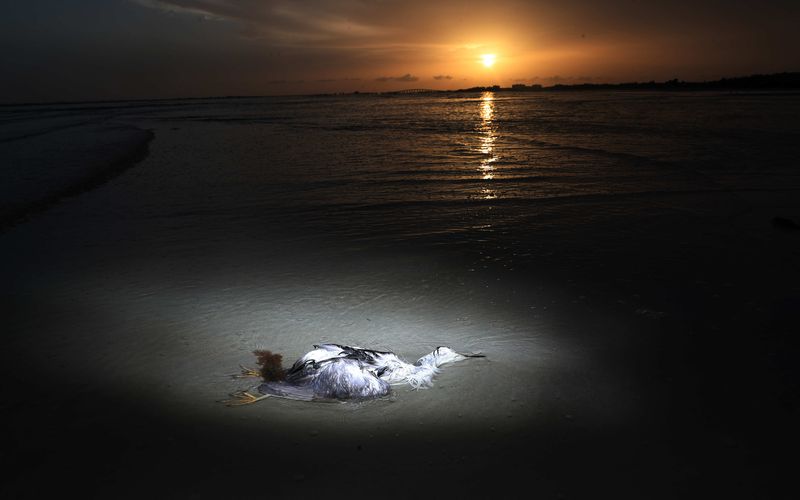
The 2018 red tide was bad for sea life as dolphins, sea turtles, all types of sea birds and even whale sharks washed up dead on local beaches.
The outbreak was so strong that it was difficult for humans to be at the beach, and places that were normally crowded with tourists and locals were barren of human activity.
Lee County was under multiple states of emergency
Then-Gov. Rick Scott declared a state of emergency for the region, and Lee County was under a second state of emergency for another harmful algal bloom in the Caloosahatchee River (a blue-green algae outbreak that started on Lake Okeechobee).
Some people cancelled hotel reservations while others sold their homes and left Florida altogether.
Millions of pounds of dead marine life were mixed with trash and burned in Lee County.
Amir Neto, director of Florida Gulf Coast University’s Regional Economic Research Institute, pointed out that the NOAA study only considered the hotel and hospitality industries, and that the true economic impact of the 2018 red tide could be much higher.
“What they looked at specifically is what they called tourism sales,” Neto said. “They looked at beverages and food stores, accommodations, rooms and other lodging. So pretty much accommodations and hospitality.”
Neto said other studies show more of an impact to this region.
“They were looking at gross sales,” Neto said. “So the $2.7 billion estimate is for tourism related activities and if you look at some other research done by UF IFAS, there are other aspects of red tide that aren’t encompassed here. There could be other things that would be affected that are not counted here. With fishers, we can’t fish as much so we’ve lost these types of revenue as well, and the supply chain effect of not having that demand.”
He said measuring the full impacts from a large event like a strong red tide is difficult.
“It’s really tricky to measure red tide (impacts),” he said. “It’s really hard to look at red tide from different causes. Because you have causes and then you have direct effects. Even if it’s not the final number, it allows us to gauge the different ways red tide impacts the region. I think that’s really my take-away from my perspective.”
How does red tide impact humans?
People with existing respiratory issues are often more susceptible to the impacts of red tide.
Toxins from blooms can become airborne and enter the human body, sometimes leading to hospitalization.
“Most people experience red tide toxins as minor respiratory irritation — coughing, sneezing, teary eyes, and an itchy throat,” a NOAA website reads. “However, people with chronic lung problems, like asthma and chronic obstructive pulmonary disease, can have more severe reactions when they breathe in air-borne red tide toxins, which could lead to hospitalization.”
This article originally appeared on Marco Eagle: Red tide in 2018 caused $2.7B in damages to hotel, restaurant industries, NOAA reports
Reporting by Chad Gillis, Naples Daily News / Marco Eagle
USA TODAY Network via Reuters Connect