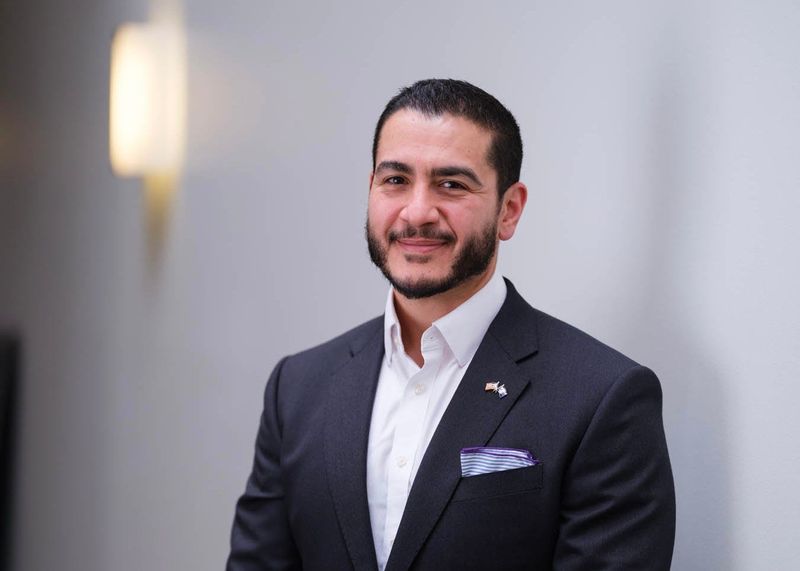
Abdul El-Sayed, a former public health administrator and a Democratic candidate in Michigan’s U.S. Senate primary, sat for an endorsement interview with the Detroit Free Press Editorial Board on June 9. Here’s what El-Sayed told us about AIPAC, the American Israel Public Affairs Committee, and about the lens he’d use to determine when and whether foreign aid is appropriate.
Editorial Page Editor Nancy Kaffer: AIPAC has come up a lot in the race.

Abdul El-Sayed: Well, they’re the only ones up on TV right now, so…
NK: Can you walk us through why AIPAC is more concerning than the Grand Canyon State Caucus or the Turquoise PAC?
AES: I don’t know what the Turquoise PAC is. *laughs* … So, number one, it’s a size issue. They will be the number one spender in this race. They’ve already said that they’re going to spend $30 million. (Editor’s note: Spending by outside groups in the Senate primary – the vast majority in favor of Stevens – has now topped $52 million.) They’ve already moved money through their shell PAC. Now they’re moving money directly through their super PAC.
They just did a $2.4 million buy this week, and they’re going to do more of that every single week for the rest of this campaign. They’re going to go positive for (their candidate), and then they’re going to come negative against me. So they’ve done more positive spending for their candidate than I will do for, like, the entire campaign already. So just as a matter of the spending in this race, they are going to be the number one player, so I think they deserve all that attention.
Number two, they exist to backstop a foreign government. There is no other foreign government that has the kind of firepower in domestic politics as they do, and there is no other government that has had as much impact on our own politics as Israel has. So whether it’s the genocide or it’s the fact that there is one person who’s been trying to get an American president to fight this war in Iran for the better part of 40 years, and he is the Prime Minister of Israel – he sat in the Situation Room, made a presentation, and then we went to war. A lot of people want to pretend, like, that it just happened, and I’m like, I’m sorry, but that’s just not coincidence. And then you have a weak bipartisan response as a function of the fact that even if they’re not firing all their money into all the races, they have the ability to move up to $30 million in a race at any time, which of course becomes an axe of Sophocles hanging over every politician.
They went after (U.S. Rep.) Thomas Massie (D-Kentucky) to the tune of $32 million. He’s no longer going to be in Congress. They’re coming after me to the tune of, I don’t know, $30-plus million. They’re going to try and make sure I’m not a U.S. Senator. So I think they have more than earned our scorn. And at the cost of money that should be spent here, on people here.
I come at this from a place of principle. I will not treat money spent to Israel differently than I treat money spent to Egypt, right? I don’t think we should be sending money to either. Egypt is the second biggest recipient of foreign military aid. If you’d like to start there, we can start there.
I don’t want to see my tax dollars being used to put a chokehold on the Egyptian people by a military dictatorship, which is what happens in Egypt. Similarly, I don’t want my money used in apartheid and genocide. I want my money used to provide classes for kids and good schools and health care here in Michigan. So they are making themselves one of the most important players in our politics.
I’ll just finish here. You don’t even have to tell this cycle’s story because it’s not told yet. Just go back to 2022 when the same congresswoman ran in a very messy primary against a former synagogue president and one of the only Jewish members of the Michigan congressional delegation, and AIPAC dropped $10 million on that race, and they were the decisive spender in the race.
NK: What’s the lens that you would use to make decisions about where we should spend our military aid and support, where we shouldn’t, what should guide us in getting into conflicts?
AES: International law. I believe we ought to be the first among equals to enforce international law. We worked really hard after the worst world war in human history to build all these institutions, to build all these frameworks, and then we became the chief violator of all the frameworks. So, when it comes to Ukraine, I think we are involved in a righteous struggle to protect a sovereign nation from being invaded by their neighbor. That’s completely consistent with international law.
When it comes to Israel, we are aiding and abetting a human rights violator who, at minimum, at baseline, is engaged in apartheid, and has been for decades, and conducted a genocide, and now has pulled us into a war we have no business fighting.
You think about Afghanistan and Iraq and Vietnam. These are all moments where we just, frankly, violated international law because of some realpolitik theories that proved wrong. Domino theory, do you guys remember that with communism?
So all of that is to say, I just think we should be true to our ideals and our values. We should engage in those values appropriately.
And I do not believe that any of us pay our taxes to buy bombs or intakes for other countries. So I don’t believe in an unconditional blank check for military aid.
If there is a international law purpose to be providing military aid, as is the case in Ukraine. That’s an international law purpose we are working among our allies to support. But when it comes to Israel or Egypt or Saudi Arabia or Jordan or Pakistan, or you name the place, that we send unconditional foreign military aid, I think that should just be legal.
And yes, I believe in the Leahy laws. I don’t think we should be sending or trading weapons with folks who violate humanitarian law.
How to vote
You can vote early in person through 5 p.m. Aug. 2 in most communities. Find your early voting location here. You can vote ‒ and register to vote ‒ in person on Aug. 4, Election Day.
Submit a letter to the editor at freep.com/letters, and we may publish it in print or online.
This article originally appeared on Detroit Free Press: Abdul El-Sayed, U.S. Senate candidate, on AIPAC and Israel | Opinion
Reporting by Detroit Free Press Opinion Staff, Detroit Free Press / Detroit Free Press
USA TODAY Network via Reuters Connect
By Detroit Free Press Opinion Staff, Detroit Free Press | USA TODAY Network