

(This story has been updated with new and corrected information.)
There is a push for more private schools in Palm Beach County, with wealthy patrons like developer and Miami Dolphins owner Stephen Ross starting new schools or paying for substantial updates to capitalize on the area’s Wall Street South reputation.

But families moving to Florida as part of the post-pandemic boom may not know that state oversight of private schools is far less rigorous than its oversight of public schools.
Also, background checks for school employees who may come into contact with children, while required for public schools, are not required for private schools who don’t accept the state’s taxpayer-funded vouchers.
Taxpayer-funded vouchers and demand from wealthy new arrivals appear to be fueling the rise of private schools in Palm Beach County and Florida. But it’s a veritable free-for-all, with the state requiring little of the schools in the way of accountability or quality control in exchange for the nearly $5 billion they get each year from vouchers.
Florida has academic, safety and certification standards for teachers and public schools, and districts — including the Palm Beach County School District — take the extra step of obtaining accreditation from an outside agency that has its own academic and safety standards. All of that is aimed at making sure taxpayer money is not being wasted and providing parents with some measure of assurance about the schools to which they send their children.
Few of those assurances are in place for private schools, which, in the absence of state standards, are nonetheless not required to be accredited. Even schools accepting state vouchers are not required to be accredited, according to the Florida Department of Education criteria on its websites.
Less than 31% of the roughly 189 private schools in Palm Beach County report to the state Department of Education that they are accredited, according to The Palm Beach Post’s review of state private school survey data.
That review, which offers a glimpse into a private school landscape that often gets little scrutiny, also found that:
∎ Private schools in Palm Beach County have a combined enrollment of 33,159. That’s a far smaller figure than the 160,000 students in the Palm Beach County School District, which has seen its enrollment drop sharply in the last year because of demographic and economic factors and the increasing use of vouchers for private schools.
∎ Thirty-three of the county’s 39 municipalities have at least one private school, with Boca Raton (47) and West Palm Beach (39) accounting for nearly half of the total number of private schools in the county. More than half — 96 — have academy, prep or Montessori in their name.
∎ About 40% of private schools in the county are for-profit, and about 37% are affiliated with a religion.
∎ Nearly two-thirds of private schools — 64% — report that they accept vouchers.
Those vouchers have an average value of about $8,000, which covers tuition at some private schools in the county but won’t cover it at more expensive schools like Jupiter Christian School, where annual tuition costs range from $21,000 to $23,000-plus. Tuition at some private schools in the county can reach as high as $50,000.
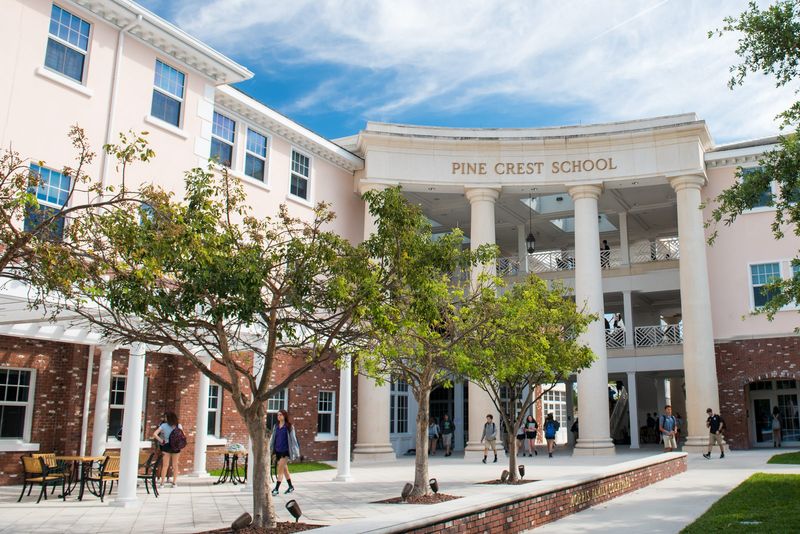
Pine Crest, which has campuses in Fort Lauderdale and Boca Raton, hopes to open a second school − and its biggest campus − in Palm Beach County. The Post recently reported that West Palm Beach Commissioners approved a term sheet authorizing the city to negotiate a possible sale of the Roebuck Road property to Pine Crest.
Pine Crest charges between $39,000 to $50,000 for tuition. It does not accept taxpayer-funded vouchers.
The school says it seeks “families who will place the educational experience of their child as a priority in budgeting their financial resources and in their commitment of time.”
Pine Crest is not included in the state survey data analyzed by The Post, but the school is accredited by the Florida Council of Independent Schools (FCIS), the Southern Association of Independent Schools (SAIS), the National Association of Independent Schools (NAIS) and Cognia.
The school does offer need-based financial aid, but it spurns vouchers, saying “many state and federal scholarships impose significant obligations on the school, and it is for this reason that Pine Crest does not accept scholarship funds or vouchers.”
“Pine Crest families wishing to apply for outside educational assistance should inform the Office of Financial and Inclusion Aid,” the school says on its website. “The school reserves the right to make determinations on the acceptance of outside educational funding, including but not limited to governmental, corporate and/or private funding sources.”
Is it accredited? Sometimes it’s hard to tell
Despite the high tuition charged by some private schools in the county, only 30.7% report that they have accreditation, which is conferred after a voluntary process that requires the school seeking accreditation to pay upfront and annual fees and meet academic and safety standards.
Some of the county’s best-known private schools like Jupiter Christian or The Greene School in West Palm Beach, started by billionaire developer Jeff Greene and his wife Mei Sze Greene with plans for a major expansion, list accreditation by multiple agencies. But most private schools in the county did not list an accreditation.
Learning whether a private school is actually accredited can be a challenge for parents.
Wellington Collegiate Academy, for example, lists no accreditation on the state survey. But on its homepage, Wellington Collegiate shows the logo of two accrediting agencies, the National Council for Private School Accreditation and Accreditation International.
Does that mean Wellington Collegiate Academy is accredited by both agencies? If so, why did it not list those agencies on the state survey?
Children’s House Montessori in Boca Raton says on its website that it is accredited by Cognia, the same Georgia-based non-profit organization that accredits large school districts including Palm Beach County and has provided accreditation and improvement services to more than 40,000 schools in more than 100 countries. But, like Wellington Collegiate Academy, Children’s House Montessori does not list any accrediting agency on the state survey.
Florida’s requirements of private schools
While state law requires private schools to fill out a survey annually, it seems not to matter what private schools put on the survey.
The state Department of Education makes clear on its website that the state law requiring private schools to complete an annual survey is only “to provide a ‘service to the public’ and not to regulate, control, approve or accredit private educational institutions.”
The department added that it “does not verify the accuracy of the data submitted pursuant to the annual survey. Inclusion of a school’s information in the database does not imply approval or accreditation by the Department of Education.”
In addition to accreditation, there are other substantial differences between public and private schools.
Unlike public schools, private schools do not get letter grades from the state. They are not required to hire certified teachers, and their graduation rates are not publicly reported.
The law requires any owner or “chief administrative officer” of a private school be fingerprinted and undergo a state background check, a step all public school employees undergo. A person convicted of a crime of “moral turpitude” cannot own or operate a private school. Those crimes aren’t spelled out but typically include theft, fraud, violent crimes and sex offenses.
But unless the school accepts state vouchers, it’s up to the owner to decide whether to run the same checks on the school’s employees, according to the law. At Pine Crest, for example, all employees and contracted vendors who may come into contact with students undergo background checks.
Private schools that do participate in Florida’s voucher program must run those checks on staff that come into contact with students.
Private school students are not required to take state academic assessments, though private schools that accept vouchers must either have students take an assessment approved by the state Department of Education or opt into the state’s testing regime.
A lawsuit over state money and accountability
The difference in accountability for private schools is a central element of the lawsuit parents and the Florida Education Association filed against various state officials and the state Department of Education, which oversees the voucher program.
“Over the past two decades, and especially in recent years, the state has built a system where publicly funded schools operate under very different rules,” the FEA suit, filed in May, states. “Schools receiving taxpayer dollars are no longer held to the same standards, the same oversight, or the same level of accountability. As a result, students are not being served equally.”
State officials have scoffed at the suit. Department of Education spokesperson Cassie Edwards said the FEA, the largest association of education professionals in the state, is “once again wasting taxpayer dollars and members’ dues on a frivolous lawsuit.”
With more and more taxpayer money being made available to private schools, Democrats in the state Legislature have begun to raise objections to what they see as a free ride for private schools while every aspect of a public school’s performance is publicized and analyzed.
“If a school accepts taxpayer dollars, it should be held to the same rigorous standards as our public schools,” said sate Rep. Emily Gregory, D-Jupiter. “Florida families deserve accountability, transparency, and a high-quality education for every child.”
Wayne Washington is a journalist covering education and Riviera Beach development for The Palm Beach Post. You can reach him at wwashington@pbpost.com. Help support our work; subscribe today.
This article originally appeared on Palm Beach Post: Private schools thrive, with less oversight than publics | Exclusive
Reporting by Wayne Washington, Palm Beach Post / Palm Beach Post
USA TODAY Network via Reuters Connect

By Wayne Washington, Palm Beach Post | USA TODAY Network
