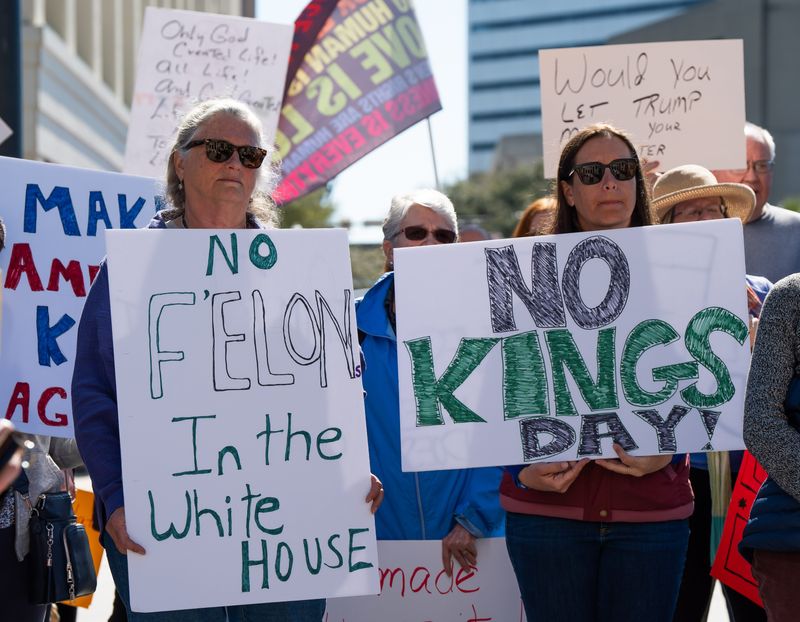
Another wave of “No Kings Day” demonstrations is planned in Jacksonville this weekend, one of more than 2,500 protests planned nationwide on Saturday, October 18. Over 80 of those will take place in Florida, including seven in Jacksonville, St. Augustine and Fernandina Beach. The demonstrations aim to defend democratic institutions and push back against what organizers describe as increasing authoritarianism.
Fueled by frustration over President Donald Trump’s hardline immigration policies, the deployment of ICE and National Guard troops, shifting trade tariffs, and what critics see as a dangerous consolidation of power, the protests reflect growing public concern.

With tensions running high, safety remains a top concern. Legal observers and civil rights organizations are urging participants to not only prioritize their well-being but also to understand and assert their rights while demonstrating.
Here’s what you need to know about exercising your rights during protests — including how laws like Florida’s HALO Law may affect your actions — and how to stay safe while making your voice heard.
I’m going to a protest. How can I protect myself?
First and foremost, the website says they expect all “No Kings” protest participants to de-escalate any potential confrontation with those who disagree with its values and to act lawfully at these events, and stressed that no weapons should be brought to a protest.
Public protests are protected in the United States by the First Amendment and are legal in public areas, provided you are not blocking car or pedestrian traffic or blocking access to government buildings.
That said, law enforcement may interpret your intentions differently, and some have acted with force.
The Human Rights Campaign advises protesters to scope out the area of the protest ahead of time and identify multiple routes out of the area. An offline-accessible map can help. During the protest, remain aware of your surroundings and what’s happening around you.
What is the HALO Law, and when did it take effect in Florida?
The HALO Law — which stands for ‘Honoring and Listening to Our Officers’ — took effect in Florida in January 2025.
This law requires individuals to maintain a distance of at least 25 feet from first responders, including police officers, firefighters, and emergency medical personnel, when asked to step back during the performance of their duties. Failure to comply can result in a second-degree misdemeanor, punishable by up to 60 days in jail or a fine of up to $500.
Can I take photographs or video at a protest?
Yes, when you are lawfully present in a public space, you have the right to photograph or video record anything in plain view, including federal buildings and the police, the ACLU said. Law enforcement may not confiscate your photos or video without a warrant and may not demand you delete anything from your camera or smartphone. However, law enforcement can order you to stop if you’re interfering with legitimate law enforcement operations. Be aware of HALO Law while taking pictures.
Where are the ‘No Kings’ protests happening in Jacksonville on Saturday, October 18?
More than 2,500 “No Kings” protests are scheduled across the U.S., including over 80 events in Florida alone. In Northeast Florida, a full day of marches, rallies, and caravans is planned in cities including Jacksonville, Neptune Beach, St. Augustine, Orange Park, and others.
Here are some of the key events:
➤ Find an event near you
All protests are intended to be peaceful, in line with the values of the 50501 movement. Organizers emphasize on their website that all events are rooted in nonviolence and ask every participant to commit to peaceful action and de-escalation, even in the face of opposition. The website also advises against bringing weapons into the protest.
When protesting, know your rights
According to the ACLU of Florida, the First Amendment generally prohibits restrictions based on speech content; however, this does not mean that the Constitution completely protects all types of speech in every circumstance.
“For example, threatening someone with violence is not protected,” the organization writes on its website. “Additionally, government officials are allowed to place certain reasonable, nondiscriminatory, and narrowly drawn ‘time, place, and manner’ restrictions on the exercise of First Amendment rights.
Your rights are strongest in “traditional public forms” such as streets, sidewalks and parks, but you can be asked to disperse if you are blocking car or pedestrian traffic. You may also protest at government buildings as long as you don’t block access to them or interfere with the purpose of it.
Florida Statutes 871.015 state that a person may not “knowingly engage in protest activities or knowingly cause protest activities to occur within 500 feet of the property line of a residence, cemetery, funeral home, house of worship, or other location during or within 1 hour before or 1 hour after the conducting of a funeral or burial at that place.”
Anyone violating this will be charged with a misdemeanor of the first degree.
In 2021, Gov. Ron DeSantis signed HB 1, an anti-protest law that enhanced criminal penalties during specific gatherings and created new criminal penalties for “mob intimidation” and damaging or pulling down historic objects. However, in 2024 the Florida Supreme Court ruled unanimously that the law does not apply to people at a protest who don’t engage in violent or disorderly conduct.
What should I bring to a protest?
Protest signs and sunscreen are just the beginning. Experts at Physicians for Human Rights suggest bringing the following:
Many organizations advise protesters to leave their phones at home to protect their privacy as they can easily be tracked. If you must take your phone, keep it turned off until you need it and, before you go, disable Face ID or fingerprint security and stick with the 6-digit passcode instead. You may also consider buying a cheap secondary phone to use.
This article originally appeared on Florida Times-Union: Planning to attend ‘No Kings’ Protest Oct.18? What to know about ‘Halo Law’ before you go
Reporting by Doris Alvarez Cea, Jacksonville Florida Times-Union / Florida Times-Union
USA TODAY Network via Reuters Connect