When their daughter Bexley was born in 2023, Sparkie Harrison and her husband lived in Santa Rosa County’s rural Berrydale community.
But after Bexley developed jaundice just before being released from Ascension Sacred Heart, the hospital would not allow the couple to take the infant home—unless Bexley saw a pediatrician the next day.

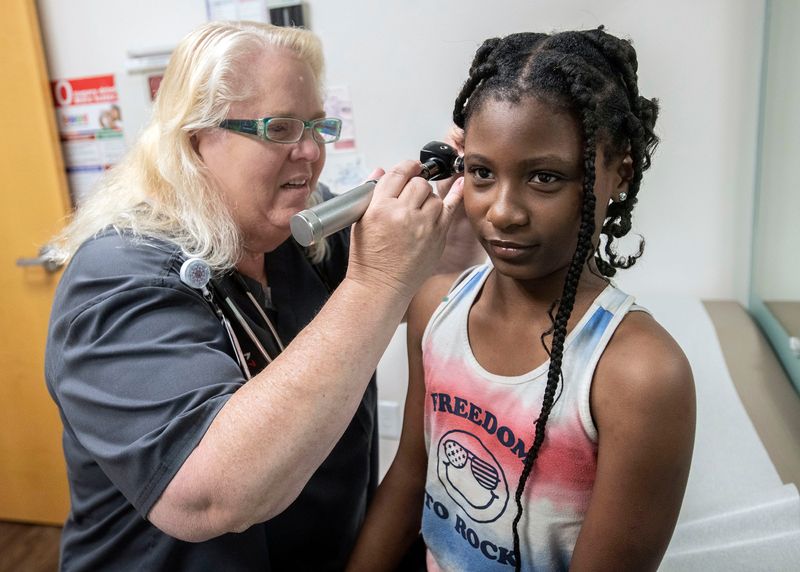
The couple was able to make an emergency appointment with Dr. Marian Stewart, a Century pediatrician, whose office was only 20 minutes from their home.
“We brought Bexley home on a Wednesday and Dr. Stewart saw her twice on Thursday, once on Friday, and again on Monday,” recalled Harrison, who now lives in Century.
“I had filled out the paperwork for Dr. Stewart to be Bexley’s pediatrician but having to take her in on Thursday was last minute. We knew we were extremely fortunate to have a pediatrician so close to us.”
Stewart has practiced in North Escambia and Santa Rosa counties since 1999. She joined Community Health Northwest Florida in 2017 and serves young patients from all over the area. Community Health of Northwest Florida also offers pediatric services at its Cantonment clinic, but patients at that site are treated by a nurse practitioner.
“I see patients from not only Century but Jay, Flomaton, Atmore, Brewton, Walnut Hill and even Milton—I used to take care of the parents, now I’m taking care of their kids,” Stewart said. “I have four or five families who still drive from Pensacola to see me because I was the parents’ doctor.”
On any given weekday, Stewart sees 20 to 25 patients. She said before computers were widely-used, she saw about 40 patients a day—treating everything from ear infections, ADHD and other behavioral issues to diagnosing rare illnesses such as Neurofibromatosis, Renal artery stenosis and Neonatal lupus.
In a year, Stewart estimated that she treats about 3,000 patients.
“The big reason is that it’s close to 40 miles from Century to Pensacola to the nearest pediatric hospital and pediatricians,” she said.
Most Florida families who live in rural areas aren’t as lucky as Stewart’s patients.
Rural communities statewide are facing a dire shortage of general pediatricians compared to urban settings, but the practice climate as a whole in Florida for the specialty can be difficult, according to Dr. Jennifer Takagishi, vice president of the Florida Chapter of the American Academy of Pediatrics—a professional organization that helps shape policy for the care of children.
“Some of the rural counties have more family medicine physicians who will also see children but in some places they will not,” she said.
Multiple issues influence whether freshly-minted general pediatricians come or stay in Florida and for retaining seasoned practitioners, Takagishi said.
Still, all is not lost for the specialty that oversees the health and development of children, she and others say. An upbeat indicator came this past spring on National Residency Match Day when medical school graduates got word where they will do their residency training.
Pediatrics filled 95% of its available slots, the largest number of future pediatricians since the match day program began 73 years ago, according to the American Academy of Pediatrics.
“The increase in the number of graduates matching into pediatrics is encouraging but still is below the number of new pediatricians needed to provide access to care for all of the nation’s children,” Dr. Jesse Hackell, chairman of the organization’s committee on pediatric workforce, said about the results.
Stewart, a Santa Rosa County native, believes the next generation of rural pediatricians must be homegrown and have their education supported – financially.
“I grew up in Jay, graduated from Jay High School. After medical school, I had people asking me to come back to town. I said the town was too small, but I gave it a year. In six months, I had a full slate of patients, and I’ve been busy ever since,” she recalled, noting the importance of having not only pediatricians but primary care physicians and family practice doctors in rural communities.
“But kids need help paying for medical school. If we can get these kids through medical school, they’ll come back to their communities.”
She said her father was a high school teacher and her mother was secretary, but she received financial assistance through Pensacola State College’s J. Hugh and Earle W. Fellows Foundation.
“Back when I was in school, it was loan specifically for medical and theology students. That was how I paid for all of my medical school. It was a loan back in my day but now it is just a straight scholarship,” she added. “There are routes available for kids who want to pursue medical school.”
Florida drawbacks that make recruiting pediatricians hard
A drawback for some to go into pediatrics is the lower starting salary, both in Florida and nationally, which doesn’t bring down medical education debt as fast compared to starting salaries in other specialties, Takagishi said.
The average debt is around $250,000 to $300,000 for college and medical school, yet new general pediatricians don’t earn what physicians in internal medicine or other primary care physicians make, she said.
In the Tampa Bay region, where Takagishi is located, the starting salary for a general pediatrician may be $180,000 to $200,000, she said.
In the Pensacola area, Medscape reports an average salary of $193,057 for a pediatrician with one to seven years of experience. For those with close to 30 years of experience, the average salary is around $280,000.
While Takagishi didn’t have figures for other specialties, Medscape’s annual physician salary data for 2025 pegs primary care physicians as a whole at earning $287,000 a year. And among the top earning specialties, Medscape says the average compensation for an orthopedic surgeon this year is $564,000.
But what has made Florida, in particular, unappealing to some pediatricians is the political climate, she said.
Florida became the first state to recommend that healthy children not receive the COVID-19 vaccine and the state prohibits coverage for gender affirming care for minors.
And on Wednesday, Florida Surgeon General Joseph Ladapo announced a plan to eliminate all vaccine mandates. Ladapo said the Florida Department of Health and Gov. Ron DeSantis’s office would work together to end every single vaccine mandate.
The health department doesn’t have the unilateral power to completely abolish vaccine mandates. While the department can remove requirements for certain vaccines, like required immunizations for school-entry, a full appeal will require the support of the state Legislature.
“If you do gender affirming care, if you are a vaccine promoter, some of those policies that are coming down from our Legislature are either having people not want to come or people are leaving because it’s not the environment that they want,” Takagishi said. “Yes, they are leaving the state because they don’t want to be in that environment.”
By the numbers
Data from the American Board of Pediatrics, which certifies pediatricians who meet standards, bears out how Florida doesn’t have enough pediatricians for its population of children compared to other states.
Florida ranks 30th for its rate of board-certified general pediatricians per 100,000 children under the age of 18, the 2024 data shows.
The state falls in line with rates similar to southern states like Georgia and South Carolina yet is far below Northeastern states such as Massachusetts and Connecticut.
Florida has 3,085 board-certified general pediatricians for its 4.3 million children under 18, data shows. There are 70 general pediatricians for every 100,000 children in Florida.
In Escambia County, the American Board of Pediatrics reports there are 57 board-certified general pediatricians to serve 68,296 children under 18 or 1,198 children per each pediatrician. Santa Rosa County has 29 board-certified pediatricians for 44,333 children under 18 or 1,529 children per pediatrician.
Massachusetts has a rate that is twice Florida’s. It has 1,934 pediatricians and 1.34 million children. That means there are 144 pediatricians per 100,000 children in that state.
Historically Massachusetts does well on health care score cards based on access and being home to some of the nation’s top teaching hospitals, according to Commonwealth Fund, a leading health policy research organization.
Harrison, a member of the Century City Council, knows the town of 1,739 is extremely fortunate.
“We’re so grateful to have Dr. Stewart as Bexley’s pediatrician and I know the residents of Century and the surrounding area feel the same way,” Harrison said.
“Most families around here see her. We’re in a rural area, and I think there’s a pediatrician in Jay but if you don’t have a car or transportation to get there—it can be challenging. ”
This article originally appeared on Pensacola News Journal: Pediatrician shortage hits rural communities hard. Florida’s vaccine stance makes it worse
Reporting by Mary Lett and Liz Freeman, Pensacola News Journal / Pensacola News Journal
USA TODAY Network via Reuters Connect