Story updated to add new information.
Alligator Alcatraz can remain open without federal environmental reviews, a three-judge appeals court panel decided 2-1 Tuesday in a case that began in June 2025 and has had multiple appeals and related lawsuits.

Two environmental groups and the Miccosukee Indian Tribe failed to “prove either a final agency action or federal control” of the immigration detention center, Chief Judge William Pryor wrote in the April 21 opinion from the United States Court of Appeals for the Eleventh District.
With that, and an admonition of U.S. District Judge Kathleen Williams’ Aug. 21 ruling, the panel vacated the injunction she issued 15 days after oral arguments took place April 6 in the Southern District of Florida.
What did the lawsuit say, ask for?
Friends of the Everglades, The Center for Biological Diversity filed the lawsuit in June, with the Miccosukee joining that suit in July, to stop construction of Alligator Alcatraz before it opened in Collier County on July 1. The groups argued the State of Florida was working in partnership with the federal government to build the immigration detention center but failed to study the environmental impacts as required by federal law.
The lawsuit was filed against the secretary of U.S. Department of Homeland Security (DHS), the acting director of the U.S. Immigration and Customs Enforcement (ICE) and the executive director of the Florida Division of Emergency Management.
Williams’ preliminary injunction ordered state and federal officials to begin winding down operations at the detention center and close it within 60 days. That never happened, though at the time, a U.S. Department of Homeland Security official said the agency was “complying with this order and moving detainees to other facilities.”
Williams’ ruling ordered the President Donald Trump and Gov. Ron DeSantis administrations to stop bringing additional detainees to the complex and gave officials 60 days to wind down operations and remove temporary fencing, lighting fixtures and generators, gas, sewage and other waste receptacles.
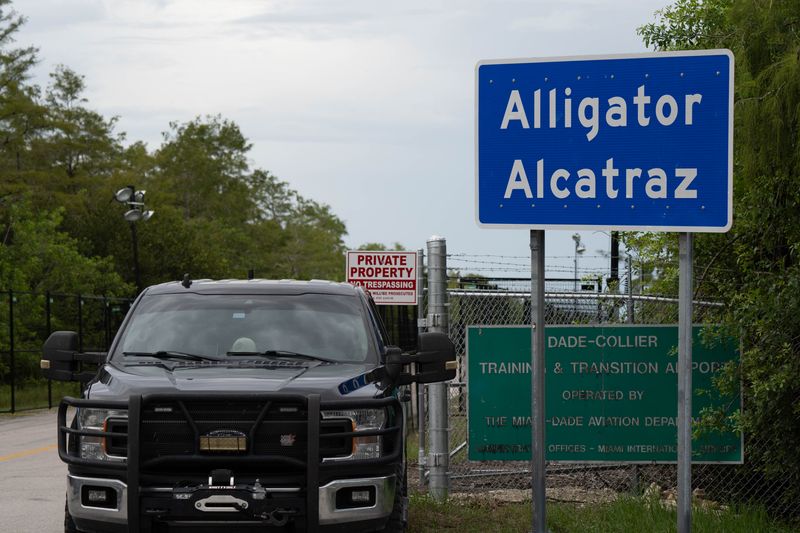
Alligator Alcatraz, also called Soft-Sided Facility South and South Florida Detention Center in court documents and on government websites, is located on what was a Dade County-owned airport training field, Dade-Collier Transition Airport, in Ochopee in Collier County.
The facility is in Ochopee, just north of Everglades National Park in Big Cypress National Preserve, about 48 miles east of Naples and 45 miles west of Miami International Airport.
The Big Cypress National Preserve, set aside in 1974, is located mostly in eastern rural Collier County and abuts directly to Everglades National Park. Generations of Floridians fought to preserve and protect this area, which spans millions of acres across the extreme southern tip of the state, and many of the endangered animals that thrive here are nocturnal, including the Florida panther and the Florida bonneted bat.
Alligator Alcatraz was a first-of-its-kind facility, run by the Florida Division of Emergency Management instead of ICE. Gov. Ron DeSantis took over the training field via a 2023 emergency order and built the facility in eight days in 2025.
The administrations were quick to ask the 11th U.S. Circuit Court of Appeals to put the preliminary injunction on hold while appeals played out, and Sept. 4, another three-judge appeals court sided 2-1 with the State of Florida. The state had sworn statements that the federal government wasn’t involved, so the panel reversed that injunction, saying the camp could stay open while the appeal played out because it had been built with state funds, and thus, the court said, federal environmental laws didn’t apply.
In early October, federal officials disclosed that the state had requested and received more than $608 million in federal reimbursement for the project from the Federal Emergency Management Agency and the Department of Homeland Security. Since then, the state and the federal government have said no federal money has been issued to Florida for Alligator Alcatraz.
In response to questions from the Naples Daily News about the money, Stephanie Hartman, director of communications for FDEM wrote in an email March 18, “As with the existing FEMA reimbursement process, once expenses are incurred, reimbursements will be requested from and reviewed by FEMA. Following approval, the appropriate funds will then be released to the state.”
Requests for comments on the appeals court ruling from FDEM and DeSantis received no reply on Wednesday, April 22.
The money is at the heart of the case to show federal oversight and therefore the requirement for an environmental review under The National Environmental Policy Act, NEPA, which prohibits implementation of a proposed federal action before its environmental impacts are considered.
Records show Florida asked the Federal Emergency Management Agency for $1.5 billion for Alligator Alcatraz.
Appellate decision wasn’t unanimous
In its 2-1 decision, Pryor wrote the majority opinion and U.S. Circuit Judge Nancy Abudu wrote a dissenting opinion. The third panelist was U.S. Circuit Judge Andrew Brasher.
“Because the environmentalists and Tribe failed to prove either a final agency action or federal control, and because the injunction, in part, violates a statutory prohibition of enjoining immigration enforcement, we vacate and remand,” Pryor wrote.
State officials constructed the facility using state funds. Immigration and Customs Enforcement officials completed a “post construction compliance check” to ensure that the site meets federal standards for immigration detention. Florida officials planned to “seek reimbursement of its expenses from the federal government,” but when the district court entered its injunction, Florida had received no federal funding. Florida manages the facility using state law enforcement officers. Several state agencies have agreements with the federal government allowing them to assist in immigration enforcement.
Pryor said the district judge abused discretion when ordering the preliminary injunction. Abuse of discretion by a lower court is defined as a decision that is arbitrary, unreasonable, or based on a clear error of law or fact, exceeding the bounds of reason.
The environmental groups and the Miccosukee didn’t prove there had ever been a ‘final agency” action and therefore didn’t challenge a “final agency action,” and without that, a decision — no matter how firm — is not final agency action. Because the environmentalists and Tribe did not challenge a final agency action, the district court abused its discretion when it entered the preliminary injunction, Pryor wrote.
The environmentalists insist that immigration enforcement is the “purpose for which the facility was built.” And “immigration enforcement is exclusively a federal power.” But states have sovereign power to choose to assist federal law enforcement. … Because the environmentalists and Tribe failed to prove a likelihood of success on the merits of their claim, we do not discuss whether they proved irreparable harm or whether the balance of the equities favored an injunction. We also do not address the district court’s ruling that venue was proper in the Southern District of Florida. The expedited nature of these proceedings created a limited record insufficient to support a decision on venue.
In her dissent, Abudu wrote that the state and federal governments did not show abuse of discretion.
“Here, the Department of Homeland Security (“DHS”), the Director of the U.S. Immigration and Customs Enforcement (“ICE”), and the other Defendant Appellants do not meet that burden. Nevertheless, a majority of this court has once again relied upon its own factual findings and interpretation of this record to determine that the district court abused its discretion for reaching a different outcome than the panel itself would have,” Abudu wrote.
In doing so, the majority absolves both the state and federal defendants of their collective responsibility to the human beings currently detained in the Facility, the Tribe members, and the Big Cypress National Preserve (“BCNP”) simply because (1) the federal government failed to formalize its agreement with Florida in a manner the majority deems sufficient, and (2) one day in the unknown future the state of Florida could decide it no longer wants to participate in the detention scheme. It cannot, and should not, be the case that the federal government, which all parties agree has exclusive control over the detention of migrants, can abdicate its responsibility to exercise that control in a way that is consistent with federal law simply because, here, Florida has supported DHS and ICE in carrying out this endeavor, the majority opinion also errs by minimizing the federal government’s role and responsibility in immigration detention, while mischaracterizing the scope of the district court’s injunction on the federal government’s ability to exercise control over said detention.
Abudu wrote that the majority panel relegated the federal government’s involvement “to no more than a removed supervisor or supporter of state action,” which “grossly understates DHS and ICE’s role in the creation and operation of the detention facility.”
This is most evident in the majority’s weak analogy to the relationship between a property owner constructing an office building and having to comply with federal standards that ensure people in wheelchairs or who have other mobility issues can still access the building. Aside from the obvious distinction that the state of Florida is not a private actor, the state defendants have partnered with DHS and ICE in carrying out the President’s immigration detention goals which he gets to set prior to any necessary judicial constraints. If anything, the majority’s analogy highlights that the private property owner’s building must be accessible to all members of the public. Here, the detention facility’s only goal is to house thousands of people under DHS and ICE’s control, in a secluded area, away from the public, without any accountability. If not for its partnership with DHS and ICE, Florida’s housing of these individuals (and in some cases families) would be more akin to kidnapping and, at its most extreme, perhaps human trafficking. The state cannot detain a non-citizen without the proper authority to do so.
“The Miccosukee Tribe of Indians of Florida (the “Tribe”) was disappointed by the decision of the 11th Circuit in Friends of the Everglades et al. vs. DHS, which vacated the decision of the District Court calling for environmental review of the unpermitted construction of the Alligator Alcatraz facility in the Everglades,” the Tribe said in a statement. “The Tribe has long been committed to the environmental stewardship of Tribal homelands and the safety of the Tribal community.”
Will the environmentalists, Miccosukee keep fighting?
Yes.
“This fight is far from over,” said Eve Samples, executive director of Friends of the Everglades.
“Alligator Alcatraz was hastily erected in one of the most fragile ecosystems in the country without the most basic environmental review, at immense human and ecological cost,” Samples said in a statement. “We are pursuing every legal avenue available to right this wrong. Alligator Alcatraz will go down in history as a boondoggle to taxpayers and a flagrant assault on the Everglades, and we look forward to returning to the District Court to advance our case to shut it down.”
Elise Bennett, Florida and Caribbean director and senior attorney at the Center for Biological Diversity, said the group will keep fighting “because the Trump and DeSantis administrations’ obsession with sacrificing our Everglades, endangered panthers and wild waters to their cruel detention center is utterly indefensible.”
“Our hearts are heavy for all the harm that will continue to fall upon those in the heart of Big Cypress, but this disappointing decision won’t stop our challenges to the numerous environmental violations that the Trump administration is overseeing there,” Bennett said in a statement.
In a statement from the Miccosukee Tribe, Chairman Talbert Cypress said, “While the decision by the 11th Circuit was disappointing, my administration will continue to fight for the Everglades. This is our home. The federal government has stated they are not reimbursing the full costs of the State in constructing and operating Alligator Alcatraz. Floridians don’t want to see their hurricane relief fund spent on detainees in the most remote and ecologically fragile public lands- without running water, sewage, or connection to the power grid. We appreciate the efforts of Florida’s elected officials to reign in wasteful public spending.”
Miccosukee Tribe member Betty Osceola said absolutely the fight isn’t over. As she celebrated Earth Day with interviews around the country, Osceola said she was disappointed by not surprised by the appeals panel decision.
“When I was in court, the line of questioning right from the get-go from the chief justice gave me an indication that the ruling would not go in our favor,” she said in a phone interview.
She will keep up the fight to have Alligator Alcatraz closed. It means so much to her tribe, the animals who live there and the predicant set by the State of Florida taking over land without oversight, she said.
“As a Miccosukee tribal member who grew up in the greater Everglades, I’m always going to stand up and advocate for our tribe’s homelands, for our tribal people,” she said. “That’s never going to stop, regardless of what the issue is, and it’s not over. I’m still going to stand, to be that voice, to advocate for the environment.”
Do you have an opinion about this topic? Write a letter to the editor and send it toletters@naplesnews.com and/or mailbag@news-press.com. Keep it to 250 words or fewer and include your contact info. Have more to say: Send a guest column of no more than 600 words.
J. Kyle Foster is a senior growth & development reporter for The News-Press & Naples Daily News. Reach her by emailing jfoster1@usatodayco.com.
Please support local community journalism and stay informed about Southwest Florida news by subscribing to The News-Press and Naples Daily News; download the free News-Press or Naples Daily News app, and sign up for daily briefing email newsletter, food & dining and growth & development newsletters here and here.
This article originally appeared on Naples Daily News: Court: Alligator Alcatraz can stay open without environmental review
Reporting by J. Kyle Foster, Fort Myers News-Press & Naples Daily News / Naples Daily News
USA TODAY Network via Reuters Connect