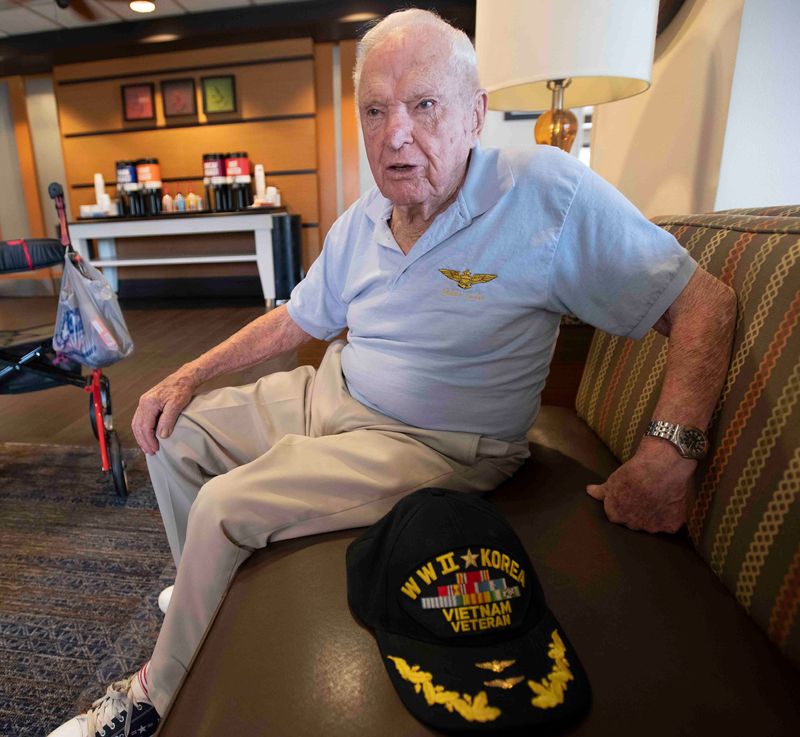
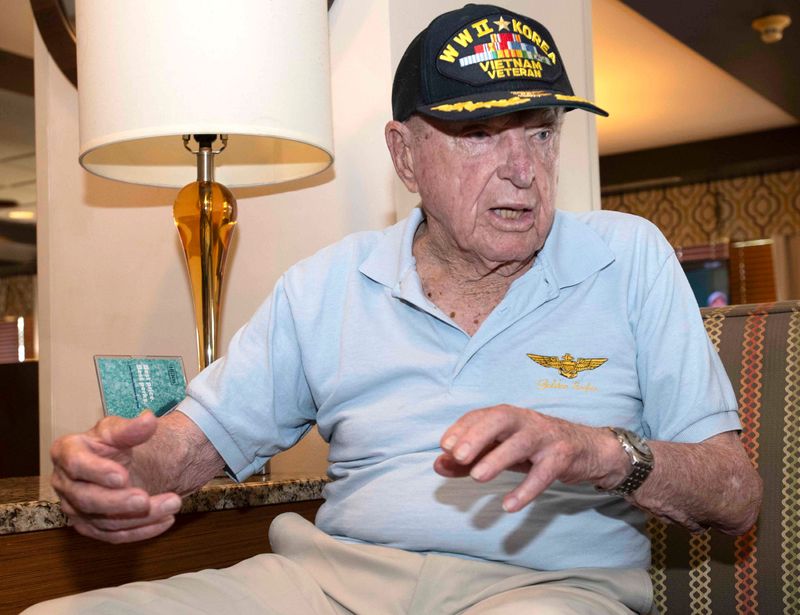
Retired Navy. Capt. Royce Williams’ aerial derring-do during the Korean War is perhaps one of the greatest solo achievements in U.S. combat aviation history. Yet, for a half-century, it was erased from history, a heroic fight and a heroic flight scrubbed from existence.
On Nov. 18, 1952, then-Lieutenant Williams took off in his F9F Panther jet from the USS Oriskany in blizzard conditions on an air combat patrol off the Sea of Japan. Soon, he would find himself in a solo dogfight with seven Soviet MiG-15s. Most aerial dogfights last a few minutes. This one lasted 35 minutes.

“It’s one of the most incredible engagements in Naval aviation history and air combat history,” said Hill Goodspeed, historian at the National Naval Aviation Museum at Naval Air Station Pensacola. “It was an incredible accomplishment and indicative of his life in Naval aviation.”
Williams, now 100 years old, visited Pensacola to participate in the Red White & Blues’ Veterans Flight as he and other Korean and Vietnam War veterans rode along in World War II-era Stearman biplanes on July 11 and July 12 preceding the Blue Angels performance. He’s a Navy hero for sure, having served as a fighter pilot in Vietnam, as well as Korea, and served as commander of the USS Eldorado, a U.S. Navy command ship from 1969 to 1971.
But for, well, half his life, perhaps his greatest aviation accomplishment was kept under wraps.
But when the dust settled and the smoke dissipated that November day, Williams had shot down at least four of the Soviet MiGs, though there’s a chance he got six. He returned to the Oriskany unharmed, but with 263 bullet holes in his Panther.
Yet few would know.
See, the Soviet Union was not officially involved in the Korean War and U.S. intelligence and defense officials classified the dogfight for fear that publicity would further draw the Soviets into the conflict. Williams couldn’t even tell his wife. Few knew what happened, and the mission was scrubbed from intelligence records.
The “official” record at the time was that Williams had shot down one plane, though the plane was not identified as a Soviet aircraft.
Williams had launched from the Oriskany with three other Navy pilots, but the division leader and his wingman were forced to return when the division leader’s jet experienced mechanical problems. Williams went on, with his own wingman Lt. Dave Rowlands, and the two planes continued on the patrol.
Encountering the seven (unmarked, as the Soviets weren’t wanting to broadcast their involvement) MiGs, Williams was able to shoot one down, and his wingman Rowlands followed the smoking MiG below the cloud cover toward the sea.
Williams would have to take on the remaining six fighters on his own, dipping in and out of blizzardy clouds, using the enemy’s mistakes against them. Fighting was so close that at times when he fired upon the MiGs, he had to maneuver to escape the pieces blown off the opposing jets.
His heroic dogfight was declassified in 2002.
The official story, he said, “was hooey.”
“They made something up and just went with it,” Williams said. “I was ordered that I could never tell anyone what happened, so that was that. I made a pact with myself that I would never say anything, and, after a while it didn’t bother me. No one asked, because what was there to ask? They didn’t know. That was the end of it.”
Though he’s a century old, Williams, a South Dakota native who lives with his caretaker in California, has become a celebrity since the story was declassified and the story of one the country’s most dramatic combat dogfights was finally told. He appeared on news programs, including Fox News, and was interviewed by many other television, magazine and newspaper articles. People were intrigued by the man who successfully taken on seven Soviet combat pilots, shooting down four.
Maybe more. Though he engaged seven MiGs, according to Soviet archival records released after the fall of the Soviet Union at the end of 1991 only one of the seven planes returned to base.
So how many Soviet MiGs did he shoot down? At least four. Maybe six.
“I didn’t see anyone fall into the see, but that’s because there was a lot going on and I was looking out for myself,” he said. He remembers having one MiG left on him and, having already “been hit so badly, I headed in the direction of the task force” so as to return to the Oriskany.
Williams’ Panther was bleeding fluids and had damaged hydraulics and electronics. One round had ripped through a wing into his engine. Plus, he was low on ammunition.
But the MiG kept coming.
Flying at 12,000 feet, he said he felt enemy fire hitting the plane and seeing bullets in the clouds.
“Bullets above me,” he said, “bullets below me. I was pushing hard.”
He eventually lost the MiG in the heavy clouds and made his way back to the task force.
So what did his wife say to him when he was finally able to share the hair-raising, action-packed, hush-hush adventure with her?
He smiled.
“She said, ‘Oh Royce.'”
Williams retired in 1980, and now his dogfight in Korea is getting even stronger attention.
He was originally awarded the Silver Star in 1953 for his Korean patrol flight having been acknowledged as shooting down one enemy fighter in the battle. But since the case’s declassification, that has been upgraded. In 2022, he was awarded the prestigious Navy Cross, the second-highest Navy military honor following only the Medal of Honor.
And that, the ultimate honor, is being discussed and advocated for as well. In 2022, Californian U.S. Rep. Darrell Issa pushed for Congress to consider Williams for the Medal of Honor, but the campaign did not find enough initial support. Standards for the Medal of Honor are strict, including witnesses and official reports, as well as time standards regarding the length between the action and the nomination for the award. Another who pushed for Williams to receive the Medal of Honor was retired Rear Adm. Doniphan Shelton who said Williams’ actions that day in 1952 was “unmatched” in either the Korean or Vietnam wars.
Problem is, Williams’ dogfight was classified for 50 years, and the official record doesn’t tell the whole story.
“Adm. Shelton worked day and night on this in his brain,” said Tammy Sande, who worked with Shelton, who died in 2021. It was Shelton who talked with Rep. Issa about Williams’ case and pushed for the Navy Cross. “He picked up this story and was like, ‘This guy got screwed.'”
Sande is Williams’ caretaker and traveled with him from California to Pensacola for the Red, White & Blues event.
“I don’t think I have ever known someone so committed to their country as he is,” Sande said. “He spent 37 years in the military and loved it and he’s do it again. He just has that mentality. He did what he was trained to do that day, and he was there all alone.”
In 2023, South Korean President Yoon Suk Yeol presented Williams with the Taegeuk Order of Military Merit, South Korea’s equivalent of the Medal of Honor.
He said he has received numerous gifts from South Koreans and Americans since his adventures became public, including a pair of shoes that showcase the design of the very Panther he flew that day in 1952. Everyone loves his shoes, always worn with patriotic red, white and blue sock designs.
“They’re probably some of the most photographed shoes in the world,” he said, laughing. “I just got these in the mail one day.”
Williams has visited Pensacola on numerous occasions. He qualified as a Naval aviator at NAS Pensacola in 1945.
He has mixed feelings that his old ship, the USS Oriskany, the mighty aircraft carrier that was decommissioned in 1976 and was sunk in the Gulf about 20 miles off the coast of Pensacola in 2006. The Oriskany is now an artificial reef, located 212 feet deep in the Gulf and is now a popular diving destination. The Times of London called the Oriskany reef one of the top 10 wreck diving sites in the world.
“It’s under water now,” he said, chuckling a bit. “That wouldn’t be my idea. I think it should still be floating. But I understand that divers use it, so am glad it’s somewhere where it can still be viewed.”
This article originally appeared on Pensacola News Journal: Oriskany pilot fought seven Soviet MiGs, but mission stayed classified for 50 years
Reporting by Troy Moon, Pensacola News Journal / Pensacola News Journal
USA TODAY Network via Reuters Connect