Bugs are actually an essential part of nature. But when they feed on our plants, stored foods, wood, fabric, us humans, and our animals, they become a problem. Less than one percent of bugs are pests. Beneficial bugs pollinate, decompose, aerate soil, biocontrol weeds and damaging bugs, are a food source for many animals, provide products like honey and silk, medical uses, and the aesthetic qualities of butterflies.
As Master Gardeners, we tell you to identify the insect before spraying an insecticide. I know that’s hard. We don’t want to kill beneficial insects, though. I’m not an entomologist, but I am capable of observation, and there are some computer apps, like iNaturalist.org that can help with identification. Also, there’s a book available from the University of Florida’s IFAS bookstore, “Helpful, Harmful, Harmless?,” to help with identification.

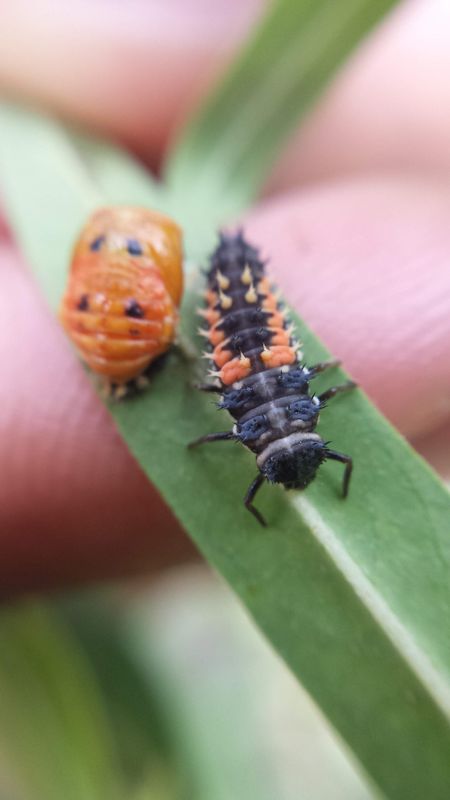
As an example, by following Integrated Pest Management (IPM) – Gardening Solutions principles, my first step was identifying aphids on the guara flower stems. I could spray a strong stream of water to knock them off, or cut the flower stems back and dispose of the infected stems and aphids and let the plant rebloom. What I observed was one different-looking bug among lots of aphids. It was the larval stage of a ladybug; they eat lots of aphids. Biological control had arrived! Spraying an insecticide wasn’t necessary. As a reminder, insects have several instar stages from egg to adult and they can look completely different in each stage. A good example is butterflies; from egg to larva (caterpillar) to pupa (chrysalis) to reproductive adult stage butterfly.
Another way to control pests in the garden is right plant, right place, one of the nine principles of Florida Friendly Landscaping. A plant that is stressed by inappropriate sunlight, soil, drought conditions or injuries can attract pests. Plants also prefer certain temperatures to grow and produce. That’s why we tell you not to plant and to pull crucifer crops when it gets hot. I tried to save a pretty edible red kale for seeds, but it turned into a trap crop for bugs, so into a plastic trash bag it went.
Not all garden pests are bugs; some are mites (arachnid, the spider family) and snails and slugs (gastropods). There are some beneficial members of those families, though.
Each one of these pests and beneficial creatures could be the subject of an article. I’ve previously written Times-Union articles on the predatory Rosy Wolf snail (my garden heroes who took care of a bumper crop of round brown snails) and bark or tree cattle (Archipsocus nomas). I don’t use poisons in my garden and usually just have a few eaten leaves. With time, patience, observation and spot control, you too can move to a more natural, ecologically balanced garden.
Brenda Daly is a Master Gardener volunteer with the Duval County Extension Service and the University of Florida/IFAS. For gardening questions, call the Duval County Extension Office at (904) 255-7450 from 9 a.m. to noon and 12:30 to 3:30 p.m. Monday-Friday and ask for a Master Gardener volunteer.
This article originally appeared on Florida Times-Union: Not all bugs in your garden are pests. How to tell the difference.
Reporting by Brenda Daly, For the Jacksonville Florida Times-Union USA TODAY NETWORK / Florida Times-Union
USA TODAY Network via Reuters Connect