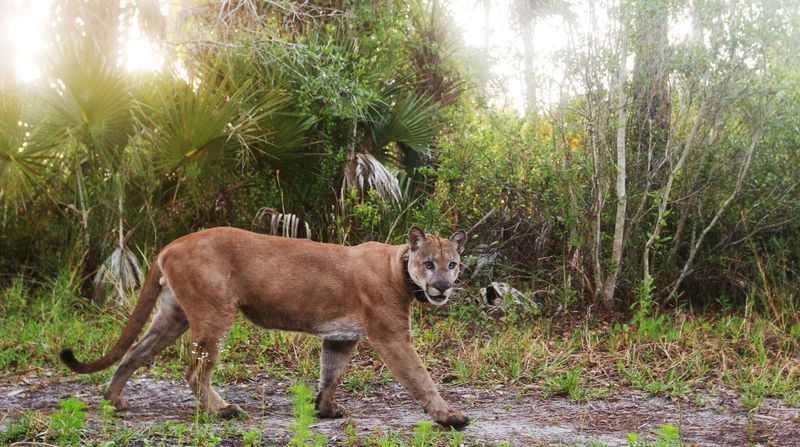
The timing was almost cinematic: Word of a female Florida panther kitten hit and killed in rural Collier County came hours after news that three nonprofits plan to sue the federal government for failing to protect the imperiled cats.
Though advocates have called the situation dire for years, there’s a new tone when they talk about the potential suit with terms like “last stand,” make or break” and “”tipping point.”

Three nonprofit advocacy groups have warned the U.S. Fish and Wildlife Service, the U.S. Army Corps of Engineers, and a developer, Tarpon Blue Silver King I LLC, that they intend to file a federal lawsuit in 60 days over a large proposed development in Collier’s Florida panther habitat.
The project, Rural Lands West, is a 10,264-acre residential/commercial development. The groups say federal agencies violated the Endangered Species Act by authorizing the project in what they describe as active breeding and primary zone panther habitat. They say the agencies didn’t take a hard enough look at the project’s potential impact and that what they characterize as a cursory look can spell doom for the species.
Agencies “never considered how this project would affect both the survival and recovery of the species,” said attorney Jason Totoiu, with the Center for Biological Diversity, one of the involved groups, along with the Sierra Club and South Florida Wildlands Association. “What is troubling here is that likely we’ll establish a precedent moving forward that future projects will succumb to this same sort of cursory analysis (without) a real, critical look.,” he said. “We just don’t know what is that tipping point right now.”
In their notice, the groups argue that the Fish and Wildlife Service relied on a biological opinion ”that didn’t adequately analyze how the development could affect panthers’ ability to recover, whether the species is already in jeopardy, or whether the project could worsen those risks,” Totoiu said.
The groups’ notice gives the defendants 60 days to fix their mistakes, says Matthew Schwartz, executive director of the South Florida Wildlands Association, to “take what they wrote, throw it in the garbage and say ‘We were wrong; we’ll start from scratch,” Schwartz said with a sardonic chuckle. “So yeah, we’re expecting it to go to a lawsuit.”
The notice also points to the project’s proximity to the Florida Panther National Wildlife Refuge – “just a stone’s throw away,” is how Schwartz characterizes it – established in 1989 and managed by the Fish and Wildlife Service. The groups say the government analysis didn’t address potential harm to panthers living in or using the refuge.
The groups cite ongoing threats to the species, including continued habitat loss and vehicle strikes, the No. 1 cause of Florida panther deaths. “When you look at the panther mortality maps, you can take away the roads but you can see the roads on the maps just by looking at the dots where panthers are killed … roads in the middle of the habitat are just lit up with panther deaths,” Schwartz said. Deaths like the 8-month-old kitten announced the same day as the legal action.
Any new development will mean more roads, more cars and more dead panthers, he says.
Panther recovery goals call for three viable, self-sustaining populations of at least 240 cats each, supported by sufficient quality habitat, before the species can be considered recovered.
“The whole point of the Endangered Species Act is to list species so that we can provide them with the protections and tools and the money needed to eventually recover them and remove them one day from the list,” Totoiu said. “If agencies never look at recovery, you’re not effectuating the goal of the act.”
Though he’s been fighting for decades, Schwartz says this one feels different.
“I literally think this is the panther’s last stand and I’m not saying it to be dramatic. I think it’s true,” he said. “If this lawsuit fails, I think we’re done. I think that if this lawsuit, with the issues that we’re raising and are going to raise in the actual lawsuit – if they can find a way to OK this (development) there’s so many more projects in the works, how are we going to stop those?”
“The whole point of this lawsuit is really to challenge the system – not just this project … We’re challenging their approval process for the panther, and hopefully we win because if they win, they’re going to have developed all that land, and the public lands will become little islands – isolated, fragmented islands.”
This article originally appeared on Marco Eagle: No more Florida panthers? Some claim Collier’s plans signal the end
Reporting by Amy Bennett Williams, USA TODAY NETWORK – Florida / Marco Eagle
USA TODAY Network via Reuters Connect