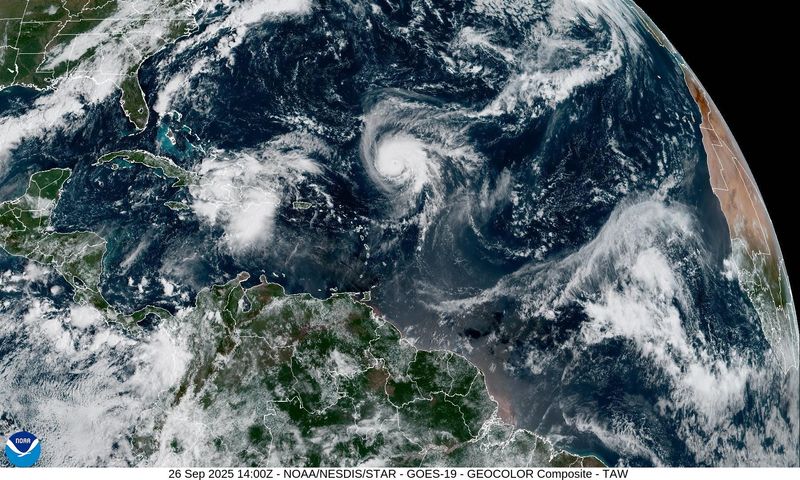
For the second time in history, Hurricane Humberto has the opportunity to create an atmospheric phenomenon more commonly seen in the Pacific basin known as the Fujiwhara Effect.
When two tropical systems spinning in the same direction get within a certain distance of each other, they can find themselves caught in a mesmerizing dance around a focal point.

It’s not a frequent occurrence in the Atlantic basin due to how far apart storms are typically spaced, according to the National Hurricane Center. There have been a few notable cases over the decades, including the 1995 Atlantic hurricane season, when another Hurricane Humberto was weakened by Hurricane Iris before being absorbed by an extratropical cyclone.
Forecasters say that there’s a non-zero chance that we could see the same phenomenon happen again, with Humberto positioned roughly 900 miles east of Invest 94L, which is forecast to develop into Imelda over the weekend into early next week.
What is the Fujiwhara Effect?
Japanese meteorologist Sakuhei Fujiwhara first wrote about the complex interaction in a 1921 research paper. It’s often described as a dance between two tropical systems with the stronger system leading the weaker one.
The Fujiwhara Effect can complicate forecasts due to the erratic nature of the storms’ movements, but there are typically four outcomes:
What happens during the Fujiwhara Effect?
Physics. In the northern hemisphere, storms rotate counter clockwise due to the Coriolis Effect. The gravity of two storms spinning in the same direction within a certain proximity together with pull them toward each other.
How the storms interact depends on their size, how far apart they are and other environmental factors. Storms of equal size will dance. If there is an imbalance, the stronger storm will impact the weaker storm’s path and could absorb it if it’s close enough, according to the NHC.
Do merging hurricanes form super hurricanes?
During the Fujiwhara Effect, merging storms don’t necessarily combine their strength to create a singular, massive hurricane. Instead, one of the storms will typically steal moisture from the other storm, allowing it to strengthen further while the other weakens and dissipates.
What are the chances that Hurricane Humberto and Imelda create the Fujiwhara Effect?
The answer to that question remains unclear. Tropical systems typically have to be within roughly 870 miles of each other before the Fujiwhara Effect occurs.
Depending on how strong Hurricane Humberto becomes, it’s possible that it steers the potential Imelda toward the United States before it happens. AccuWeather forecasters also point out that either of the storms could stall offshore while the other moves away.
Why does the Fujiwhara Effect rarely happen in the Atlantic?
The reason the Fujiwhara Effect is uncommon in the Atlantic can be chalked up to a lack of coincidence. Tropical cyclones in the Atlantic basin are sparse compared to the Pacific, where the Fujiwhara Effect is more common.
The Atlantic on average spawns fewer tropical systems than the Pacific. When storms do form, the sheer size of the geographical area they travel leaves little opportunity for storms to exist within the necessary proximity.
Humberto helped create the Fujiwhara Effect before
There have only been a handful of times when the Fujiwhara Effect was recorded in the Atlantic basin, and one of the most notable occurrences was when another hurricane named Humberto was absorbed by Hurricane Iris in 1995.
That version of Humberto was a Category 2 hurricane that was active between Aug. 22 and Sept. 1. Humberto and Hurricane Iris had a Fujiwhara interaction around Aug. 23, which led to both storms weakening due to wind shear disrupting their structure.
Afterward, Iris was downgraded to a tropical storm while Humberto was downgraded to a Category 1 hurricane. Humberto recovered briefly but was absorbed by an extratropical cyclone on Sept. 1, 1995.
This article originally appeared on Pensacola News Journal: Next week could be the 2nd time Hurricane Humberto creates Fujiwhara Effect
Reporting by Brandon Girod, Pensacola News Journal / Pensacola News Journal
USA TODAY Network via Reuters Connect