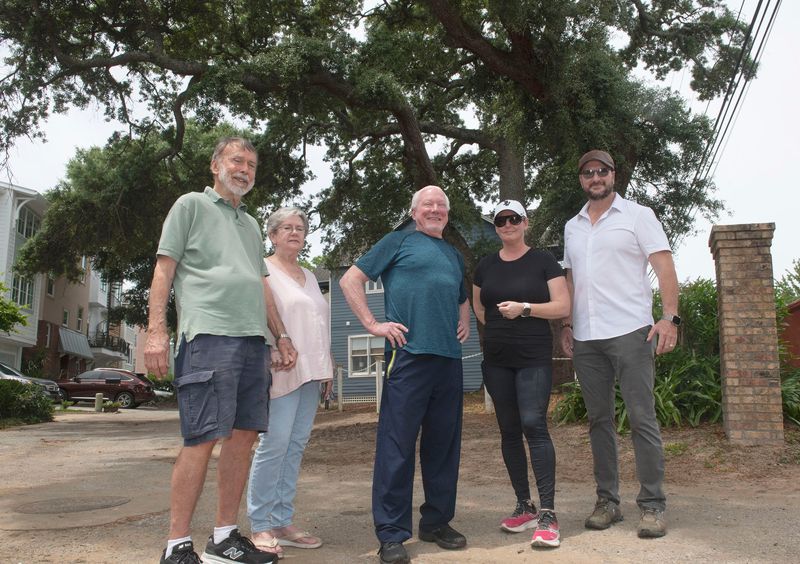
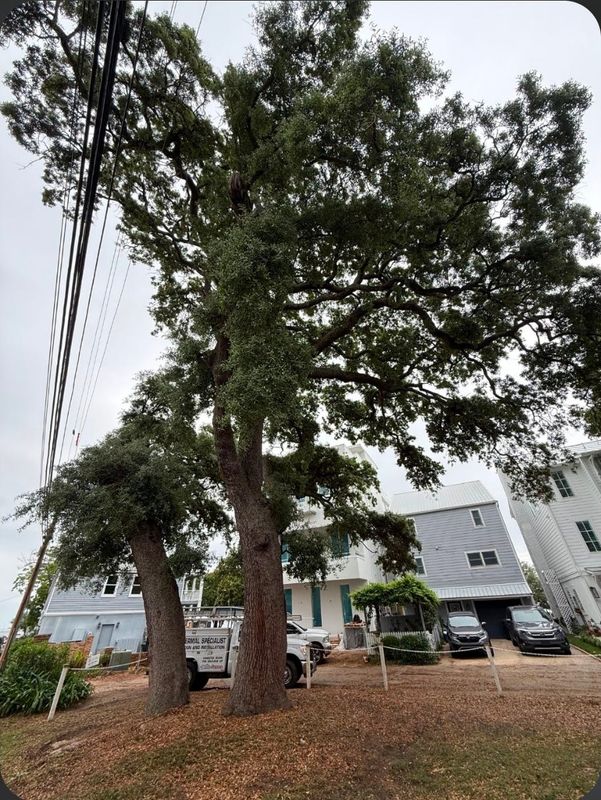
Neighbors at the end of E. Government Street in downtown Pensacola’s Seville Historic District are worried about the fate of two longstanding oak trees located on a lot that was recently sold to buyers whom residents say may tear them down to make room for a new home.
More than half a dozen residents are rallying around the trees at the lot located at 607 E. Government St.—a legacy oak estimated to be about 250 years old and a heritage oak estimated at 100 years old.

They said the previous owner of the property told members of the local homeowners’ association that she sold the lot to a couple who plan to build on it and may remove the trees.
“During the homeowners’ meeting where this was brought up, that she was selling the lot and they were going to build, I’m like, ‘Well, I guess I’m going to have to chain myself to the tree,” Sandy Magie said with a rueful smile.
Magie and her husband Rod have lived in the small subdivision of Crown Cove at the end of E. Government Street for 30 years. Their house is right across from the small empty lot that is home to the two trees.
“I’d like to preserve a little green space,” Sandy said, “and this is the last little bit of green space in Crown Cove, and this tree is so beautiful it just breaks my heart a little bit for it to come down to put a house on the lot.”
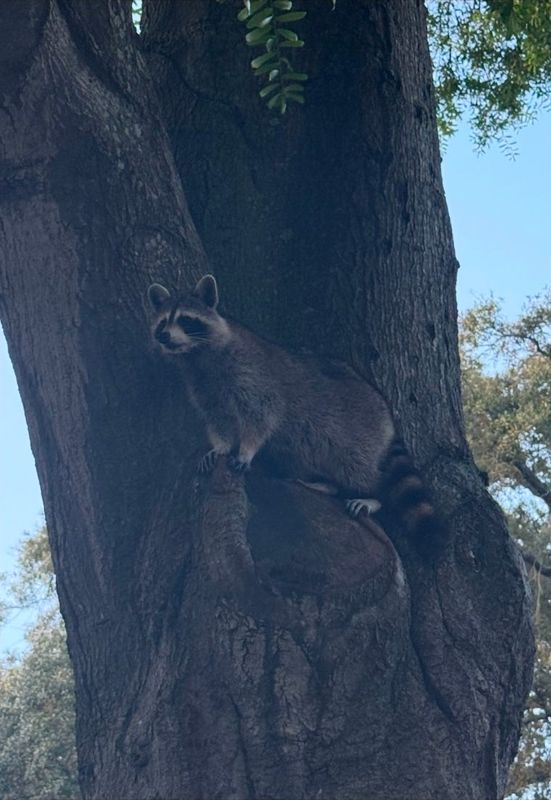
Neighbors value them so much—for their historic beauty and the habitat they provide for wildlife like birds, squirrels, and a family of raccoons—that they’ve encircled them with posts and a chain to help protect them from people who were parking on the vacant lot.
According to Pensacola Assistant Public Information Officer Dominique Epps, the city has not received a tree removal permit application for the property, which would be required to remove them, nor has the city issued a tree removal permit for the location.
“As of right now, the only record we have is a site visit conducted in March with a prospective buyer and realtor,” Epps said. “As a reminder, if a private property owner submits a tree removal application and follows the city’s tree ordinance, the city cannot prevent a private property owner from removing trees on their property.”
A “reinterpretation” of Pensacola’s tree ordinance?
Kevin Stephens owns the property next door to the lot and, like some of his neighbors, he wants the trees to stay.
He said he has been talking with city officials including Pensacola’s former and new city arborist who also indicated the new owners may want to remove one or both trees and that the city could sign off on it.
Stephens is concerned the city is “reinterpreting” ordinances meant to protect trees to avoid litigation, until “stronger language is added in the new land development code that protects these trees.”
“They said the city is now reinterpreting the existing law that says if your building footprint is larger than the existing tree there, you can chop the tree down,” Stephens said. “By that argument, I can go buy a lot with a big historic tree, design a house plan that’s bigger than it is, and tear the tree down. It’s unbelievable.”
Stephens and other neighbors are concerned that this “reinterpretation” of the city’s ordinances will not only mean the downfall of the two historic oaks in Crown Cove, but will also “be carte blanche across the board” for any tree once considered “protected.”
Chris Carroll lives across the street from the lot, and he doesn’t want to see the trees go.
He said he was forced to redesign a home he built on a different city lot due to Pensacola’s tree ordinance and says the law is there for a reason.
“We’re all about growth, but there’s a stopping point,” Carroll said. “This tree’s over 250 years old. You used to not be able to cut them down, but now this person can be able to cut them down? Then where does it end?”
According to the Escambia County Property Appraiser’s website, the property was purchased on April 24, 2026, for $171,000. The News Journal left messages for the owners, but they were not returned.
Stephen Preisser has lived in the neighborhood since 2019.
He said if the city is softening its interpretation of the tree ordinance, that seems to leave trees unprotected from any potential buyer who doesn’t want to work around the law.
“This lot can be developed without removing the tree. If you can develop this lot without removing the tree, I don’t understand why you get permission to remove the tree just because you want to build a bigger house,” Preisser said. “The answer would be to buy a bigger lot.”
According to city code, no protected or heritage tree can be removed without a permit from the city’s designated arborist, and “every effort must be made to protect and retain existing protected trees on proposed development sites,” but they may be approved for removal if one or more conditions are present including visibility hazard, safety hazard, construction of improvements, site conditions, compliance with other ordinances or diseased or weakened trees.
Stephens said the city arborists told him the trees on the recently sold lot are healthy.
He hopes by raising awareness these and other protected trees may not have to face the chopping block.
“If you talk to the average businessperson, developer, homeowner, city resident, etc., they’re going to tell you what we all thought, that a heritage oak or legacy oak can’t be taken down. We’re hoping for stronger language in the new land development code that protects these trees,” Stephens said.
Pensacola is working to provide more information on the city’s approach to the tree ordinance, but Epps added: “If and when the city is provided a site plan for a home on the lot showing the trees must be removed to accommodate construction, then a tree removal permit may be approved with tree replacement or mitigation fees (according to city code.)”
This article originally appeared on Pensacola News Journal: Neighbors ready to fight for legacy oak after new owners buy downtown lot
Reporting by Mollye Barrows, Pensacola News Journal / Pensacola News Journal
USA TODAY Network via Reuters Connect