Nat Ford’s farewell speech to the Jacksonville Transportation came almost one year to the day after JTA launched self-driving transit shuttles in downtown.
Ford was the force behind the creation of that system using autonomous shuttles — his official JTA biography calls it a “crowning achievement” of his time in Jacksonville — but he won’t be at the table when JTA decides whether to expand the shuttles to the rest of downtown at a cost of several hundred million dollars.

That far-reaching decision will come as JTA is at a crossroads in more ways than one. The agency is dealing with a sharp downturn in sales tax revenue that forced layoffs earlier this year and will reduce service on some bus routes in order to close the shortfall.
Ford is moving on to become CEO of the Dallas Area Rapid Transit Agency in October. The JTA board will choose someone this month from within the agency to serve as interim CEO. One of those potential candidates, Cleveland Ferguson, was a finalist this week to become CEO of MARTA in Atlanta, but the MARTA board chose its interim CEO for that post.
In Jacksonville, selection of a permanent replacement won’t come until December at the earliest.
JTA still must have a second round of public meetings on the future of the downtown Skyway and whether the agency wants to put autonomous shuttles on it or pick another use for the Skyway.
The NAVI system completed its first year with a track record of safety but struggled to build up ridership. The average cost per passenger trip was $479, according to a Florida Times-Union analysis for ridership and the cost of running the services.
In remarks to the JTA board at its June 29 meeting, Ford urged it to keep fostering the “culture of innovation” that made Jacksonville the first in the nation for putting autonomous shuttles in its regular fare-paying transit system.
“One of the accomplishments I’m especially proud of is how this board had the courage to embrace innovation,” he said. “Together, we transformed what many viewed as an ambitious dream into tangible progress.”
Immediately after Ford spoke to the board, City Council member Rory Diamond, who has called NAVI a boondoggle, delivered a far different message. He said City Council would like to reconsider its past support for authorizing $247 million for future expansion of autonomous shuttles to run on the Skyway.
“It also would give you the chance to say look, maybe autonomous vehicles weren’t the choice that we wanted to make,” Diamond said. “Maybe the numbers that were true four or five years ago aren’t true today.”
Big unknown for NAVI expansion is what it would cost
Then as now, the biggest question facing decision-makers is what the cost would be.
In 2021, City Council doubled the local gas tax to 12 cents per gallon for a $930 million list of projects that included $247 million for converting the elevated Skyway so rubber-tired autonomous shuttles could run on it as well as on streets with ramps connecting them.
Five years later, JTA officials say the cost will be much higher than $247 million figure in 2021 but have not released any estimates for the cost of various alternatives under consideration. They have said the agency would seek federal support to close the funding gap.
While the cost of expanding what JTA calls the Ultimate Urban Circulator has risen, ridership on the inaugural system on a Bay Street loop has remained few and far between.
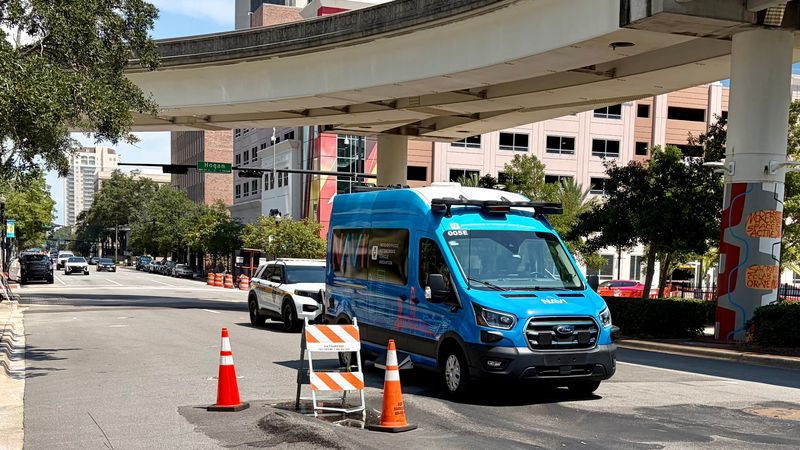
NAVI, which is short for Neighborhood Autonomous Vehicle Innovation, totaled 15,234 trips for its first year since service began on June 30, 2025. JTA has said the annual operating and maintenance cost of the NAVI system was about $7.3 million per year so that translates to a cost of $479 per passenger trip.
JTA recently renegotiated the contract to an annual cost of $5.8 million per year from July 2026 until July 2027. If NAVI has the same level of ridership over that time span, it would equate to $380 per passenger trip.
NAVI has avoided any headlines about crashes. JTA says the service posted an “exceptional safety record” with shuttles traveling 61,000 miles in the autonomous mode without any safety incidents caused by the autonomous system.
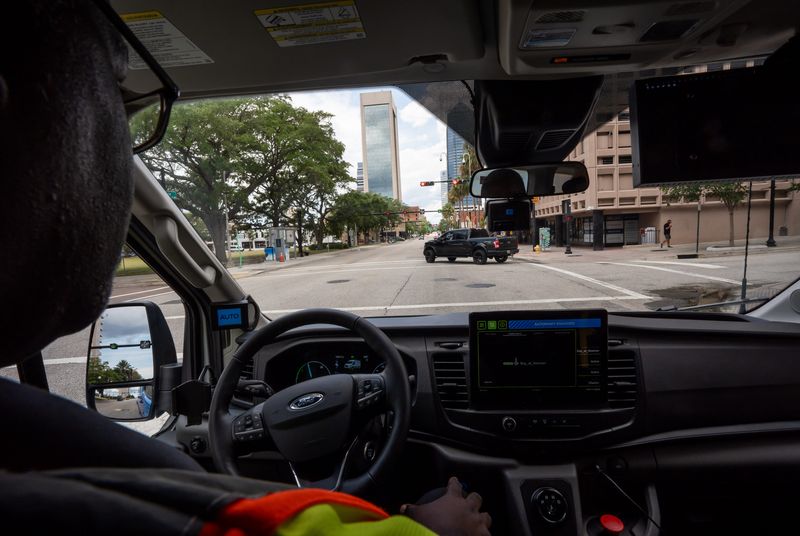
The vehicles still depend on drivers onboard the shuttles to take control of the steering for portions of their trips. In June, the vehicles traveled 85% of their mileage in autonomous mode where they were guided by technology on a route along Bay Street from office towers on the Northbank to the sports complex.
JTA says NAVI dealt with 80 route detours during its first year and whenever the shuttles shift to streets that don’t have the technology embedded along them, the drivers must manually steer the shuttles rather than them being in autonomous mode.
The shuttles still run from 7 a.m. to 7 p.m. Monday through Friday but in order to trim costs, JTA increased the waiting time at stations to 12 minutes from the original 7-minute waits for a NAVI shuttle to arrive.
NAVI gets raves from outside Jacksonville but not from residents
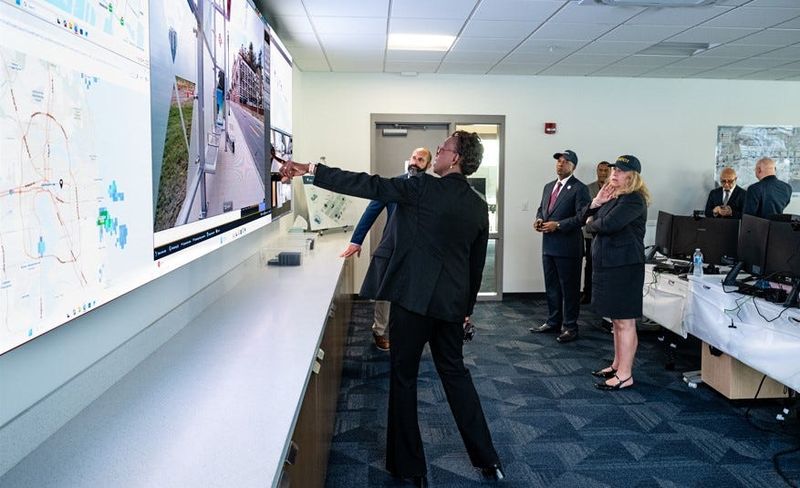
NAVI has attracted visits from other transit agencies and a glowing review by U.S. Department of Transportation administrator Seval Oz when she came to Jacksonville and cited “the visionary Nat Ford.”
“Jacksonville has become a model of how autonomous mobility can be integrated into an existing public transportation network and deployed in a way that serves communities,” said Oz, who is assistant secretary for reearch and technology.
But in Jacksonville, an ongoing JTA study about the future of the Skway found residents prefer to turn it into an elevated path for walking and bicycling as their top choice. No. 2 was running bigger trains on it. Putting NAVI shuttles on the Skyway structure ranked third.
JTA has not provided estimates for what different options would cost but it has said service using the Skyway structure would be down for five to six years for those alternatives. The long downtime reflects the structure would be largely reconstructed in order to make it usable for a different kind of transportation than the current Skyway vehicles.
JTA board Chair Aundra Wallace said after the board picks an interim CEO, that person can talk to the board about all the projects that JTA has in the works. He said he thinks the final decision on the future of the Skyway should wait for a permanent CEO who can then engage with federal officials.
“My personal opinion is that is a conversation that has to be had at the federal level,” Wallace said. “I do not think it’s fair to put an interim person in the position of having to have a conversation about the Skyway.”
The board plans to hire an interim CEO later this month by inviting administrators already working for JTA to apply for the position.
Ferguson, the executive vice president and chief administrative officer at JTA, was among three finalists interviewed Aug. 10 by the MARTA board in Atlanta, according to the Atlanta Journal-Constitution.
“The process gave us three exceptional candidates, and I don’t say that lightly,” MARTA board Chair Jennifer Ide said, adding each finalist “brought something real to the table and any one of them could have lead MARTA well.”
Ford said after MARTA named Ferguson a finalist he is an “outstanding executive” and said he has “tremendous confidence in his abilities.”
“We have an exceptionally talented leadership team, and I’m proud of the depth and experience we have within our organization,” Ford said Aug. 10.
“Our focus remains on continuing to serve our customers, executing our strategic priorities and ensuring a smooth transition for the organization,” Ford said.
After that transition, the decision on the future of NAVI and the Skyway will rest with JTA board who will be casting their first votes on whether to expand the autonomous system. None of the current seven members were on the board in 2021 when JTA and the city reached the agreement on dedicating $247 million of gas tax revenue toward the Skyway conversion for the Ultimate Urban Circulator.
(This story was updated to add new information.)
This article originally appeared on Florida Times-Union: Nat Ford departs JTA as his autonomous transit vision is at crossroads
Reporting by David Bauerlein, Jacksonville Florida Times-Union / Florida Times-Union
USA TODAY Network via Reuters Connect
By David Bauerlein, Jacksonville Florida Times-Union | USA TODAY Network