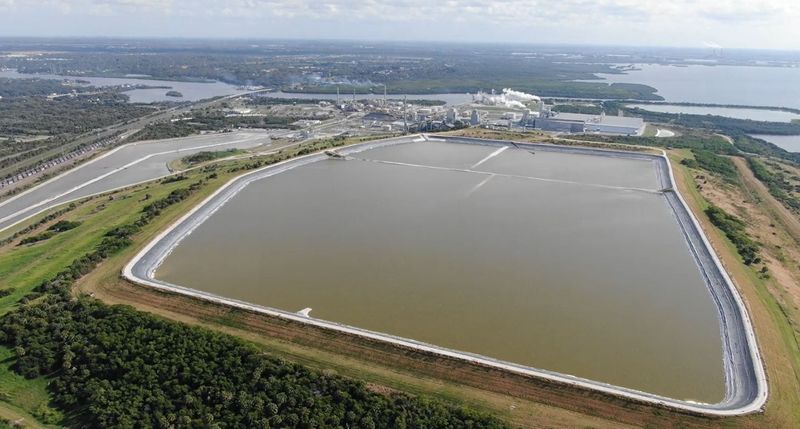
The Mosaic Company aims to inject wastewater contaminated during fertilizer mining and processing deep underground in Polk County, and the Florida Department of Environmental Protection has already granted the first permits necessary to make the effort a reality.
The Florida DEP, often criticized by environmental advocates for failing to regulate the fertilizer industry and other environmental protection shortfalls, has issued a draft permit that would allow Mosaic Co. to drill a Class V exploratory well in Polk County at its facility in Bartow.

The permit, issued in August, does not allow the company to dispose of wastewater. However the exploratory well would be used to evaluate how suitable geology 8,000 feet underground is to confine the Mosaic’s wastewater, and to what standards the company would have to treat it to before injection.
Mosaic would have to apply for a Class I permit to be able to inject its waste underground, but environmental activists are concerned that the writing is already on the wall and that Mosaic will one day be able to dispose of its hazardous waste underground.
“This really just looks like another page in the book about our failing regulatory accountability for really dangerous waste here in the state,” Florida Director for the Center for Biological Diversity Elise Bennett said. “Time and time again we see a lack of accountability, and ultimately that hurts Floridians and the environment that we rely on for our health.”
Mosaic’s Plan: A Safe, Scientific, and ‘Highly Regulated’ Process
Mosaic considers plans to treat hazardous wastewater and inject it deep underground as a safe, common and scientifically rigorous endeavor that is often misunderstood.
However, if permitted, the effort represents the first time Florida’s robust fertilizer production industry would be allowed to inject waste from active operations underground. The former Piney Point fertilizer processing plant in Manatee County, which is not Mosaic property, was granted a permit to inject waste underground in 2021 after a breach forced the release of hundreds of millions of gallons of polluted wastewater into Tampa Bay. However, the facility closed operations in 2001 and its wastewater predominantly stemmed from dredging material that was disposed of on the property in 2011 and stormwater that collected in its ponds since then.
Mosaic hydrologist David Brown emphasized that the current Mosaic permit is strictly for exploration. The wells will intersect with 65-million-year-old rock formations containing highly saline water, and core samples of the rock will be analyzed to ensure any wastewater is treated to a point where it is deemed compatible with it.
The company would need a permit before starting efforts to treat wastewater to state standards and inject it underground. Environmental advocates say those standards fall short of the level of treatment needed if the company were to dispose of its waste into Florida surface waters, and are concerned that any mishap could lead to contamination of groundwater sources.
“I think people do not fully understand the process that you must go through,” Brown said. “There’s not going to be raw process water injected into the ground, that’s not going to happen. That’s something that would not be allowed by law.
Brown described deep well injection as a common practice in the state, with over 200 wells already in operation for various types of wastewater. He also stressed the process includes multiple layers of safety, including a nearby monitoring well and a requirement to re-prove the well’s integrity every five years to renew the permit.
“The water has to be treated to a point that it is compatible with the formations and water quality at depth,” Brown said. “We don’t know what that is at our location… So we bring back samples of the rock at depth, and that’s when you find out exactly what will have to be done to safely and effectively dispose of the water at Mosaic. No one knows those details yet, but the absolute bottom line is it must be compatible with the formation and the water at depth.
“The absolute bottom line is it must be compatible with the formation and the water at depth,” he said. “You cannot inject hazardous fluids into the ground in the State of Florida.”
Environmental Concerns: A ‘Cradle to Grave Operation of Pollution’
Environmental advocates view Mosaic’s plan not as a scientific step, but as another dangerous proposal from an industry with a long history of environmental disasters that include sinkholes at Mosaic’s own Mulberry facility.
Manasota-88 Chairman Glenn Compton said the injection well is a cheap way for the Mosaic Co. to dispose of its waste without treating it to standards suitable for surface water disposal.
Compton and other critics expressed concern that once the contaminated water — which they say contains heavy metals like arsenic and cadmium — is underground, any mistake is irreversible.
“We know that over time all wells are going to fail,” Compton said. “We don’t have a crystal ball where we can see underground and actually know where this wastewater ends up, and once we learn that there is a problem it’s too late to do anything about it.”
Bennett, the Florida director for the Center for Biological Diversity, added that Florida’s unique geology makes the plan even riskier.
“The industry can’t say for certain that they won’t be affected by either a sinkhole or some other event that ultimately leads to the mixing of their waste and our fresh drinking water,” she said.
The Center for Biological Diversity is currently engaged in two lawsuits reflecting its deep distrust of the industry and its regulators. One suit challenges the federal Environmental Protection Agency to classify phosphogypsum, a primary byproduct of fertilizer production, as the hazardous waste. The other contests approval of a pilot project to use phosphogypsum in road construction.
“Every step taken is just a step closer to putting this waste in places that are inappropriate,” Bennett said. “If keeping it in piles that are lined and away from the public hasn’t been enough, then I don’t think putting it underground near our aquifers is any better. Any step without independent scientific research and rigorous analysis is really reckless, and it puts the health and wellbeing of Floridians below the interests of a polluting industry.”
This article originally appeared on Sarasota Herald-Tribune: Mosaic Co. aims to inject fertilizer production wastewater 8,000 feet underground
Reporting by Jesse Mendoza, Sarasota Herald-Tribune / Sarasota Herald-Tribune
USA TODAY Network via Reuters Connect