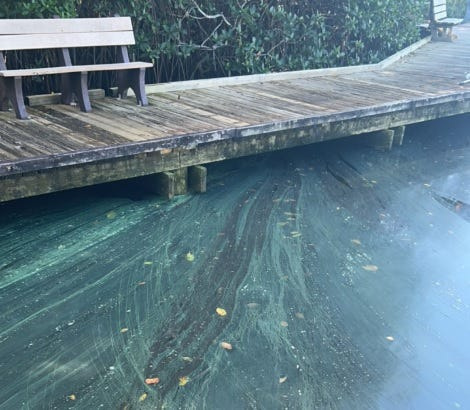
Four reports of toxic algae in Lake Okeechobee in Martin County prompted an Aug. 22 Florida Department of Health water advisory to be careful in those areas.
The alert is in response to water samples taken on Aug. 18 and Aug. 19. The public should exercise caution in and around Lake Okeechobee, according to the Department of Health in Martin County.

Here’s when and where the four algae blooms were reported:
Cyanobacteria, commonly called blue-green algae, contained the toxin microcystin at a level of .27 near the St. Lucie Canal, .78 near the Palm Beach County line, .27 near Southwest Conners Highway and .27 in the area just south of the Okeechobee County Line, according to the health department.
Microcystin is harmful to people, pets and wildlife to touch, ingest or inhale when the level is 8 parts per billion, according to the Environmental Protection Agency.
DOH, DEP test for cyanobacteria
The Florida Department of Environmental Protection collects water samples, which are analyzed at a laboratory, then publishes the results online at Protecting Florida Together and on the DEP’s Algal Bloom Dashboard.
Algae is common in Florida’s freshwater environments, but a bloom occurs when rapid growth of algae leads to an accumulation of individual cells that discolor water and often produce floating mats that emit unpleasant odors.
Blooms can appear as various-colored scum, foam or paint on the water surface, but algae in the water may not always be visible.
Some environmental factors that contribute to blooms are sunny days, warm water temperatures, still water conditions and excess nutrients, such as nitrogen and phosphorus from urban development and farms. Blooms can appear year-round but are more frequent in summer and fall.
Toxic algal bloom precautions
The DOH advises residents and visitors to take these precautions:
What do I do if I see an algal bloom?
Tim O’Hara is TCPalm’s environment reporter. Contact him at tim.ohara@tcpalm.com.
This article originally appeared on Treasure Coast Newspapers: Martin County DOH: Lake O has 4 reports of toxic cyanobacteria, prompting water advisory
Reporting by Timothy O’Hara, Treasure Coast Newspapers / Treasure Coast Newspapers
USA TODAY Network via Reuters Connect