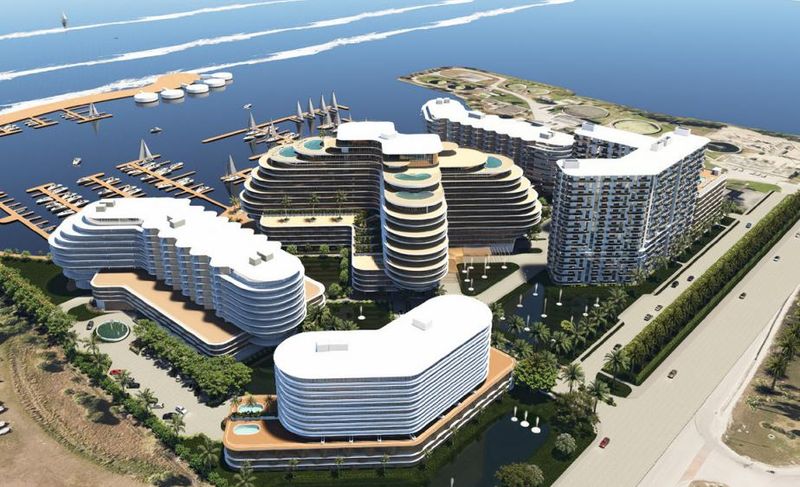
FORT PIERCE — City leaders have recently decried the state’s Live Local Act, saying it ties their hands from stopping unprecedentedly massive high-rise buildings from being built on South Hutchinson Island.
What is the Live Local Act, what kind of development does it allow and more questions answered:

What is the Live Local Act?
The Live Local Act, also known as Senate Bill 102, is a law passed by the Legislature and signed by Gov. Ron DeSantis during the 2023 legislative session. It went to effect on July 1, 2023.
The law has been updated each year since it passed, but at its core it remains the same. In an attempt to incentivize affordable-housing construction, the law allows developers to circumvent certain local approval processes and get around many local development restrictions if a certain percentage of the project is set aside for affordable housing.
In its current form, at least 40% of units must be affordable for households that make 120% or less of the Area Median Income.
Projects that meet that mark can build to the highest allowed density on any residential land anywhere in the city and to the highest allowed height anywhere within 1 mile of the project, regardless of existing zoning or land use for the property. Qualified developments may also receive tax incentives available specifically for Live Local Act projects.
Will the Causeway Cove project qualify for the Live Local Act?
Developers have proposed five high-rise buildings, each well above existing height limits at the Causeway Cove Marina property on South Hutchinson Island, and have claimed they will use the Live Local Act to build them.
Of the more than 1,000 apartment units planned, more than 400 would have to be set aside for affordable housing in order to qualify for the law.
If the project meets that mark, it would be able to get around the 45-foot height limit for South Hutchinson Island properties inside the Fort Pierce city limits.
However, the law only allows developments to be built to at most match the tallest approved height within 1 mile.
In the justification statement that Causeway Cove developers submitted to the city, the tallest approved project within 1 mile is listed as the hotel/parking garage at King’s Landing, at 11 stories. Yet the site plans for the development show five buildings at 17, 17, 14, 14 and 11 stories.
Despite the developer only mentioning King’s Landing, city spokesperson Kaitlyn Ballard said via email that city staff have determined there are properties within a mile of Causeway Cove where zoning allows for building up to 200 feet.
What do supporters of the Live Local Act say it does?
The Live Local Act is intended to increase the state’s supply of affordable housing by encouraging developers to build more lower-priced units.
“The act aims to significantly bolster the availability of affordable housing options for Florida’s dedicated workforce, allowing them to reside in the very communities they tirelessly serve,” according to the Florida Housing Coalition. “This groundbreaking legislation not only allocates historic levels of funding to workforce housing but also introduces a wide array of novel programs, incentives and prospects. It endeavors to reshape Florida’s housing strategy with a singular focus: enhancing accessibility to housing for all.”
It overwhelmingly passed both houses of the Legislature in 2023, 40-0 in the Senate and 103-6 in the House.
What complaints do critics of the Live Local Act have about it?
The law was heavily opposed by local governments. The Florida League of Cities, which represents 411 local governments, lobbied heavily against it, claiming it was an overreach by the state against home rule.
“The Florida League of Cities, which we all are members of, fought this, and we fought it valiantly, but we were not successful because they were determined to pass this law,” Fort Pierce Mayor Linda Hudson said. “It’s a developer’s dream.”
The law is likely to result in a number of large developments that cities will have no ability to restrict, Fort Pierce City Commissioner Michael Broderick said.
“From my perspective, this is the tip of the iceberg. This is just going to be the first round of this,” Broderick said. “The only thing I can say is there’s going to be a lot more to come of this as developers analyze this statute, how it works and how it navigates around cities like the city of Fort Pierce. We’re going to be, I think, deluged with these, and we’re going to sit here twiddling our thumbs. There’s nothing we can do.”
Can cities opt out of the Live Local Act?
Some cities have begun to opt out of the Live Local Act, or portions of it. Many of those cities, such as Orlando, have cited the law’s tax provisions, which allow for up to 75% exemptions to developers from local property taxes.
However, to be eligible to do so, local governments must prove that they already have enough affordable housing available.
Wicker Perlis is TCPalm’s Watchdog Reporter for St. Lucie County. You can reach him at wicker.perlis@tcpalm.com.
This article originally appeared on Treasure Coast Newspapers: Live Local Act: What to know as controversial state development law impacts Florida cities
Reporting by Wicker Perlis, Treasure Coast Newspapers / Treasure Coast Newspapers
USA TODAY Network via Reuters Connect