A very early morning, or late-night, depending on how you look at it, SpaceX rocket launch is expected to lift off from Florida this week.
If all goes according to plan, a SpaceX Falcon 9 rocket will carry AST SpaceMobile’s BlueBird 11, 12 and 13 cellular broadband satellites into low-Earth orbit in the early morning hours of Wednesday, Aug. 5. And the launch is scheduled for a little over an hour after a portion of a Falcon 9 rocket launched in 2025 is expected to make impact with the side of the moon that faces Earth.

Though rockets here launch from NASA’s Kennedy Space Center or Cape Canaveral Space Force Station, people can sometimes see this phenomenon far beyond the launch pad.
Watch NASA+ content with Amazon Prime Video
Weather permitting and depending on cloud cover and trajectory, a rocket launch from Florida’s Space Coast could be visible as far north as Jacksonville Beach and as far south as West Palm Beach.
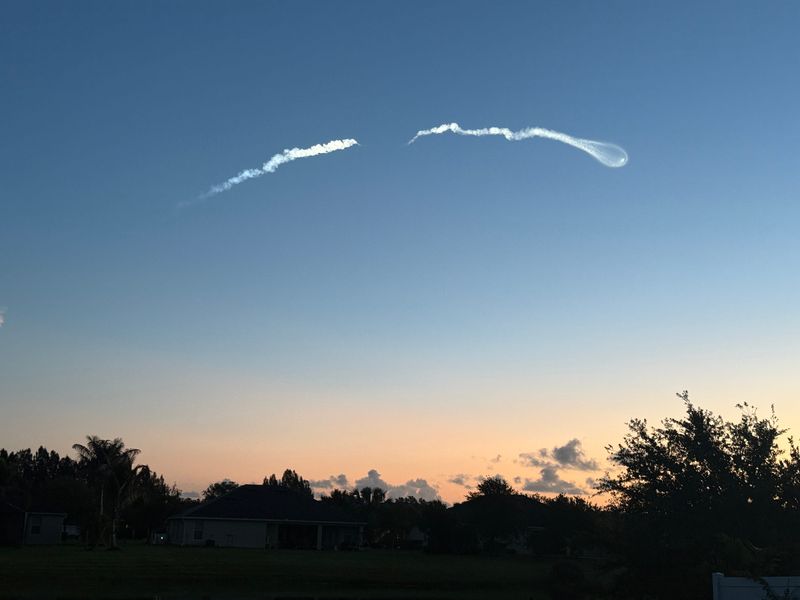
When there’s a launch window in the middle of the night or very early morning, there’s an opportunity for unique photos — the rocket lights up the dark sky, and the contrail afterward makes for a great photo.
Below is more information on the next rocket launch from Florida, suggestions on where to watch it and how to watch some launches with NASA+ on Prime Video.
For questions or comments, email USA TODAY Network Space Reporters Rick Neale at rneale@floridatoday.com, Brooke Edwards at bedwards@floridatoday.com or Eric Lagatta at elagatta@usatoday.com. For more space news from the USA TODAY Network, visit floridatoday.com/space.
Wednesday, Aug. 5, SpaceX AST SpaceMobile 11-13
Will a SpaceX rocket hit the moon tonight?
In short, yes. But it is not an entire Falcon 9 rocket that will impact the side of the moon that faces Earth tonight, it’s just a portion of it. A few months ago, an independent astronomer predicted that a portion of a SpaceX rocket was on a collision course with the moon, more than a year after it launched from Florida.
Now, the upper-stage of the Falcon 9 rocket is less than a day away from slamming into the moon at more than seven times the speed of sound. The crash is expected to create a new crater on the moon’s pockmarked surface and kick up enough dust that powerful instruments may be able to spot it on Earth, more than a quarter-million miles away.
Since January 2025, a portion of a SpaceX Falcon 9 rocket has been orbiting high above Earth, taking 26 days to complete one trip around the planet. Now, that portion of the launch vehicle is projected to imminently crash into the moon’s near side, which permanently faces Earth. Because the moon has no atmosphere, the hardware has no chance of burning up before impacting the lunar surface.
The prediction came from Bill Gray, an astronomer who writes the widely used Project Pluto software to track near-Earth objects like asteroids, comets and human-made spacecraft. Gray’s analysis was based on ground observations from telescopes and surveys of the orbit of the object, which has been designated 2025-010D.
The 8,800-pound Falcon 9 upper-stage is projected to crash into the moon at approximately 2:35 a.m. ET Wednesday, Aug. 5, near a feature known as the Einstein crater, according to Gray. The object will be traveling at about 2.43 km a second, or 5,400 mph, when it strikes the moon, according to Gray’s analysis.
Where can I watch a rocket launch in Florida?
A rocket launch with a northeast trajectory can be visible as far north as Jacksonville Beach, Florida, which is about 160 miles north of Cape Canaveral (about a two-hour and 30-minute car ride, depending on which route you take).
Rocket launches with a southeast trajectory can be seen as far south as West Palm Beach, Florida, which is about 150 miles south of Cape Canaveral (about a two-hour-and-20-minute car ride).
Rocket launches are most visible from the Space Coast, where they launch from, and are often visible from the Treasure Coast and Volusia County as well.
Where to watch a rocket launch in Sebastian, Vero Beach, Florida
Where to watch a rocket launch in Fort Pierce, Jensen Beach, Florida
Where to watch a rocket launch in Stuart, Florida
Watch some rocket launches with NASA+ on Prime Video
NASA content, including some rocket launches, is available to watch through NASA+ on desktop, both from its official site and YouTube. The platform is also available to download as a mobile app on smartphones.
All NASA+ content is also available to those who have Prime Video downloaded on any of their devices – whether it be a smartphone or smart TV.
Watch NASA+ content with Amazon Prime Video
The content, which does not require a Prime subscription to view, is one of Prime Video’s FAST channels (free ad-supported television). Viewers can find it under Prime’s Live TV section at the top of the screen when they open the app.
Lianna Norman and Jennifer Sangalang are trending reporters for the USA TODAY NETWORK-Florida, covering rocket launches, Florida wildlife, breaking news and more. You can get all of Florida’s best content directly in your inbox each weekday
This article originally appeared on Treasure Coast Newspapers: Late-night SpaceX launch from Florida. Watch from the Treasure Coast
Reporting by Lianna Norman, Jennifer Sangalang, Rick Neale, Brooke Edwards and Eric Lagatta, USA TODAY NETWORK – Florida / Treasure Coast Newspapers
USA TODAY Network via Reuters Connect
By Lianna Norman, Jennifer Sangalang, Rick Neale, Brooke Edwards and Eric Lagatta, USA TODAY NETWORK – Florida | USA TODAY Network