Heads up, Florida. Along with alligators, Burmese pythons and Asian needle ants, now killer bees are spreading across the state — and the country — as average temperatures rise.
Africanized honey bees, often referred to as “killer bees,” are now found in 13 states and are slowly spreading northward, attacking people, livestock and pets along the way.

In the last three months alone, a man mowing his property died after a bee attack, three people were taken to the hospital after tree trimmers disturbed a colony, hikers ran a mile to get away from an agitated hive, and a woman and three horses were swarmed by a hive spooked by a lawn mower. The horses later died from “thousands” of stings, their owner said.
What are killer bees?
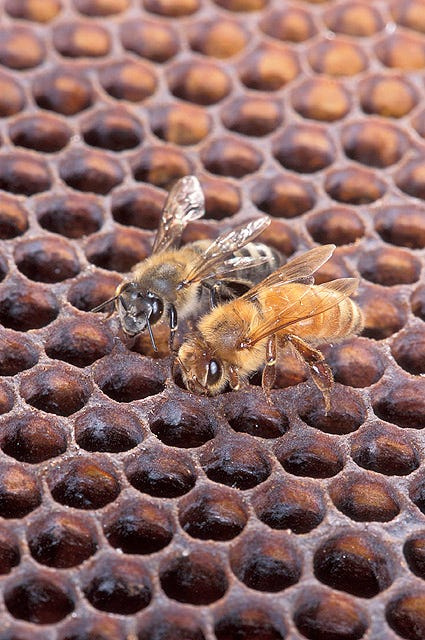
African bees are slightly smaller than the docile European honey bees that we’re used to in the U.S., and their sting and venom is the same.
But Africanized honey bees are more aggressive in protecting their nests, according to the Florida Department of Agriculture and Consumer Services. When threatened, colonies of Africanized honey bees will send out far more bees in a defensive response, leading to many more stings. They’ve also been known to follow their victims for up to a mile — even following cars and trucks — and can sting through regular beekeeping gear.
Bumping a European honey bee colony might get 5 to 10 bees coming after you, according to Jamie Ellis, a professor of honey bee research at the University of Florida.
“If I did the same thing with an Africanized colony, I might get 50 to 100 individuals who would follow me much farther and I’d get more stings. It’s really an issue of scale,” he said. And Africanized honey bees are also much more sensitive to potential threats.
“Killer bees” first made headlines in the 1990s when they began to appear in the United States, spawning alarming news stories and a surge of horror movies such as “Deadly Invasion: The Killer Bee Nightmare,” “The Swarm,” and “The Savage Bees.”
How many people have been killed by killer bees?
There’s no national database of bee-sting-related deaths, but a 2023 study by the Centers for Disease Control and Prevention found that on average, 72 people die a year from hornet, wasp and bee stings.
However, scientists emphasize that while Africanized honey bees are more defensive, they hold a lot of promise for overall honey bee health because they’re more pest and disease-resistant and are very genetically diverse. Breeding and gene manipulation could result in hardier (and gentler) versions.
Are killer bees in Florida?
At least 13 states have reported Africanized honey bees and in the south, southern Florida has the most.
“From Tampa to Orlando to Daytona, south of that, a large percentage of the feral bee population are of African decent. North of that, we don’t have much,” Ellis said.
While they are dangerous and pest control companies have reported multiple Africanized bee colony removals over the years, actual attacks are rare.
Africanized honey bees don’t like cold winters or high levels of rain. But as our climate changes and winters aren’t as cold, they’re finding agreeable habitats further north.
Africanized bees have also been reported in Alabama, Georgia, Louisiana and Mississippi, though they prefer dryer climates.
They’ve spread to the Southwest, where the arid environment matches the parts of South Africa where they’re originally from. Feral colonies are common in southern California, Nevada, Arizona, New Mexico and especially Texas.
They’ve also been seen in southwest Arkansas, southern Utah and about two-thirds of Oklahoma, said Allen Szalanski, a professor of entomology at the University of Arkansas.
How do I avoid killer bees? What do I do if I find an Africanized honeybee hive?
If you encounter aggressive bees, get away, fast. Don’t stand still, and run for an enclosed building or vehicle.
“Get away as quickly as possible. Don’t jump in water, don’t swat with your arms. Just run away as fast as you can,” Ellis said. “You might want to pull your shirt up around your nose and mouth to protect against stings that could cause swelling of your airway.”
The biggest threats are to tethered or penned animals that can’t get away, and to humans using heavy equipment who don’t hear the angry bees they disturbed until the swarm is on them.
After you get away, call for professional help, especially if you’re in a rural area where they’re more likely to be.
To avoid encounters in the first place, the FDACS advises:
How did killer bees come to Florida?
In 1956, Brazilian geneticist Warwick Kerr brought African bees to Brazil to hybridize them with Western honey bees from Europe and make honey-producing bees better adapted to Brazil’s climate. A year later, 26 Africanized queen bees were accidentally released into a nearby forest, where they thrived, said Kirk Visscher, an emeritus professor of entomology at the University of California, Riverside.
The hybrid spread rapidly through South America, Central America and Mexico and made it to Texas in 1990.
Florida had its first positive ID of an Africanized honey bee in the Tampa Bay area in 2002, the FDACS said.
What is Florida doing about the Africanized honey bees?
Florida established the country’s first African honey bee detection program, jointly operated by FDACS and the U.S. Department of Agriculture.
Nearly 500 bait hives have been placed throughout the state, the FDCAS said, primarily in port areas, along Interstate 10 and on the Florida-Alabama border. They are checked every three weeks, based on the bee’s reproductive habits. The FDACS also conducts educational outreach programs to inform the public about the dangers.
What are Florida’s bee laws?
FDACS regulates beekeeping and honey certification in Florida. All beekeepers must register their colonies and receive annual colony inspections. All beekeeping equipment used to house honey bees must be clearly identified with the owner’s name, contact and/or registration information.
Apiaries maintained on non-agricultural land must follow best management requirements for maintaining European honey bee colonies. All hives must have movable frames.
Inspections are also required if the hives are sold or moved and not clearly marked with the beekeeper’s registration number; for all out-of-state movements; and for all shipments moving into Florida from outside the state.
Violations are a first-degree misdemeanor for the first offense and a third-degree felony for subsequent offenses, and potentially a fine of up to $5,000 on top of any other penalties.
This article originally appeared on Fort Myers News-Press: Killer bees are spreading and they have been found in Florida. Here’s where
Reporting by Elizabeth Weise and C. A. Bridges, USA TODAY NETWORK – Florida / Fort Myers News-Press
USA TODAY Network via Reuters Connect