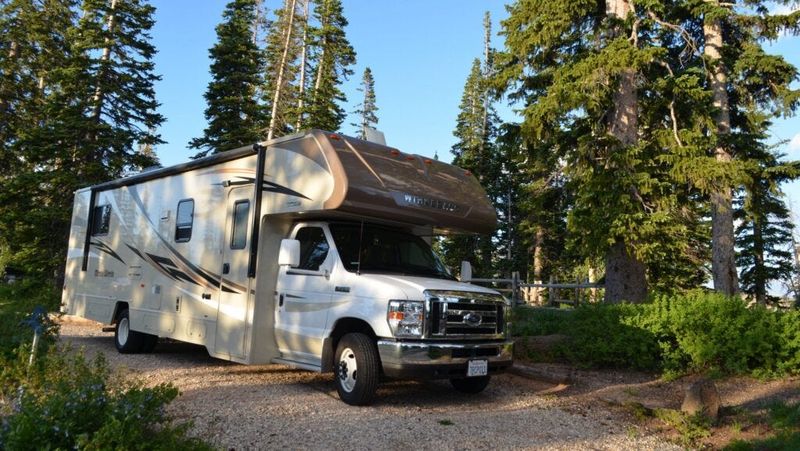
You’ve got a recreational vehicle, it’s a lot of fun, and you’ve started to wonder why you shouldn’t just live there all the time. Or you own property here, but no house, and you’d like to park your RV and make a little paradise for yourself in a warm place where there’s no state tax. Is that legal in Florida?
Yes and no.

Florida has no law against living in an RV as long as it meets local building codes and any requirements for utility and septic hookups. You can even establish residency there.
But every county and many cities have their own ordinances about RV use and storage, and most of them say you can’t live in one. Orange and Miami-Dade counties flat-out forbid it, for example.
Florida state law defines recreational vehicles as temporary living quarters, so local zoning codes and land-use restrictions apply. Licensed RV parks are all over the state, of course, but if you want to park anywhere else, you need to check your local city and county rules first.
Can you live in an RV in Florida on your own property?
Many cities and most Florida counties prohibit the use of RVs as permanent dwellings, and some may only allow it for a limited time under specific conditions.
The most common situation is when you’re building a new home or repairing an unlivable one on your land and you want to live there while you do. Some counties will issue temporary use permits to let you pull up and park while your single-family home is still under construction. But you must have an active building permit, and most require you to move out within a set time, usually 30 days after construction is completed. There may also be restrictions on how long you can do so in a calendar year.
Some counties — Columbia, Escambia, Franklin, Gilchrist, Hernando, Holmes, Jefferson, Polk, Suwannee, Walton, and Washington — will allow temporary stays. Those can run from 14 days up to six months, depending on the county, and are generally limited to specific zoning areas such as agricultural or environmentally sensitive areas. Requirements (or prohibitions) for utility and septic hookups can vary from county to county.
Which Florida counties allow permanent RV living?
The following Florida counties will let you live and sleep in your RV on a permanent basis. Check each county’s rules for specific details or any changes and updates. You may be limited to certain zoning areas, and there may be restrictions on where you can put your RV, what size the lot must be, and what electrical and sanitation methods are required or prohibited. Some may require your RV to be road-ready at all times, especially in flood zones.
Permits or affidavits of zoning compliance must be filed with the county.
Can you live in an RV in an HOA in Florida?
First of all, find out if your city or county allows permanent RV occupation at all. If so, make sure there is room on the lot to accommodate the RV under local zoning ordinances.
HOA rules will likely restrict you from parking the RV in a driveway or street, but a Florida law passed in 2023 specifically says parcel owners or tenants may store RVs on their property as long as no one can see it from the front or from an adjacent parcel.
Can I sleep in my RV at a Florida rest stop?
There are no federal laws against sleeping in a vehicle, and no Florida state law against sleeping in your vehicle in most public places during the day. Some areas in Florida, such as the Florida Keys, make it illegal to sleep in your car anywhere, at any time.
However, state law prohibits overnight sleeping in a vehicle in public spaces unless you’re legally allowed to be there. You also can’t stay in a public park or a beach where driving is allowed after it closes.
You can catch a few winks at highway rest areas, but only for up to three hours unless you’re a commercial motor vehicle driver, and then you can snooze for up to 10 hours.
Can I live in my RV in a Florida state park?
The maximum camping stay in a Florida state park is 14 days during peak times. After two weeks, you must leave and stay away for at least three nights before coming back, and you can only stay up to 56 nights in each six-month period (Oct. 1 – March 31 and April 1 – Sept. 30). A park manager may, at their discretion, extend the 14 days up to 28, depending on availability.
Can I live in my RV in a Florida national forest?
You are limited to 14 days per month in national parks. Any attempt to live there violates federal regulations.
Can I claim homestead exemption on my RV?
Maybe! If you are legally living in an RV on property you own as your permanent residence and you make a formal declaration of domicile, the county property appraiser will examine your situation and decide if homestead exemption would apply.
C. A. Bridges is a journalist for the USA TODAY Network-Florida’s service journalism Connect team. You can get all of Florida’s best content directly in your inbox each weekday day by signing up for the free newsletter, Florida TODAY.
This article originally appeared on Pensacola News Journal: Is it legal to live in an RV in Florida?
Reporting by C. A. Bridges, USA TODAY NETWORK – Florida / Pensacola News Journal
USA TODAY Network via Reuters Connect