

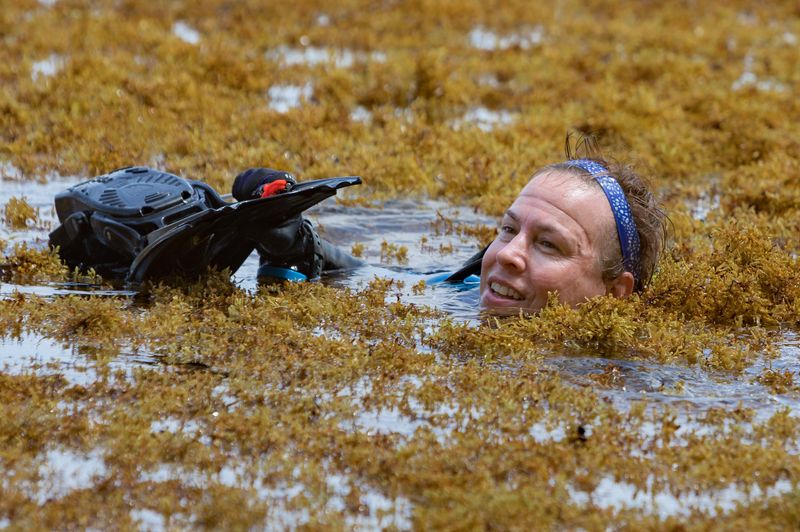
Sargassum, that stinky brown heap of rotting seaweed, has been piling up again at Palm Beach County beaches.
When it’s floating in the Atlantic, sargassum is great for marine life, offering habitats and nurseries. But when it hits the beach or travels up the waterways, it washes ashore and produces a truly epic and harmful stench and hosts organisms that can irritate the skin and cause respiratory issues.

The problem has been increasing in recent years. A record-high mass of nearly 30 million metric tons was floating across the Atlantic toward Florida and the Caribbean in May, according to the latest update from the University of South Florida’s Optical Oceanography Laboratory.
It’s expected to get even worse in June, just in time to force Florida residents and tourists to wade through the mess while seeking sun and surf.
Can we just get rid of it?
Is it legal to clean up or remove seaweed from the beach in Palm Beach County or Florida?
Sargassum is not protected in Palm Beach Country or Florida. As long as you pick it up with your hands or with hand tools, you can remove as much as you like, according to the Florida Fish and Wildlife Conservation Commission.
However, during sea turtle nesting season (March 1 through October 31 from Brevard through Broward counties and May 1 through October 31 in other Atlantic Coast counties), you have to check with the FWC first.
And if you want to remove enough that you’ll need mechanical equipment, or it would involve sand removal, excavation, or impacts to dune vegetation, you’ll need a permit first.
That’s on the beach.
Is it legal to clean up or remove sargassum from the water?
On the water, up to 100 pounds of sargassum can be removed from canals or nearshore state waters with a recreational fishing license. However, a commercial saltwater products license is required to remove more than 100 pounds, the FWC said.
Removal is prohibited in South Atlantic federal waters, as it is designated an Essential Fish Habitat for several open sea fish species, according to the Environmental Protection Agency (EPA). It’s also designated as Critical Habitat for loggerhead sea turtles under the Endangered Species Act in some areas of the U.S. South Atlantic and the Gulf.
What are Florida cities doing about sargassum?
Local municipalities have sent cleanup crews to clear out as much as they could, but it’s not easy. They must first survey the area for sea turtle nests, they must work to minimize how much sand they remove and check for baby sea turtles mixed up in the mess, and they generally have to avoid working during peak daylight hours when people are crowding the beach.
Meanwhile, more sargassum is floating in every day.
Sometimes, local cleanup crews will just move the piles to a less-populated section of the beach. Disposing of it elsewhere poses some problems.
Sargassumdecomposition produces hydrogen sulfide and ammonia, and bioaccumulated metals, especially arsenic. In an unlined landfill, they can contaminate groundwater and degrade the soil, the EPA said. Safer disposal would involve washing it first, an added and complicated expense. And not every beachside area has that much landfill room.
Potential uses for sargassum
Scientists, startups, and coastal communities are exploring a long list of possibilities. The EPA lists multiple potential uses for sargassum, ranging from compost and fertilizer to bioplastics, biofuel, biochar or charcoal briquettes, cement additives, chipboard, livestock and fish feed, soaps, and pharmaceuticals.
Some scientists are even trying to see if we can just eat it.
But for now, sargassum remains a smelly hassle to deal with.
C. A. Bridges is a journalist for the USA TODAY Network-Florida’s service journalism Connect team. You can get all of Florida’s best content directly in your inbox each weekday day by signing up for the free newsletter, Florida TODAY.
This article originally appeared on Palm Beach Post: Is it legal to clean up seaweed in Palm Beach County or Florida?
Reporting by C. A. Bridges, USA TODAY NETWORK – Florida / Palm Beach Post
USA TODAY Network via Reuters Connect
By C. A. Bridges, USA TODAY NETWORK – Florida | USA TODAY Network
