The wait for Invest 93L continues as it makes slow progress across Florida, and it could still become a tropical depression later this week, according to the latest advisory from the National Hurricane Center.
➤ Track all active storms

➤ Weather alerts via text: Sign up to get updates about current storms and weather events by location
As of 8 a.m., Invest 93L was moving west across Florida’s Panhandle between Tallahassee and Panama City, bringing disorganized showers and thunderstorms mainly south and southwest of its center. There are no flood watches or warnings this morning in Florida.
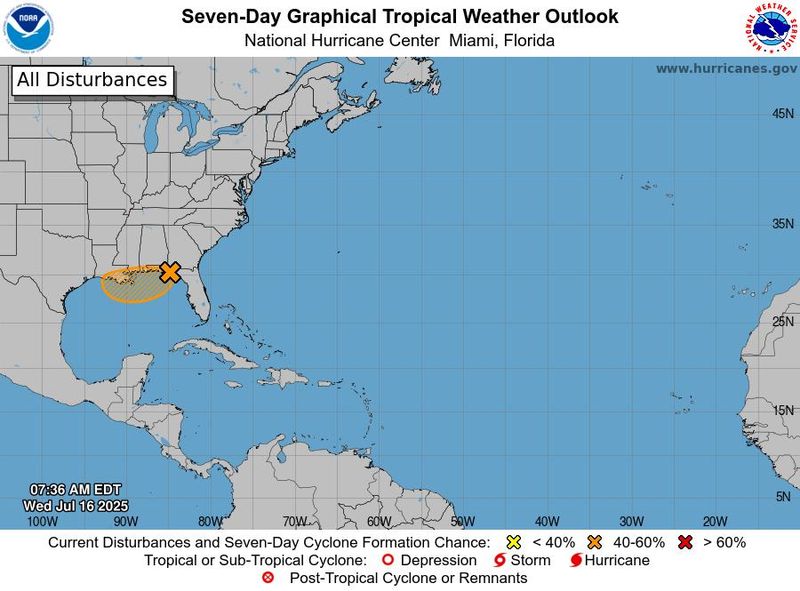
Invest 93L currently has a 40% chance for tropical development over the next seven days and a 40% chance over the next 48 hours.
So what does this mean for Jacksonville? Forecasters said the invest is expected to continue moving west and could emerge or redevelop over the northeastern or north-central portion of the Gulf, reaching the Louisiana coast by Thursday.
Conditions are “generally favorable” for development and a tropical depression could form over the next couple of days.
What is the weather in Jacksonville today?
The National Weather Service is calling for a 30% chance of rain today. Jacksonville will see mostly sunny skies for much of the day, but keep an umbrella handy — there’s a slight chance of showers beginning around 2 p.m., with a better chance of thunderstorms after 3 p.m.
Today’s temperatures are expected to reach around 92 degrees, but it will feel hotter due to the humidity, with heat index values potentially hitting 102. A steady southeast wind around 14 mph, with gusts up to 21 mph, could provide a bit of relief from the heat.
This evening, showers and thunderstorms could linger through 8 p.m., followed by a slight chance of light rain until around 10 p.m. Overnight, expect partly cloudy skies and a low around 76. Winds will shift to the south at 5 to 13 mph, with gusts up to 20 mph.
How will the Invest 93L storm impact Jacksonville?
The National Weather Service is forecasting mainly afternoon and evening thunderstorms through the week. These storms could bring frequent lightning, heavy rain, and gusty winds.
While the heaviest rainfall is expected near and west of the I-75 corridor, parts of Northeast Florida, including Jacksonville, could still see locally heavy downpours.
Additionally, the weather service is also warning beachgoers about a moderate risk of rip currents along local beaches, a threat that will continue through at least Thursday. If you’re heading out on the water, note that coastal conditions are rough enough for a Small Craft Exercise Caution advisory.
Looking ahead, forecasters are also keeping watch on the northeastern Gulf of Mexico, where there’s a medium chance of tropical development this week. While it’s too early to say how — or if — it could impact our area, it’s a reminder to stay weather-aware during hurricane season.
NWS Jacksonville weather radar shows path of storms associated with Invest 93L for July 16, 2025
What will be the name of the next hurricane?
The next named storm of the 2025 Atlantic hurricane season will be Dexter.
Historically, the fourth named storm of the Atlantic hurricane season arrives Aug. 15. The last two named storms of the season — Barry and Chantal — developed earlier than normal.
Here’s the latest advisory from the National Hurricane Center as of 8 a.m. July 16:
Invest 93L moving slowly across Florida Panhandle
Surface and radar observations indicate that a broad area of low pressure is moving westward across the Florida Panhandle between Tallahassee and Panama City.
The associated shower and thunderstorm activity is disorganized and located mainly south and southwest of the center. This system is forecast to continue moving westward, and could emerge or redevelop over the far northeastern to north-central portion of the Gulf later today or tonight, reaching the coast of Louisiana by Thursday.
If this system moves far enough offshore, environmental conditions over the Gulf appear generally favorablefor additional development, and a tropical depression could still form over the next couple of days before the system moves fully inland by the end of the week.Regardless of development, heavy rainfall could produce localized flash flooding over portions of Florida through today.
Heavy rainfall could also cause flash flooding for portions of the north-central Gulf Coast beginning late today and continuing through Friday.
Spaghetti models for Invest 93L
Special note about spaghetti models: Illustrations include an array of forecast tools and models, and not all are created equal. The hurricane center uses only the top four or five highest performing models to help make its forecasts.
What is an invest?
Short for investigation, the National Hurricane Center uses the term invest for areas of low pressure it is monitoring for potential development into a tropical depression or storm.
Invests are not tropical depressions or tropical storms. They’re usually clusters of showers and thunderstorms, and just because they’ve been designated as an invest does not guarantee they’ll strengthen into a tropical storm or hurricane.
Invests run from 90 to 99, followed by a letter: L for the Atlantic basin and E for those in the eastern Pacific. After 99, it starts over again and the next invest would be 90.
Once something has been designated as an invest, specialized data sets and computer models can begin, including scheduling Hurricane Hunter aircraft missions and running spaghetti models.
What impacts are expected in Florida from Invest 93L?
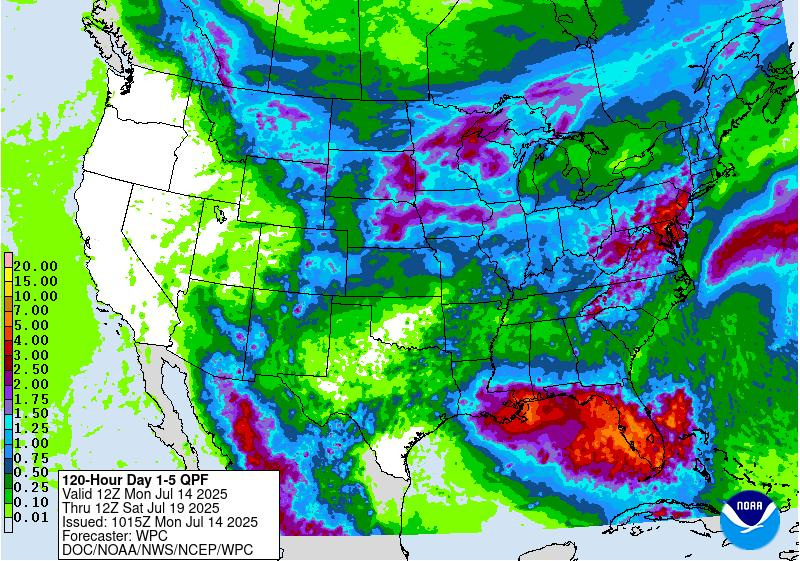
Heavy rainfall could bring localized flash flooding over some portions of Florida, especially the Panhandle and West Coast, through today, July 16.
➤ How to set up emergency cellphone notifications for flash flood warnings and safety tips
➤ Excessive rainfall forecast
The National Weather Service in Tallahassee said localized pockets of heavy rain are possible Wednesday, along with an increasing risk of rip currents along the coast on Thursday.
How heavy the rain will be depends on Invest 93L’s exact track and organization.
“A more organized tropical system would bring a larger swath of heavy rain and a more widespread flooding risk,” AccuWeather Hurricane Expert Alex DaSilva said. AccuWeather hurricane experts are currently forecasting a tropical depression to make landfall in southeastern Louisiana on Thursday morning.
“The farther south that the tropical rainstorm is able to travel over the Gulf, the longer it will have to strengthen before landfall,” DaSilva said. It’s not out the question that, in this scenario, the tropical system would have enough time to become a tropical storm.
After landfall, the storm is expected to be steered northward as it loses wind intensity, bringing rain to the southern portion of the Mississippi River Valley. However, light steering breezes may cause the storm to stall. Should this occur, some areas may experience excessive rainfall and a high risk of flooding.
Rough surf and strong rip currents are possible for Florida beaches, AccuWeather forecasters warned.
Florida weather radar for July 16, 2025
National Weather Service Florida forecast as Invest 93L moves across state
2025 hurricane season so far
An average Atlantic hurricane season has 14 named storms, seven hurricanes, and three major hurricanes.
Here’s when this year’s named storms have developed, compared to historical averages:
Weather watches and warnings issued in Florida
Hurricane names for 2025 season
Here are the names for the 2025 Atlantic hurricane season, along with how to pronounce them:
When is the Atlantic hurricane season?
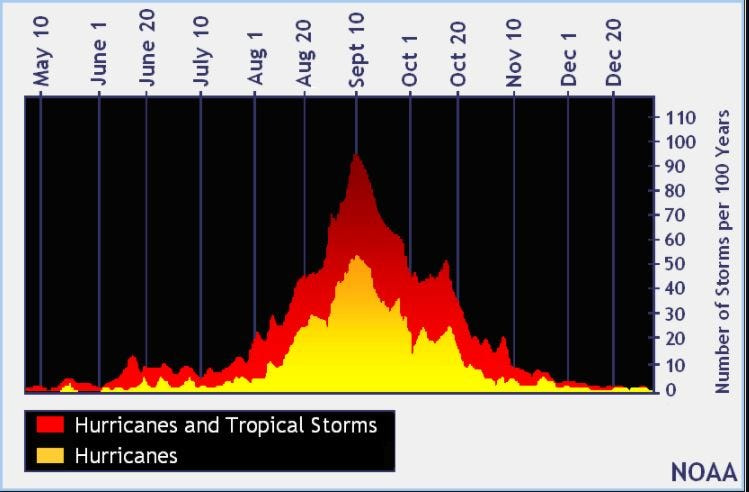
The Atlantic hurricane season runs from June 1 through Nov. 30.
Ninety-seven percent of tropical cyclone activity occurs during this time period, NOAA said.
The Atlantic basin includes the northern Atlantic Ocean, Caribbean Sea and Gulf of America, as the Gulf of Mexico is now known in the U.S. per an order from President Trump. NOAA and the National Hurricane Center are now using Gulf of America on its maps and in its advisories.
When is the peak of hurricane season?
National Hurricane Center map: See what forecasters watching now
Systems currently being monitored by the National Hurricane Center include:
Why does NHC say ‘tropical cyclone’ on its maps instead of hurricane or tropical storm?
Tropical cyclone is the generic term used by the National Weather Service, NOAA and the National Hurricane Center for any tropical system, even if it’s in the tropical Atlantic basin.
To be more precise, a tropical cyclone is a “rotating, organized system of clouds and thunderstorms that originates over tropical or subtropical waters and has closed, low-level circulation,” NOAA sadi.
Once maximum sustained winds reach 74 mph, what it is called is determined by where it originated:
Interactive map: Hurricanes, tropical storms that have passed near your city
Stay informed. Get weather alerts via text
What’s next?
We will update our tropical weather coverage daily.
Download your local site’s app to ensure you’re always connected to the news. And look for our special subscription offers here.
This story has been updated to include new information.
This article originally appeared on Florida Times-Union: Invest 93L taking its time moving across Florida. How it’s affecting Jacksonville weather
Reporting by Doris Alvarez Cea and Cheryl McCloud, Jacksonville Florida Times-Union / Florida Times-Union
USA TODAY Network via Reuters Connect