

Tom Rahill spent months mapping out a strategy for the 2026 Florida Python Challenge, his ADHD fueled genius making calculations for the drought, the competitors and the calendar in his scheme.
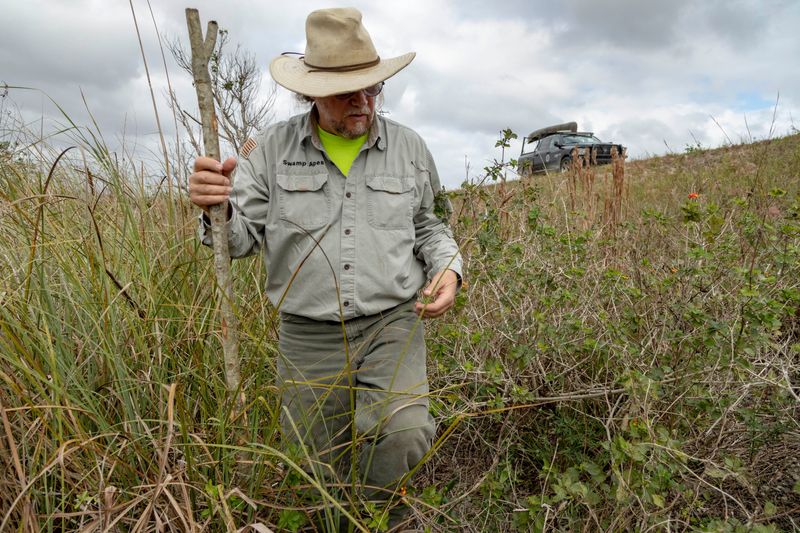
For more than two decades, the former information technology entrepreneur has spirited the invasive snakes out of the South Florida wilds, first as a volunteer and now as a contractor with the South Florida Water Management District. The 69-year-old was eager to prove his savvy despite an aching back, busted up knee and a recent hip replacement — his second.

And this year, Rahill had a secret weapon.
He and his hunting partner piloted electronic bicycles deep into the tangled guts of Everglades National Park and away from the levees and main roads that can clog with hunters during the 10-day competition.
It was the first time he used the e-bikes on a hunt, bumping nine miles down an old closed off “jungle road” to find what would ultimately be the longest snake in the competition and win Rahill the $10,000 grand prize for snagging the most snakes.
“I was only able to hunt the one full day. I was crooked, bent up, and it was days into the challenge, but I had been planning for months,” said Rahill, 69, who lives near Tampa in Lutz. “I took my granny bike down there, it’s a step through, and we came across a big 17-foot female that had just come off her nest.”
Then he swept the area for other snakes and to look for the nest because, he said, that’s what the military does — clear an area after an assault — and he’s dedicated to taking veterans on hunts as a way of therapy and to push himself beyond his own aches and pains.
Who is Tom Rahill, winner of the 2026 Florida Python Challenge?
Rahill founded the nonprofit organization Swamp Apes in 2008 to take veterans and first responders on outdoor adventures, including python hunts. The Swamp Apes was also the offshoot of his own experience after falling into a funk when his wife was away teaching and he would only see her every few months.
“I would go out and I’m grabbing pythons at two, three, four in the morning and I remember just thinking that ‘Wow, I’m not thinking about my wife right now,’” Rahill said. “Every time you come across a python it’s like Kwanzaa Christmas, Hannukah, your birthday, it’s that kind of excitement.”
So, Rahill cleared the area after finding the 17-footer, which the Florida Fish and Wildlife Conservation Commission measured officially at 16 feet, 5 inches, and he found her nest. (Rahill said he thinks FWC measured the snake after it was frozen, causing shrinkage.)
It was writhing with baby snakes squirming from their eggs like a “Medusa festival” with hatchlings everywhere. Rahill and his partner were able to bag them quickly, then had to triple bag them as they started cutting through the cloth with the sharp tooth they use to break out of their shell.
There were 98 eggs. Two didn’t hatch, leaving Rahill with the 96 snakes that won him the grand prize. His partner Rahm Levinson won $1,000 for the longest python in the professional division.
After the excitement of the catch, one of the e-bikes stopped working. It was nearing midnight and they had a giant snake and a bag of wriggling babies to get out of the swamp and to a checkpoint.
“If it took me three days to drag that carcass out of the Everglades, I was going to do it,” Rahill said.
Ultimately, they were able to get a lift out in a truck.
Rahill said the experience was serendipity, although he plans to trademark the term “serpentdipity” to commemorate the hunt and whether he’s joking or not is unclear.
“That way I can say it was a serpentditious moment, and you can be the first to write it,” he said in an Aug. 6 interview as he drove back from Panama City Beach where the FWC announced the Python Challenge award winners.
How many Burmese pythons were captured during the 2026 Florida Python Challenge?
There were 907 participants in this year’s contest from 30 states, Canada and Vietnam. In total, 280 Burmese pythons were removed. That means Rahill’s bounty was about 35% of the total take and speaks to the challenge that the contest posed this year.
The second-place winner in the professional category, Christina Kraus, brought in 36 pythons. Taylor Stanberry, who won the grand prize in 2025, took home third place for most pythons in the professional category with 34.
“We don’t have a silver bullet. Our job is not done yet,” said FWC Nonnative Fish and Wildlife Program Coordinator Sarah Funk during the awards ceremony. “Although the challenge is not the answer to the Burmese python issue, it is significant in so many ways and every python removed is a win for Florida’s native wildlife.”
Funk said since the year 2000, more than 28,000 Burmese pythons have been removed from the Everglades under various programs.
What comes next for Rahill and the Swamp Apes?
Rahill wrote a speech for after his win was announced on Aug. 5. He didn’t want to ramble.
But because his “brain is like a fireworks display all the time,” he winged it.
“I was on a mission to get one of our veterans a big snake, and we did,” said Rahill, who walked to the podium at the FWC meeting with a cane. “And I’d like to say a few things. Trust in the lord with all your heart, lean not on your own understanding, acknowledge him in all your ways and he shall direct your paths.”
Rahill’s dream for the Swamp Apes is to have a full compound with an office, a clinic, living quarters and a treatment facility with therapists.
He said veterans open up to him on hunts about personal traumatic experiences but that he’s not trained to help other than getting them out into nature.
“I’m just a country boy with a good ear and a good heart,” Rahill said.
Kimberly Miller is a journalist for the USA TODAY NETWORK FLORIDA. She covers weather, the environment and critters as the Embracing Florida reporter. If you have news tips, please send them to kmiller@pbpost.com. You can get all of Florida’s best content directly in your inbox each weekday by signing up for the free newsletter, Florida TODAY, at palmbeachpost.com/newsletters.
This article originally appeared on Palm Beach Post: Hunter found 96 baby pythons in a ‘Medusa festival’ | Exclusive
Reporting by Kimberly Miller, USA TODAY NETWORK – Florida / Palm Beach Post
USA TODAY Network via Reuters Connect
By Kimberly Miller, USA TODAY NETWORK – Florida | USA TODAY Network
