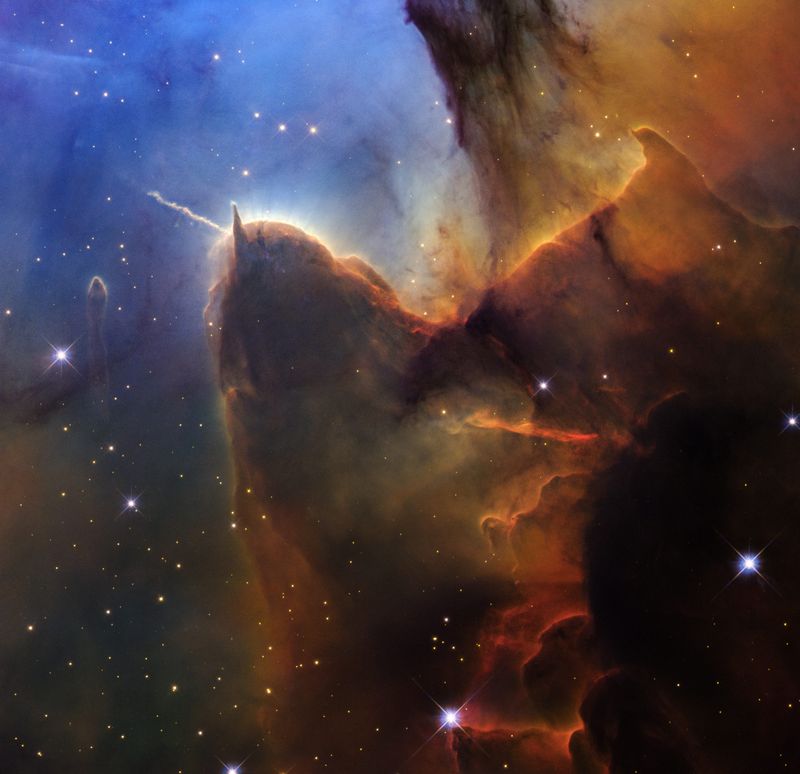
NASA’s Hubble Space Telescope has revisited a stunning cosmic phenomenon far from Earth that the observatory first spotted nearly 30 years ago.
The image, which NASA shared to celebrate the Hubble telescope’s 36th anniversary since a launch from Florida, depicts a star-forming region known as the Trifid Nebula. After first capturing an image of the nebula in 1997, Hubble once again trained its sights on the region not just to return an even more striking photo, but to provide insights into how young stars interact with their surroundings, NASA said.

Here’s a look at the Hubble Space Telescope’s new image, as well as an explanation about the Trifid Nebula.
Hubble Space Telescope captures another stunning photo of nebula
The focal point of the Hubble telescope’s new image of the Trifid Nebula is the head and body of the rust-colored cosmic phenomenon – a cloud of gas and dust where stars form.
In a press release, NASA describes the nebula as resembling “a marine sea lemon, or sea slug” drifting through the cosmos.
The striking image, NASA explains, is “reminiscent of an underwater scene filled with fine-grained sediments fluttering through the ocean’s depths.”
Hubble, which first glimpsed the nebula in 1997, revisited the scene nearly three decades later with the objective of seeing changes over time. This time around, Hubble was also equipped with an improved camera with a wider field of view and greater sensitivity that was installed during a 2009 Space Shuttle mission known as Servicing Mission 4.
What is the Trifid Nebula?
The Trifid Nebula is a bright, colorful cloud of gas and dust about 5,000 light-years from Earth in the constellation Sagittarius, according to NASA.
Discovered by Charles Messier in 1764, the star-forming nebula is also known as Messier 20, or M20.
The region is home to several massive stars that have shaped the area for at least 300,000 years, NASA said. Powerful winds from the stars continue to blow an enormous bubble partially seen in Hubble’s new image, which sparks new waves of star formation.
It will take millions of years, but eventually NASA explains that the gas and dust comprising this nebula will disappear, leaving only stars remaining.
What is the Hubble Space Telescope?
The Hubble Space Telescope reached a milestone in April 2025, when it marked its 35th year of operations since launching in 1990 on the space shuttle Discovery from Kennedy Space Center in Florida.
In its time orbiting Earth, Hubble has shaped our understanding of the universe by observing the atmospheric composition of planets around other stars and even discovering dark energy – a mysterious force that causes the universe to expand.
The launch of the James Webb Space Telescope in 2021 has allowed scientists to combine observations from both observatories “to push opportunities for discovery further,” NASA said.
Now, the agency is on the cusp of the launch of its next cutting-edge space telescope: the Nancy Grace Roman Space Telescope, due to launch as early as fall 2026.
Eric Lagatta is the Space Connect reporter for the USA TODAY Network. Reach him at elagatta@usatodayco.com. Subscribe to the free Florida TODAY newsletter.
This article originally appeared on Florida Today: Hubble revisits Trifid Nebula 30 years later to snap new photo
Reporting by Eric Lagatta, USA TODAY NETWORK – Florida / Florida Today
USA TODAY Network via Reuters Connect