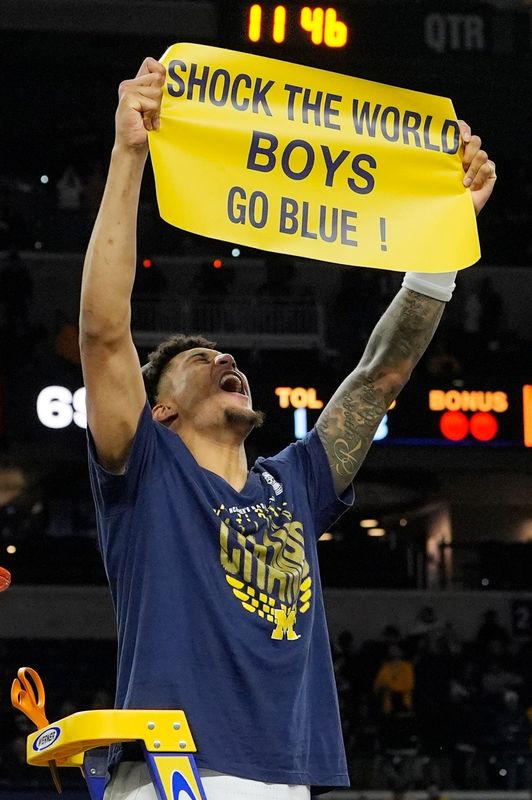
The Michigan Wolverines made college basketball history on April 6, becoming the first team to ever win a national championship with five transfer starters.
The next day, nearly one-third of all active men’s basketball players had entered the portal, according to NBA draftnik Jonathan Givony.

An astounding 1,600-plus Division I basketball players were in search of a new home within 24 hours of the season ending. The number will only rise as time goes on.
It’s a new era in college sports, one where teams hunt for mercenaries in hopes of boosting their title odds. Talent acquisition via the transfer portal can be expensive, but Michigan just proved that the return on its investment on this roster — near $10 million according to Front Office Sports and On3 — is real after hoisting the national championship trophy.
As the NCAA is handed court order after court order that prevents them from enforcing traditional rules, players and coaches continue to cash in. And while pundits and analysts debate the long-term efficacy of the new market economy in college sports, teams will continue to win national championships with transfers and graduate students as their key players.
Transfer portal impacting more than just men’s basketball
Both the men’s and women’s national champions had portal players lead the way to hoisting a banner this year. UCLA’s leading scorer and rebounder, Lauren Betts, began her career at Stanford. Gianna Kneepens played four years at Utah before arriving for a grad year at UCLA and averaging over 28 minutes per game, and the same is true for Charliss Leger-Walker from Washington State.
The same is true for the biggest money-maker in the NCAA. Indiana football’s miraculous turnaround from laughing stock to national championship was not incidental, and would not be possible 10 years ago.
After one of the greatest head coach hires in NCAA history, the Hoosiers hit the portal for Fernando Mendoza (the likely No. 1 overall pick in the NFL draft and Heisman winner), their leading rusher Roman Hemby, their starting center Pat Coogan, their interception leader Louis Moore, and plenty of other key pieces. 16 of their 22 regular starters were playing in their fourth or fifth year of college football.
The portal ecosystem in college athletics is reaching a tipping point. If you want to win games, cutting a check to an elite fourth or fifth year player in now a requirement.
Coaches have a mandate to win games, and they’ll do whatever it takes to achieve that goal. It’s not necessarily the coaches’ fault, they want to keep their jobs as much as you and I do. But the ability for players to get fifth, sixth or even seventh years of college eligibility have flooded a market with grown adults much more talented and physically-adept than high school hopefuls.
Consider Michigan star and All-American Yaxel Lendeborg. A largely unheralded high school recruit, Lendeborg played just 11 games of prep basketball before signing with JUCO Arizona Western in 2020. The 23-year-old was in the same high school recruiting class as current NBA All-Stars Cade Cunningham, Evan Mobley and Jalen Johnson. With an added COVID year, he was able to hone his skills for three years at Arizona Western, then for two more seasons at UAB before leading the Wolverines to a national title.
Now put yourself in a coach’s shoes for a moment. Imagine that your career, your livelihood, depends on how well young adults can play. Would you choose a player who has had five years of experience on that level to grow and develop, or a recruit fresh out of high school that likely needs time before they can meaningfully contribute?
“I think families need to better understand — bet on yourself,” Montverde head coach Steve Turner told USA TODAY in February. “If (lower-level offers are) what you’re getting, take the best opportunity you can to go and grow. Because you see guys that are scoring eight points a game then moving up in the portal and making millions of dollars.”
Will the market for talent ever course correct?
President Donald Trump issued an executive order on April 3 with this issue as the fulcrum. Among its many aims is to limit participation to five years for student-athletes with no questions asked, no quarter given.
According to Yahoo’s Ross Dellenger, the NCAA has begun looking into implementing this specific rule, with an emphasis on a five-year eligibility clock that begins when a student-athlete graduates high school or turns 19 — whichever comes first. Dellenger reported that the NCAA would cease to give redshirts, waiver requests or exceptions, save for a small group of outliers like those serving in military or religious missions and those on maternity leave.
This would help flatten the curve of aged-based recruiting. Stories like Lendeborg’s would no longer be possible as the transfer portal would no longer include players nearing, or already in, their mid-20s.
Another key factor of the executive order is a one-time transfer rule. This rule ignores important context, like a coach that recruited a player moving on from the job or any sort of personal/family reasons to leave a school.
Still, it would be all but eliminate players suiting up for three or four different programs over the course of their collegiate careers.
Can the NCAA enforce the new executive orders?
The dozens of lawyers who have made careers out of representing student-athletes for the right to continue playing are already lining up.
Courts have been breaking down the NCAA’s ability to enforce rules for years now, and the ruling in NCAA v. Alston in 2021 expedited the process. Judges have granted eligibility to sixth- and seventh-year players, setting legal precedents that are not easily swiped away.
“(The Executive order) tells the NCAA and federal agencies to do certain things, such as returning to a one-time transfer with immediate eligibility rule and preempting state NIL laws,” Darren Heitner, a prominent lawyer who has helped players maintain their eligibility, said in a post on X. “However, each of those things must still comply with existing law and survive judicial review. The order says so in Section 4(b), which conditions the NCAA’s rulemaking mandate on actions taken ‘to the extent permitted by law and applicable court orders.’
Trump himself acknowledged the likely legal challenges to come in a roundtable with stakeholders in March.
“And let’s see (if) we can get it through the court system, which we might not be able to do,” Trump said to the group.
The leverage that the government holds over NCAA member schools is federal funding. Trump made clear that any state school that does not comply with the executive order will be at risk of losing their federal funding, a threat that carries a lot of weight and could strong arm schools into a lose-lose situation.
Schools may have to face tough decisions in the near future. Either comply with new federal/NCAA mandates that expose them to a myriad of lawsuits, or comply with established law and put their federal dollars at risk.
This article originally appeared on Tallahassee Democrat: How Trump’s executive order may end to champs like Michigan basketball
Reporting by Nick Wilson, USA TODAY NETWORK – Florida / Tallahassee Democrat
USA TODAY Network via Reuters Connect