How big is SpaceX’s Starship rocket?
Big.

Very, very big. So big, in fact, that the spacecraft, which could launch from Florida before the end of 2025, has earned the designation as the world’s largest rocket.
To put it in relatable terms, at about 400 feet high, Starship is taller than a football field is long from endzone to endzone. The vehicle/rocket combo also towers over the 305-foot-tall Statue of Liberty near New York City.
And when you compare the rocket’s height to other U.S. spacecraft, including from SpaceX, the difference is even more pronounced. As the commercial rocket company founded by billionaire Elon Musk gears up to launch Starship on its 11th ever test flight from Texas, you may reasonably be wondering what all the fuss is about with this so-called “mega rocket.”
Wonder no more.
Here’s a look at how Starship compares to other rockets that have launched from Florida’s Space Coast in and near Cape Canaveral: SpaceX’s Falcon 9, Blue Origin’s New Glenn and the United Launch Alliance’s Vulcan.
What is Starship? SpaceX mega rocket bound one day for Mars
SpaceX is developing Starship to be a fully reusable transportation system, meaning the rocket and vehicle can return to the ground for additional missions.
In the years ahead, Starship is set to serve a pivotal role in future U.S. spaceflight. Starship is the centerpiece of Musk’s vision of sending the first humans to Mars, and is also critical in NASA’s plans to return astronauts to the moon’s surface for the first time in five decades.
NASA’s lunar exploration plans call for Artemis III astronauts aboard the Orion capsule to board the Starship while in orbit for a ride to the moon’s surface as early as 2027.
Musk, though, is more preoccupied with Starship reaching Mars – potentially, he has claimed, by the end of 2026. Under his vision, human expeditions aboard the Starship could then follow in the years after the first uncrewed spacecraft reaches the Red Planet.
How big is Starship? What to know about world’s largest rocket
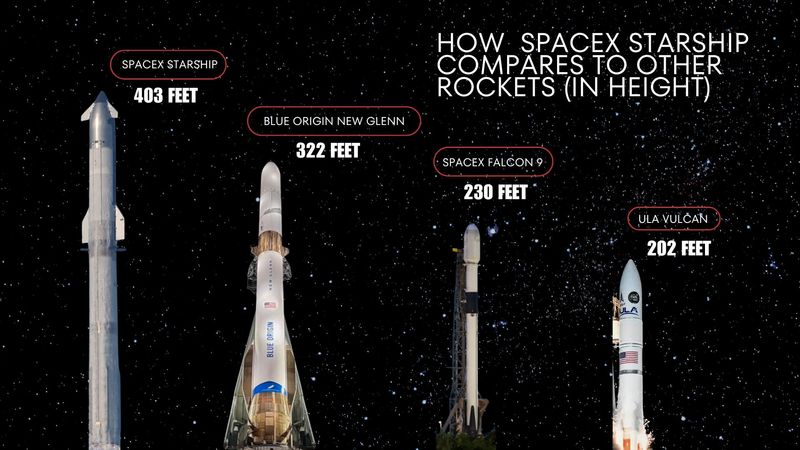
The Starship stands 403 feet tall when fully stacked.
That size means that Starship has officially supplanted NASA’s retired 363-foot-tall Saturn V as the world’s largest and most powerful launch vehicle ever developed. The three-stage heavy-lift launch vehicle was pivotal in the U.S. Space Agency’s historic Apollo lunar missions of the 1960s and 1970s that launched from the Kennedy Space Center.
When fully integrated, the Starship launch system is composed of both a 232-foot Super Heavy rocket and the 171-foot upper stage Starship itself, the spacecraft where crew and cargo would ride.
Super Heavy alone is powered by 33 of SpaceX’s Raptor engines that give the initial burst of thrust at liftoff. The upper stage Starship section is powered by six Raptor engines that will ultimately travel in orbit.
How Starship compares to Falcon 9, Blue Origin New Glenn, ULA Vulcan rockets
That size means Starship towers over SpaceX’s other famous rocket, the 230-foot-tall Falcon 9. The two-stage Falcon 9 rocket is one of the most active in the world – routinely launching astronauts on missions to the International Space Station from the Kennedy Space Center.
Falcon 9 is also the launch system vehicle used to deploy SpaceX’s internet-beaming Starlink satellites into orbit from both Florida and the Vandenberg Space Force Base in California.
The United Launch Alliance’s new Vulcan rocket, which launched in August on a national security mission from the Cape Canaveral Space Force Base, is slightly smaller than the Falcon 9. At 202 feet tall, Vulcan is highly configurable – able to fly with anywhere from zero to six solid rocket boosters in addition to its main booster for additional liftoff power.
Vulcan’s Centaur V upper stage is what powers the spacecraft to reach such extreme orbital heights after separation.
Otherwise, Blue Origin’s New Glenn rocket is the only spacecraft that comes close to rivaling Starship in size. The 322-foot-tall launch vehicle is still early in development and has only flown on one test mission in January from Florida.
When is the next Starship launch from Starbase, Texas?
SpaceX plans to conduct the 11th flight test of its Starship spacecraft Monday, Oct. 13, with a target liftoff time of 6:15 p.m. CT.
SpaceX conducts Starship test flights from the company’s Starbase headquarters in South Texas, located about 23 miles from Brownsville near the U.S.-Mexico border. Texas voters in Cameron County approved a measure in May for Starbase to become a city, complete with a mayor and a city council.
Eric Lagatta is the Space Connect reporter for the USA TODAY Network. Reach him at elagatta@gannett.com
This article originally appeared on Florida Today: How big is SpaceX’s Starship? Comparing vehicle size to rockets launching in Florida
Reporting by Eric Lagatta, USA TODAY NETWORK – Florida / Florida Today
USA TODAY Network via Reuters Connect