Florida’s Panhandle is often forgotten, sometimes left off maps and dismissed by those in big Florida metro areas such as Miami and Tampa as an inconsequential footnote, a backwoods briar-patch with little or no impact.
“You can talk to anybody who’s down south. They never think of this as Florida.”

That was former Pensacola state legislator Tom Tobiassen talking to Bill Kaczor, longtime Florida Panhandle reporter for the Associated Press.
Yet Kaczor knows they’re wrong. He knows that most of the misconceptions about the Panhandle are just that—misconceptions.
“I don’t have any misconceptions,” Kaczor said. “I have conceptions.”
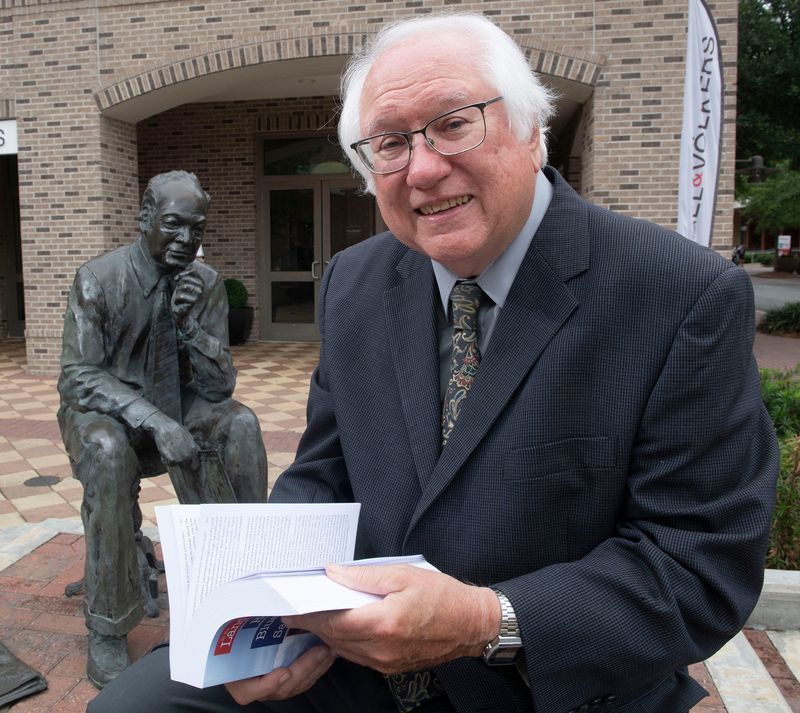
Kaczor has crafted a hefty 606-page book, “In the Land of the He-Coon, Blue Angels and Saint Bobby − Reporting from the Florida Panhandle” that details the impact of the oft-neglected Northwest Florida region stretching from Pensacola to Tallassee. The book is available online at Amazon, Walmart, Barnes & Noble and most major online booksellers.
“It’s probably 470 pages of actual writing,” said Kaczor, 79, who lives in Gulf Breeze with his wife Judy Kaczor. “The rest is pictures, the index and footnotes.”
The book, recently released by Palmetto Publishing, details the many important figures and events that occurred in Northwest Florida during Kaczor’s reporting career, which began in the late 1960s and continued until his retirement in 2013.
Kazor will have a book-signing from 1 p.m. to 3 p.m. on June 13 at Barnes & Noble Booksellers, 1200 Airport Blvd.
Those figures include the “He-Coon” represented in the title, powerful heavyweight Florida politician Bob Sikes, who served in the U.S. House of Representatives for decades, except for a brief break while he served in the U.S. Army during World War II, as well as Panhandle sports giants such as legendary Florida State Football coach Bobby Bowden (“Saint Bobby”) and boxer Roy Jones Jr., and other local legends such as Air Force Gen. Daniel “Chappie” James, Fred Levin, Don Gaetz and W.D. Childers.
Kaczor’s book, which he started compiling and writing about seven years ago, also details important, often tragic and cataclysmic events across the Panhandle including a chapter on the anti-abortion violence of the 1980s and 1990s—Kaczor had covered the U.S. Supreme Court’s Roe v. Wade decision in 1973 as a Northwestern University graduate student—the Ted Bundy arrest in Brownsville in 1978, various hurricanes and natural disasters, civil rights, military history and much more. (Again, it’s a good-sized book, but also easily digested through Kaczor’s well-crafted storytelling.)
There’s even a chapter titled “The Journalist Who Fathered a National Seashore,” about the still-beloved by those who remember him Pensacola News Journal editor emeritus J. Earle Bowden and his influence in establishing one of the Panhandle’s natural jewels, Gulf Islands National Seashore.
In the mid-1960s, Bowden began campaigning for federal protection of the beaches and forts of Santa Rosa Island in Pensacola News Journal editorials though there was backlash. Local radio station WCOA protested Bowden’s attempt to establish a federally protected “seashore recreational area” as “a federal land grab,” according to Kaczor’s book, whose sources include his own notes and archives as well as other research and attributed new stories.
The book includes an interview with Bowden who said “It was fun fighting the local battle because you were fighting a group that was interested in real estate values more than they were the pride of the community. Our purpose was pure.”
Gulf Islands National Seashore was established in 1971 and Bowden became known as “The Father” of the national seashore.
But it was, according to the book, “U.S. Rep. Bob Sikes, the venerable He-Coon of Panhandle politics,” who pressed others in Congress to pass the legislation that would establish the seashore.
“If Earle Bowden is the father (of Gulf Islands National Seashore),” Kaczor said in an interview. “Then Bob Sikes is the godfather.”
Other chapters in the book tell of the Blue Angels’ presence in Pensacola beginning in the mid-1950s, Joe Scarborough and “Morning Joe,” shark attacks and even one of Pensacola’s most colorful figures and his iconic saloon, Martin “Trader Jon” Weissman.
The book’s subtitle is “Reporting from the Florida Panhandle,” but Kaczor notes in the book’s introduction, it wouldn’t make its debut in the Pensacola News Journal until 1947. Kazor writes the “Tallahassee Democrat also shunned ‘panhandle.’ Instead, the two papers then preferred ‘West Florida and “North-handle.” One Pensacola politician in the Florida Legislature even introduced a nonbinding resolution to banish the use of “panhandle” in describing the area.
Kaczor prefers “panhandle” to “Northwest Florida.”
“People immediately recognize it,” he said of “Florida Panhandle.” “If you say Northwest Florida, people in Miami think you’re talking about Tampa.”
This article originally appeared on Pensacola News Journal: Florida Panhandle personalities, legends, scoundrels part of new book
Reporting by Troy Moon, Pensacola News Journal / Pensacola News Journal
USA TODAY Network via Reuters Connect