

By Eric Peters

There are only a few new vehicles you can still buy for less than $23,000 — and even fewer of them are cars. The Hyundai Venue and the Chevy Trax, currently the least expensive new vehicles at around $21,000 to start, are both crossovers. If you’re interested in a new vehicle that isn’t a crossover — and doesn’t cost more than about $23,000 to start — you might be interested in the 2026 Nissan Sentra.
What It Is

The Sentra is the least expensive car that Nissan — or anyone else — sells.
At $22,600 to start for the base S trim, this small sedan is priced nearly $2,100 below the base price of the Honda Civic sedan ($24,695), $525 below the base price of a new Toyota Corolla ($23,125) and just slightly below the base price of the Hyundai Elantra ($22,695), which are three of the other small cars still available for less than $25,000.
Though inexpensive, the Sentra isn’t what people used to refer to as a “stripper” — i.e., a car without AC or power windows that probably didn’t even have a radio. The base trim Sentra not only has AC and power windows (and locks), it also has LED headlights and a four-speaker stereo as well as very large (12.3-inch) LCD touch screen, which is as big as the LCD touch screens you’ll find in cars that cost three times or more as much.
For just slightly more than $23,000 — $23,370 to be precise — you can get into the next-up SV trim, and that gets you climate control AC and a larger, Mercedes-like LCD instrument cluster as well as keyless entry and remote start.
The $25,000 SR is the sportiest-looking Sentra. It gets a set of 18-inch wheels, dark exterior accents, a synthetic leather-wrapped steering wheel and sport buckets with contrast stitching, plus an upgraded six-speaker Bose audio system.
The top-trim SL ($27,990) adds luxury amenities such as quilted leather seats, dual-zone climate control AC, a heated steering wheel and an eight-speaker audio system.
All trims come standard with the same drivetrain, which consists of a 2.0-liter four-cylinder engine, paired with a continuously variable transmission driving the front wheels.
What’s New
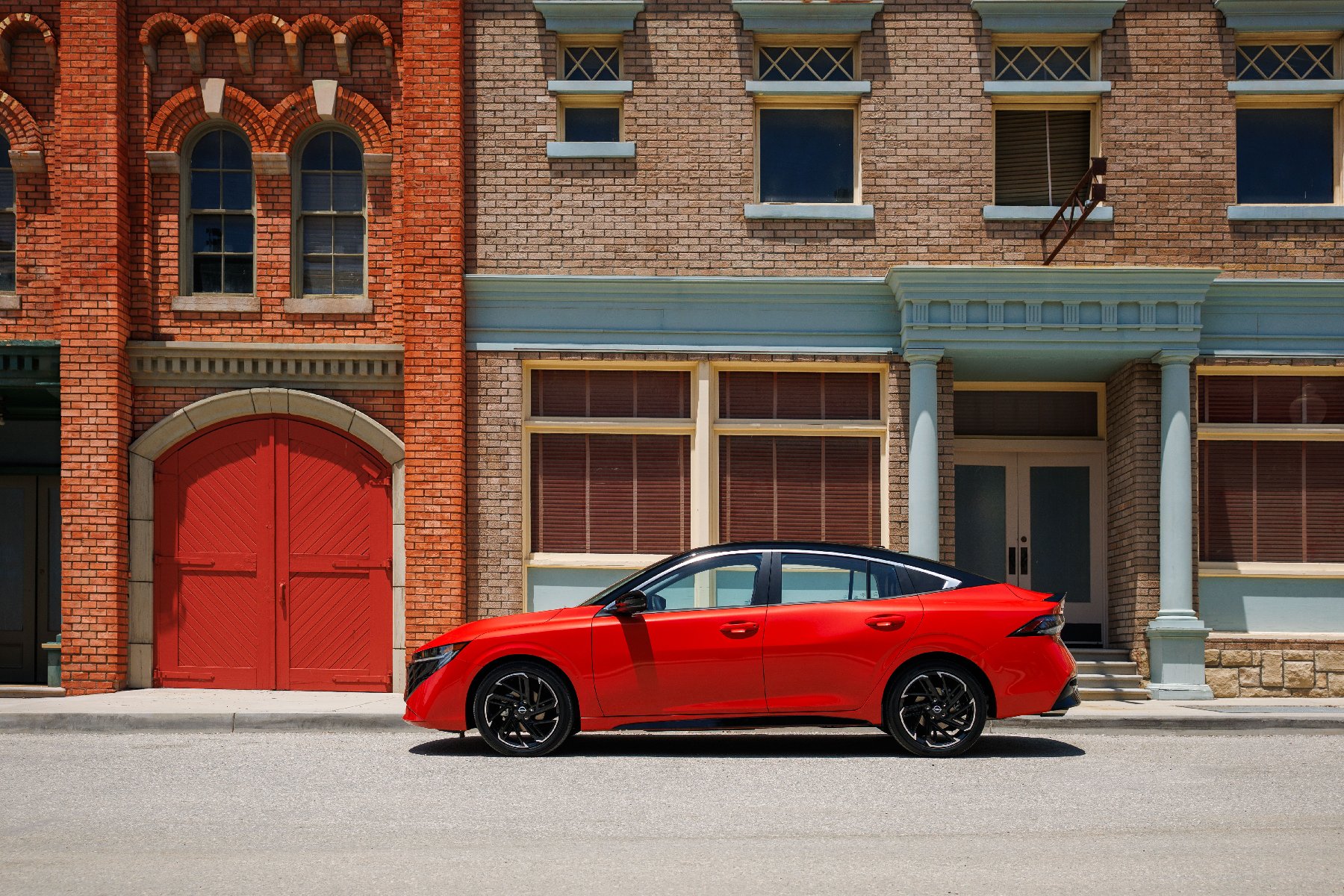
The 2026 Sentra gets updated exterior and interior styling.
What’s Good
— The most affordable new car you can still buy.
— Affordable doesn’t mean it looks or feels cheap.
— Standard engine isn’t turbocharged — so isn’t under pressure to make power, which ought to mean fewer problems down the road (and after the warranty expires).
What’s Not So Good
— Though the trunk is roomy for a small sedan — 14.3 cubic feet — it can only hold about half as much stuff as would fit in a same-size crossover’s cargo area.
— Standard — and only — transmission is a CVT. CVTs haven’t got the best reputation for long-term durability, and they also make vehicles that have modestly powerful engines feel (and sound) slower.
— No optional (more powerful) engine, even for the SR.
Under the Hood
The Sentra was for a long time both an economy car and — in SR trim — a sporty economy car. The standard engine was a 1.8-liter four designed to be economical; it made 130 horsepower and touted 27 mpg city, 36 mpg highway with the then-standard six-speed manual transmission. Economy cars used to come standard with manual transmissions — in part because if operated by someone who knew how to, they allowed for the best possible gas mileage out of the vehicle. Also because manual transmissions are simpler and so cost less to make and sell than automatics.
The Sentra SR was the sport version of this economical small car. It came standard with a larger, 2.5-liter four that was also paired with a six-speed manual, but the primary object wasn’t so much gas mileage as it was to have some fun in a still-economical small car. You got 165 horsepower to have fun with — and you still got 20 mpg city, 27 mpg highway — for $18,000 (that was the base price of the 2005 Sentra SR).
Today’s Sentra — including the SR — comes only with a 2.0-liter four and a CVT. On the upside, the standard engine touts 149 horsepower, so it’s considerably stronger than the previously standard 1.8-liter engine, and it’s almost as strong as the larger 2.5-liter four that was formerly installed in Sentra SRs.
It is without doubt very economical. Gas mileage is 31 mpg city, 39 mpg highway — and with gas prices now well over $4 nationally, that’s not an unimportant consideration.
Also, the Sentra’s engine is not turbocharged, which means it’s not under pressure to make power, and that definitely won’t hurt long-term reliability.
On the downside, the only transmission available is the standard CVT — even in the putatively sporty Sentra SR. The CVT does help the Sentra get close to 40 mpg on the highway, as per above.
All Sentras are front-wheel drive.
On the Road
It’s becoming kind of retro to drive a car — especially a small car — as opposed to a bulky crossover, pickup or SUV. It may soon become a practical necessity — if the cost of gas continues to go up. It “only” costs about $50 to fill up the Sentra’s roughly 12-gallon tank at the current (early May) average cost of about $4.40 per gallon, which is about half what it costs to fill up the typical large crossover or pickup’s tank.
A full tank can take you close to 500 highway miles in a Sentra too.
In a small car that has a sub-$23,000 starting price.
But it’s more than just that.
The Sentra is also a nice car. Startlingly so. The SL I spent a week in came with the ultra-soft quilted leather seats and almost literally everything else you’d expect to get in a $60,000 Mercedes, including an LCD dash display that looks nicer than the one in a current Benz E-Class sedan. The latter having one of those cheap-looking Pop-Tart displays in front of the driver, with a second display off to the side. The Sentra’s one-piece display looks more integrated and — more important — it’s not in your face, either. The dash itself sits low relative to the driver, and that opens up a display of the road ahead. The view to either side is also excellent because the glass is tall (rather than the doors being tall). This also increases the feel of interior space, an effect that’s enhanced by full-size car legroom (44 inches) for the driver and front-seat passenger.
It is a genuinely nice place to be inside the Sentra.
The car is a little slow-pokey feeling when you floor it, the main reason for that being the CVT. CVTs are not ideal for maximum acceleration performance, especially when paired with an engine that doesn’t make a lot of power. CVTs are designed for efficiency. They maximize mileage by keeping the engine in the optimum range — as opposed to gear — for peak fuel economy. The cost you pay for the efficiency gain (which is generally a 3-5 mpg overall improvement relative to what you’d get out of the same car with a conventional automatic with six fixed forward gears) is increased slow-pokeyness when you floor it. The engine will rev to the upper end of the dial and remain there as the car struggles to build speed. Or so it sounds. Because the CVT — unlike a geared automatic — does not upshift progressively to higher gears (which reduces engine RPM and so engine noise) as you accelerate. It feels — and sounds — like the Enterprise’s warp engines givin’ her all she’s got, captain.
But otherwise — when you aren’t flooring it — the Sentra easily moves forward and keeps pace with traffic. Once you are up to speed — as on the highway — the engine RPM settles down to a fast idle (about 2,300 RPM at 70 mph) and the feel that you are driving a very nice car returns.
At the Curb
The redesigned Sentra could pass for an Altima — the next-largest car Nissan sells. The Sentra certainly doesn’t look small. And yet it is — in terms of its footprint, which is just 183.3 inches end to end. The midsize Altima is 192.9 inches, nearly a foot longer.
Yet the Altima — which is also a nice car — actually has a bit less legroom up front (43.8 inches versus 44 inches for the Sentra) and nearly same backseat legroom (34.8 inches versus 35.2 inches for the Altima) and about the same amount of space in the trunk (14.3 cubic feet versus 15.4 cubic feet in the Altima) for about $5,000 less to start (the Altima’s base price is $27,580). It is not a stretch to say Nissan may have designed the new Sentra such as to make it too nice — relative to the Altima.
Especially when you consider what just over $27,000 gets you in a Sentra — including those plush, quilted leather seats. But even the SV — just over $23,000 — gets the fancy LCD display that ought to shame Mercedes (and BMW and Lexus and Audi) as well as automatic climate control and power pretty much everything. It bears repeating: This is a $23,000-ish “economy” car that — were it teleported to 2015 — could pass for a luxury-brand car. Nothing about it looks or feels low rent; in fact, the opposite of that. As bad in so many ways as the new car market is — in terms of affordability especially — this is bright spot. The Sentra isn’t just affordable.
It is genuinely nice.
The Rest
The only disappointment here is the SR iteration of the Sentra. Not because it doesn’t look great. Not because it isn’t nice. The problem is, it’s not much of an SR. The badge used to mean something more than just a badge. If you remember the mid-to-late ’70s, you may remember when “Z28” became kind of like that. That badge had previously meant a really hot Camaro. But — beginning in 1977 — it meant a Camaro with “Z28” badges. The Camaro was still a nice car, too. But the “Z28” wasn’t anything special anymore.
That’s the trouble here. Like the mid-to-late-’70s Z28, the Sentra SR looks like it’s packing something. But it has the same drivetrain as every other Sentra. Nissan might give some thought to putting the Altima’s 2.5-liter, 188-horsepower engine in the Sentra SR. With a six-speed manual, it’d be more than just something that looks like it’s packing something.
The Bottom Line
Small cars like the Sentra may soon experience a sales renaissance as a result of the cost of gas. But this is a small car that has much more to recommend it than just great gas mileage and a low buy-in price.
Eric’s latest book, “Doomed: Good Cars Gone Wrong!” will be available soon. To find out more about Eric and read his past columns, please visit the Creators Syndicate webpage at www.creators.com.
COPYRIGHT 2026 CREATORS.COM
