Collier County’s Development Services Advisory Committee has voted to recommend the county come up with its own rules for protective fencing at golf courses.
At a hearing on May 6, a majority of the committee voted against two competing privately initiated proposals for changes to the county’s Land Development Code designed to address the dangers posed by fly-away balls.

The Quail Creek Golf Club in North Naples seeks an amendment that would allow fencing up to 70 feet tall in a Golf Course and Recreational Use (GC) Zoning District − the district the club is in and is governed by in the county. The new section of code would include design standards, addressing everything from setbacks to landscaping requirements.
A competing proposal by nearby residents would limit the height to 35 feet.
The two proposals followed a rift between the residents and the club after it attempted to install 70-foot fencing behind their homes, without warning.
The lack of communication − and failure to obtain a permit − led to code enforcement complaints against the private members-only club.
The complaints resulted in a Stop Work Order and a code enforcement case that is still pending, as the club’s management works to resolve the situation, with hopes of keeping the poles through a code amendment.
According to county records, not only was construction done without a permit, but by an unlicensed contractor.
At the hearing before the Development Services Advisory Committee, the opposing sides had 20 minutes each to make their formal presentations.
Club is focused on safety
Naples attorney Zach Lombardo presented Quail Creek’s proposal, emphasizing safety as the club’s top priority and the driving factor behind its taller-than-usual fencing. He said he, nor the project’s planner − nor even county staff − could find issued building permits for any barrier fencing for golf courses in the county, except for one owned by the county.
He said the club was not aware of the need for a building permit.
When residents reported the lack of a permit to code enforcement, the club tried to fix the situation by applying for one, but county staff’s interpretation of the land code was that there was a building height limit of 35 feet for everything in the GC district, including fencing, although it wasn’t specifically written that way, or consistent with what’s “otherwise in the county right now,” Lombardo said.
The club disagrees with the county’s interpretation of the code.
Lombardo showed examples of the inconsistency, including the county’s Gate Golf Club, where fencing up to 200 feet in height was approved for a new 30-bay driving range, as part of a larger redevelopment effort in Golden Gate. In actuality, the poles, located along Collier Boulevard, south of Golden Gate Parkway, ended up 180 feet tall, with only a 50-foot setback, and “no meaningful screening at all from the single-family homes across the street,” he said.
“We felt the better way to deal with this was to bring forward a land development code amendment to provide predictable standards,” Lombardo said. “Because it is acknowledged that these poles are something that should be addressed from a landscaping and a setback standpoint.”
Tall fencing driven by injuries to golfers
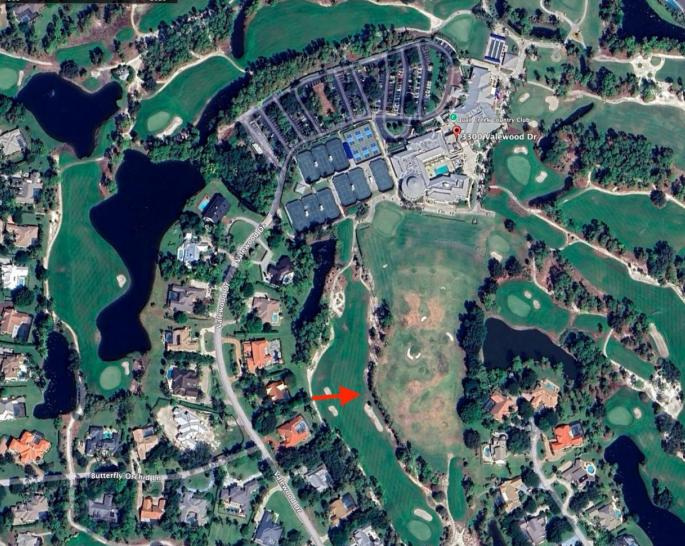
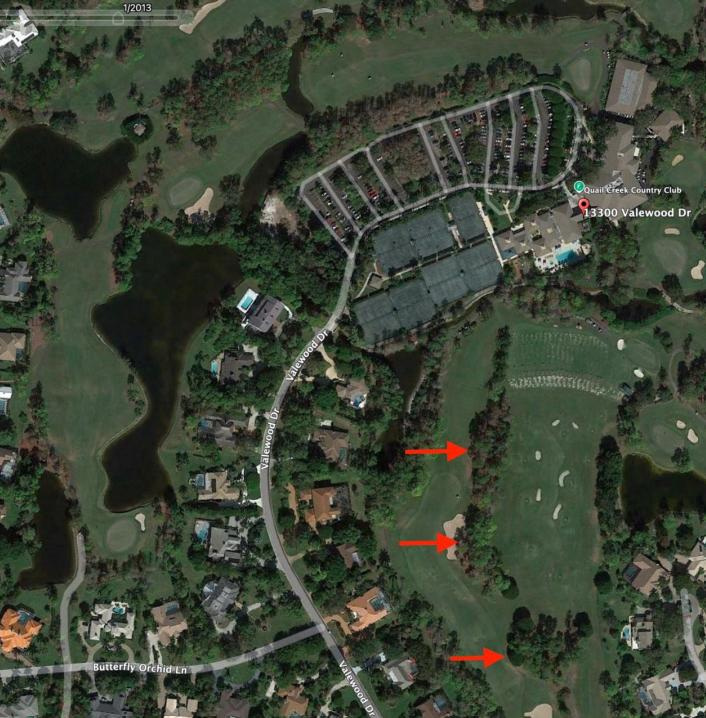
At Quail Creek, the towering poles started rising in April 2024, along the western edge of the driving range, located off Valewood Drive, roughly one mile east of Interstate 75 and north of Immokalee Road.
The netting is meant to prevent errant practice balls from reaching Hole No. 10 on the Quail Course. The decision to install mesh fencing came after six golfers got hit by range balls on that hole.
At the hearing before the Development Services Advisory Committee, one of the injured golfers, Christopher Ragain, spoke in favor of the fencing, sharing the seriousness of his injury from an errant ball in early 2023. He said doctors told him he could have been killed by the ball that struck him “like a meteor” in the head if it had hit him a few inches lower, near his temple.
“It’s not a question of whether I would have had just a more serious injury,” he said. “It was a question of whether they would have been treating me at all. And that worries me.”
After more than 40 years of the club’s existence, he said he was surprised more people haven’t gotten hurt by stray balls on its golf courses.
“It’s not a land issue, or residential building issue,” he said. “It’s a safety issue, and not just at Quail Creek.”
Club’s proposal would allow 70-foot fencing by right
The club’s amendment would allow barrier fencing at 70 feet or less by right, making it a permitted accessory use in a GC district, requiring only site plan and building permit reviews and approvals by county staff. Anything above that height would need a conditional use approval, which would require public hearings — allowing for public input — before a decision is ultimately made by a hearing examiner, or county commissioners.
The proposed changes include a required setback of at least 20 feet from any property line under separate ownership, with more stringent setback requirements if the fencing is adjacent to homes, or a public right-of-way, such as a street or sidewalk, equal to at least 1 foot for every foot in height for the fencing.
Other suggested requirements: Pole colors would have to be matte black, with black mesh fencing, and canopy, or palm trees, would have to be planted near each pole for screening if the fencing is near homes.
While “probabilistically” accidents like the one involving Ragain don’t happen often, Lombardo said it’s unfair to tell a business, such as a golf club, that it can’t plan for these “sort of Black Swan, catastrophic, unlikely events.”
He said it’s inconsistent with the way a lot of business planning is done, and the way a lot of land development is done, and with the way the county itself solved its own problem at its own golf course.
“The county was planning for absolutely incredible golfers to come in and not hit cars on 951 and not veer left into some of the surrounding neighborhoods,” Lombardo said. “What Quail Creek is asking is that it should be given the same opportunity to make its own risk calculation.”
Residents propose their own code amendment
Letitia and Frank Accarrino, neighbors of the golf club, have proposed their own code amendment to cap the height of barrier fencing at 35 feet in the GC district, unless the county grants a conditional use, which couldn’t happen without public hearings.
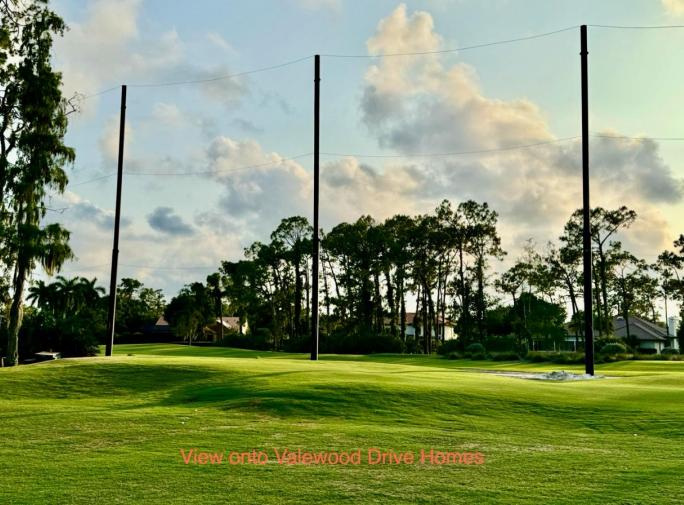
A little more than two years ago, the couple watched in shock as the club’s giant poles came into view from their backyard at Quail Creek Estates. The poles are 62 or 63 feet tall, but they’re built on a berm, raising them to 70 feet in height, sitting about 240 feet from the edge of their property.
“There was no opportunity for discussion,” Letitia told the advisory committee. “We got no notice, far from a neighborhood information meeting, or anything of the sort. We got nothing.”
After the poles appeared, she said the club agreed to one meeting with neighbors, in which the neighbors were told that the poles were “staying up no matter what.”
“Later on, we tried to provide the club with the vigorous study that we had done with a Florida Gulf Coast University professor showing that a 35-foot fence was more than adequate, but they weren’t even interested,” Letitia said.
She added: “This is about protecting golfers, private golfers, on one hole out of 36 holes of golf.”
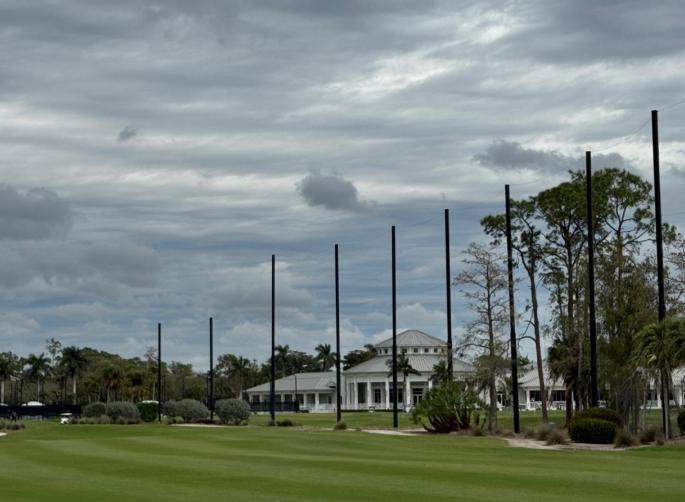
She likens the tall and tapered appearance of the poles to “industrial smokestacks,” with the horizontal line extending 850 feet.
The club’s proposed amendment, she said, is its last-ditch effort to keep the poles after failing to resolve the code violation other ways, including by seeking a variance.
“They filed a variance application, but they didn’t like our response, and I guess they didn’t like the county’s questions either, because they never responded to either one,” she told the committee.
She continued: “They’re trying to turn a site-specific violation into a countywide rule that would really damage homeowners.”
She shared examples of how the poles have impacted property owners, saying that one couple lost $1.25 million after selling their home at half the expected price.
“No GC district homebuyer could have reasonably expected this type of structure when GC district heights have always been restricted to 35 feet,” she said.
When the county revised the code in 2004, the language applying to accessory uses inadvertently fell out, she said, although “nothing substantive was meant to change.”
She and her husband’s amendment would require the netting to be more transparent and the landscaping to do a better job of covering up the poles.
As part of her formal presentation, Letitia called up Stephen Eisenberg, who has been a golf consultant for 20 years, who said based on his observations and knowledge, a 35-foot net would be adequate for the Quail Creek club, “in light of the positioning of the present tee box.”
Homeowners claim property losses from fencing
Several homeowners spoke in opposition to the club’s proposed amendment, including Kenneth Wetcher, who said he and his wife purchased a house at Quail Creek Estates 25 years ago because it overlooked the golf course, and they loved the views of nature and wildlife.
He estimated that his home’s value dropped by $500,000 due to the fencing.
“That’s just unfair and unreasonable,” especially when the fencing came without warning or an opportunity for him to have a say about it, he said.
He said he and his wife were counting on the money from the sale of their home to help them pay their way into a continuing care community, and they didn’t want others to be hurt or lose out like they had because of decisions made without neighborhood input.
“We have some concerns for the people who have bought our house and some responsibility in that area,” he said.
Becky Hundley, a former resident of Quail Creek Estates, spoke about how she and her husband invested a lot of money in remodeling their home, and they thought they would get most, if not all, of the money back, but that didn’t happen.
“I am the one who lost $1.25 million on the sale of my home,” she said. “We’ve never been given a voice through this.”
She thanked the Development Services Advisory Committee for the opportunity to share her story. She explained how the poles started going up behind her house within days of listing it.
“It was absolutely sick,” she said. “I knew that we were screwed.”
At 65, she said she should be retiring, but now she can’t after she and her husband “lost half of our investment.”
Neighbor Mariam Gulistan spoke about how the club had removed landscaping from the berms the fence poles now stand on in recent years, and how the poles “make it look like we’re living in an industrial setting.”
“I would just like to point out that I moved here from the north, and people are not going to want to move to Naples if this 70-foot pole thing becomes a countywide allowable thing,” she said. “It will be all over the place.”
Chad Commers, a Quail Creek golf club member and affected homeowner, said he could understand both perspectives, but he questioned whether there is really a safety concern of the magnitude of allowing 70-foot fencing by right. He said if the matter was so urgent, the club would have closed Hole 10 long ago.
If the club needs more height than 35 feet, he said the club needs to “go through the rigmarole, go through the mathematics, do a ballistic study, and let’s prove it.”
“Let’s have a constructive conversation that’s data-driven, instead of a knee-jerk reaction that involves the salesman,” he said.
Committee rejects both amendments
During and after the formal presentations, committee members asked questions about the competing proposals, and shared their thoughts, but in the end a majority of them didn’t favor either one of them.
Most members raised their hands in support of a motion to recommend that the county draft its own code amendment. A majority of the committee seemed to agree that the privately initiated proposals seemed to sway to their own interests.
At least one member struggled to understand the differences between the competing amendments.
Before the vote, Mike Bosi, the county’s planning and zoning director, explained to the committee that county staff didn’t know there was an issue, until the club applied for a variance in an attempt to get a retroactive approval for its 70-foot fencing.
“The county had never been aware that we did not have a standard,” he said.
In the staff’s opinion, he said, homeowners should be able to expect a 35-foot height limit on every structure in a GC district and to anticipate that there wouldn’t be any exemption that would allow for anything above it.
He estimated that there are roughly 10 golf courses that have been developed in a GC district, out of about 70, in the county, with the majority of the others built in Planned Unit Developments (PUDs), in which there are individual building and design standards.
If the county adopts new standards for golf course fencing, Bosi said every PUD would have to be amended if they were to include the new rules, complicating the situation.
Ultimately, if new standards are adopted for the GC district, committee members questioned how the clear violators in those districts, who put up fencing without building permits in the past, would be treated.
Committee member Chris Mitchell made the motion not to reject both amendments, saying he saw it as the county’s responsibility to resolve the problem, now that it has surfaced.
“If we have violations within the county at other places, and the job is for the county to protect the welfare, health and public safety of the residents, then why wouldn’t the county want to do it?” he asked.
The committee’s decision went against a recommendation by its technical panel, the Land Development Review Subcommittee, to support the amendment offered up by the club with a few conditions.
More public hearings expected on amendments
Future hearings on the proposed amendments are anticipated before the Collier County Planning Commission and Board of County Commissioners, which is expected to make the final decision.
During board discussions at the end of a county commission meeting May 12, Commissioner Bill McDaniel said the inconsistency in rules had come to his attention, and that fines in any pending code enforcement cases involving golf course fencing built without permits should stop accruing for now, to allow time for the county to resolve the lack of uniformity.
He said he wasn’t suggesting the daily fines be eliminated, but only paused, so they didn’t continue racking up.
Commissioners unanimously agreed to the pause, but one of them let it be known that he had no intentions of letting the Quail Creek club off the hook.
“I don’t mind staying it, but I have full intentions for them to pay every dime that they’ve accrued so far because they knew that they were doing wrong, and they’ve been caught,” said Commissioner Chris Hall, whose district includes the club. “They’ve admitted it, but they’re not willing to take the poles down.”
Referring to the angry residents, he said: “I just want my friends at Quail Creek to know I’ve got their back on this one.”
Laura Layden is a senior business and government reporter. Reach her by email at laura.layden@naplesnews.com.
Please support local community journalism and stay informed about Southwest Florida news by subscribing to The News-Press and Naples Daily News; download the free News-Press or Naples Daily News app, and sign up for daily briefing email newsletter, food & dining and growth & development newsletters here.
This article originally appeared on Naples Daily News: Higher or lower? North Naples golf fence debate going to commissioners
Reporting by Laura Layden, Fort Myers News-Press & Naples Daily News / Naples Daily News
USA TODAY Network via Reuters Connect